Bitcoin doesn’t trade on 20M coins, but just on 3M available on exchanges. Here’s how marginal supply and spot demand really drive BTC price. | Credit: CCN.com
Share
Key Takeaways
The $8.5B exodus from Spot Bitcoin ETFs signals a massive cooling of institutional demand that has stripped the market of its primary price support.
A violent “leverage flush” triggered $230M in forced long liquidations in a single hour, creating a downward spiral that accelerated the break below $65,000.
New 15% US import tariffs have forced a “risk-off” shift in global markets, causing Bitcoin to decouple from gold as investors seek traditional safe havens.
Market sentiment reaching an “extreme fear” level indicates a complete psychological retreat, which is generally the most painful phase of a market bottom.
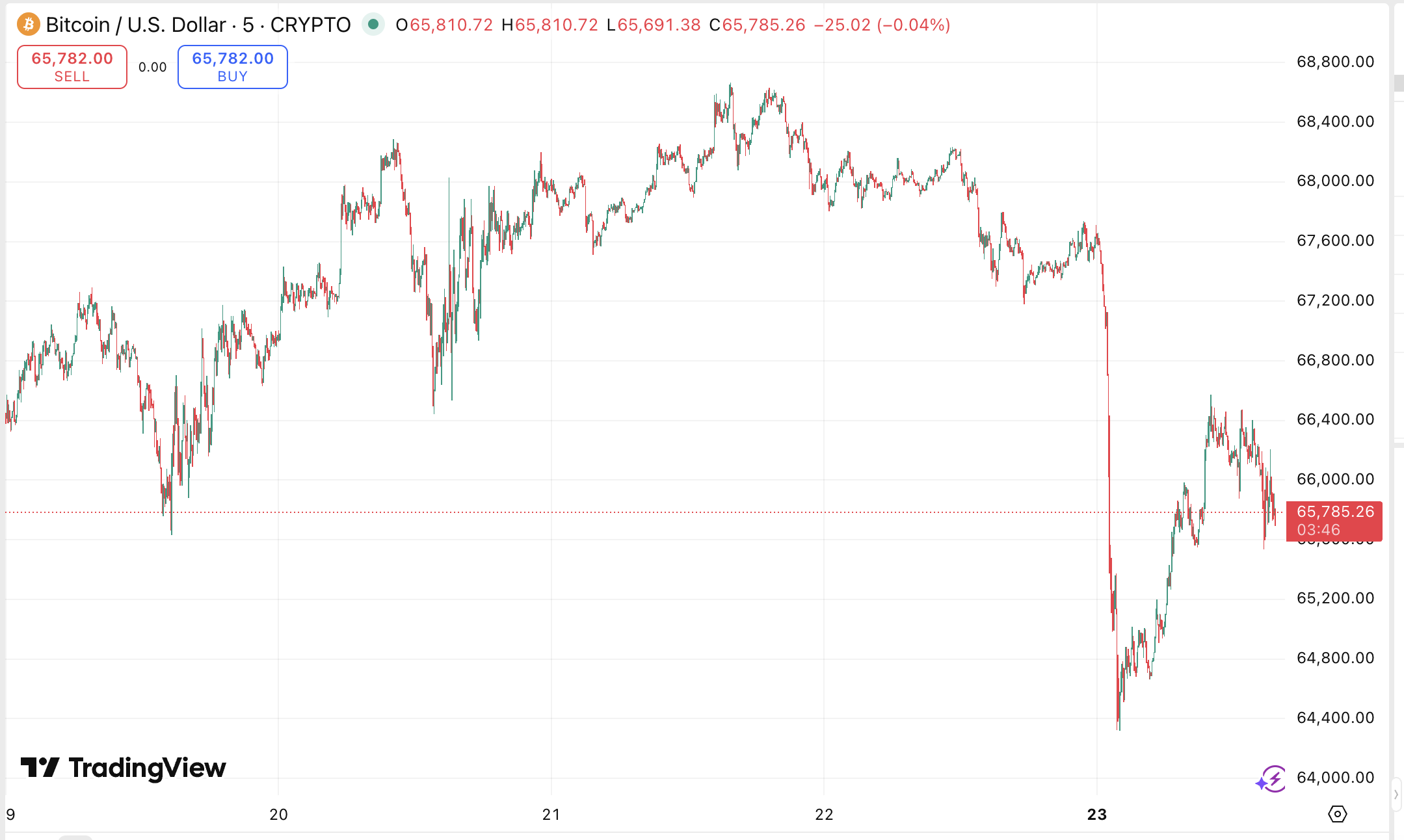
On February 23, 2026, the market awoke to a sea of crimson as Bitcoin (BTC) fell below $65,000, declining 42% from its October 2025 peak of $126,000. In just 139 days, this fall has wiped off $1.21T from the crypto market cap, sending traders into a panic and igniting discussions about whether this is a short-term correction or the beginning of a longer bear market.
With altcoins like Ethereum (ETH) dropping more than 50% and smaller tokens going even further down, the wipeout brings up a pressing question: What’s going on with the crypto market these days?
This article discusses the root causes of the BTC price drop, ranging from forced selling cascades to broader economic factors and the internal mechanics of crypto trading.
BTC/USD chart | Credit: TradingView
Reason 1: Massive Spot ETF Outflows and Institutional Cooling
Why has institutional money dried up? Here is the first reason: the once-mighty wall of institutional capital is currently flowing in reverse.
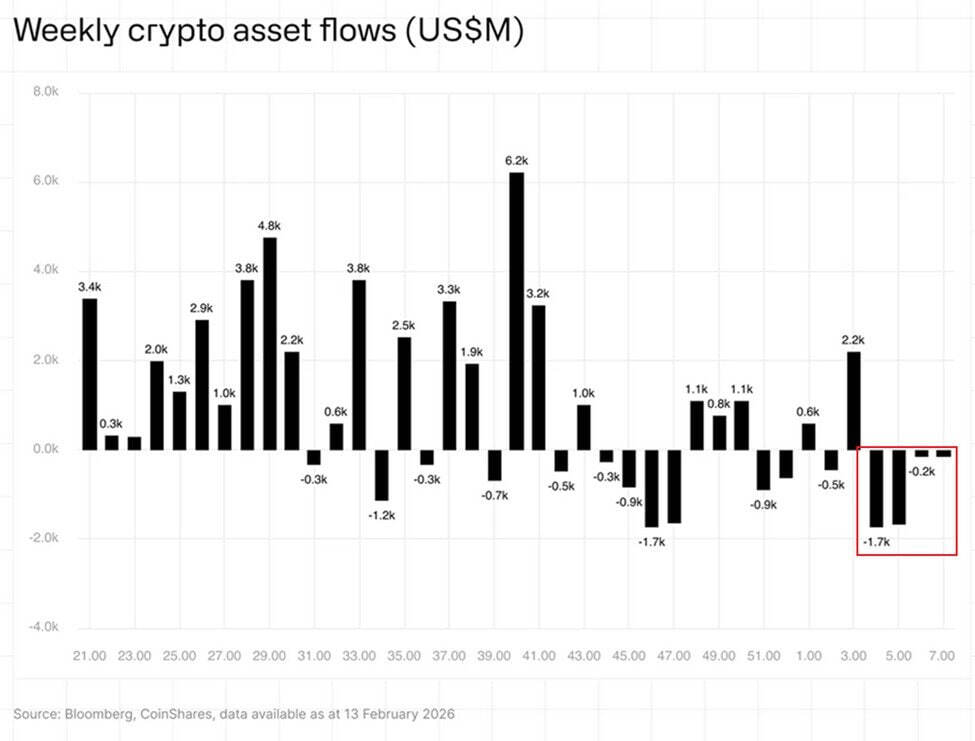
On-chain data shows that spot Bitcoin ETFs, which were previously a bullish trigger, have turned into net sellers, with $8.5B in outflows since October 10, 2025. Compared to the inflows that drove Bitcoin to its peak, this is a drastic reversal. Ethereum funds lost $123M in the week ending February 20, 2026, while Bitcoin ETFs experienced net outflows of $316M. Fund managers are forced to liquidate the underlying Bitcoin when institutional investors sell their ETF shares, resulting in a continuous cycle of selling pressure that ordinary traders are struggling to offset. This also means that, as global economic uncertainty rises, many wealth managers are shifting their focus to capital preservation. The effect is evident: Bitcoin is more susceptible to downward momentum when there is less buying demand. For context, similar outflow streaks in 2022 preceded greater corrections. If inflows do not restart, support levels like $60,000 might not hold, prolonging the wipeout.
Reason 2: Leverage Flush and Cascading Liquidations
How does a small dip turn into a $1.21T rout? This brings us to reason number two: the market finally buckled under the weight of excessive leverage.
Leverage is the culprit. A selling spiral has been triggered by the sharp decline in open interest in Bitcoin futures from its peak in 2026, which flushed out overleveraged positions. On February 23 alone, $230M in leveraged long positions were liquidated in 60 minutes after Bitcoin broke $65,000.
This is how the cascade effect works: As prices slip, exchanges force-sell margined trades to cover losses, flooding the market with supply and pushing prices lower. Over $458 million in total crypto liquidations hit in the past 24 hours, with 92% from longs. The 42% decline was worsened by a vicious cycle that brought back memories of the bear market of 2022, when liquidations wiped out $10B in a single day.
Reason 3: Whale Selling Pressure Builds
Who’s really moving the market? Whales are stepping up sales.
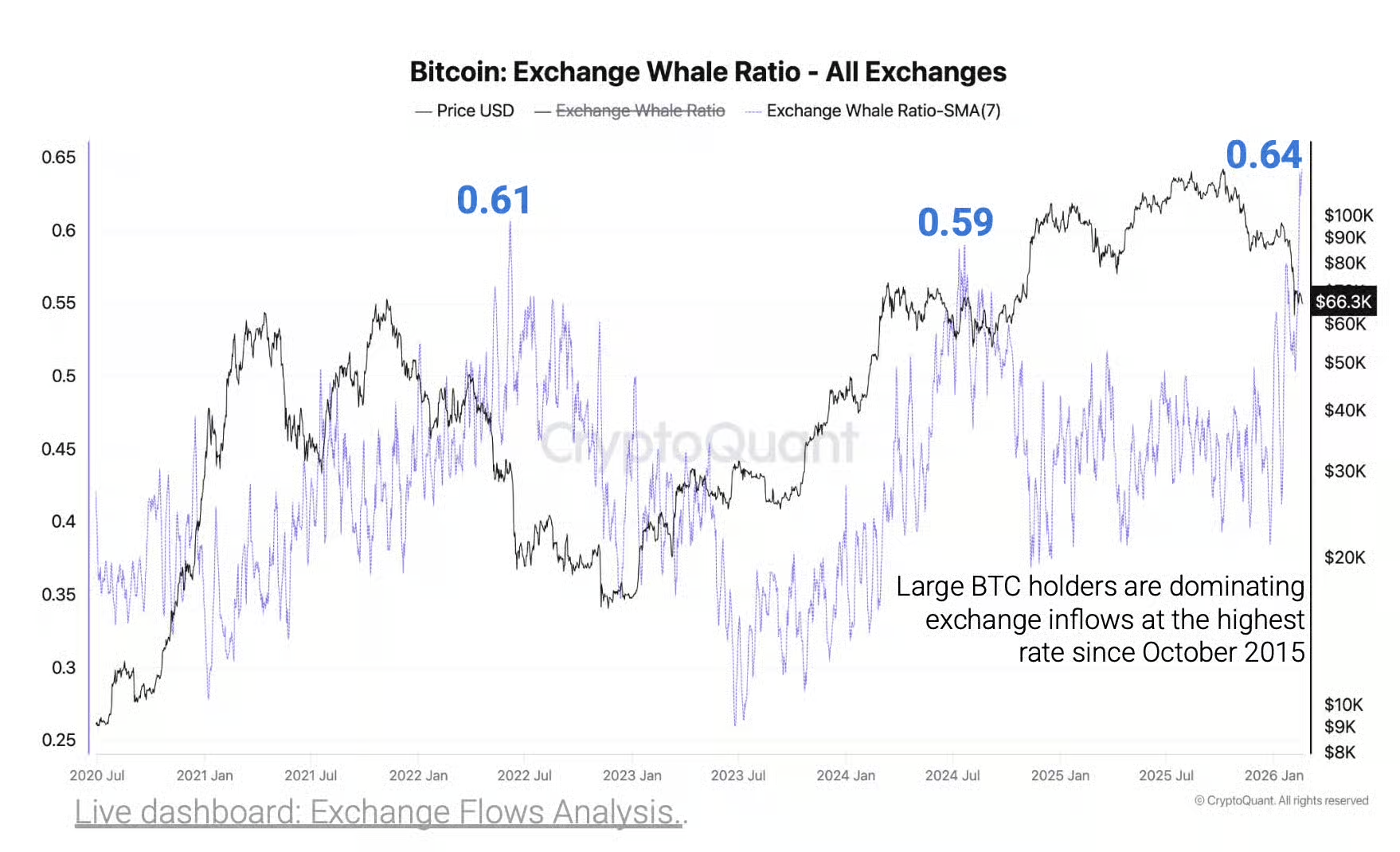
The Exchange Whale Ratio hit 0.64, its highest since 2015, meaning the top 10 deposits account for 64% of inflows to exchanges, signaling heavy sell pressure from big holders. CryptoQuant data shows nearly 23,000 BTC flowing from whales to platforms daily, adding supply when demand is weak.
Bitcoin whale selling chart over time | Credit: CryptoQuant
With short-term holdings realising $480 million in red ink each day, recent investors are also locking in losses. Similar tendencies prolonged the downturn in mid-2022, which is echoed by this whale dominance.
When looking at previous whale-driven crashes, it’s helpful to keep in mind that decreased whale accumulation sometimes lengthens bear phases since retail buys the drop without sufficient support.
Reason 4: Trump’s Tariffs and Geopolitical Jitters
What’s shaking global markets? President Trum’’s tariff increases are the catalyst.
Trump raised concerns about trade wars and slower development when he used emergency powers to impose a 15% global import tariff, up from 10%, after the Supreme Court ruled that earlier levies were unlawful. This has hammered risk assets, with Bitcoin down 4.8% to $64,300 amid the uncertainty.
As investors seek protection from tariff tensions and geopolitical instability, gold prices have increased while Bitcoin has fallen. Given this disassociation, the market continues to perceive Bitcoin as a high-beta tech stock rather than a reliable store of value during periods of severe macroeconomic pressure.
Reason 5: Market Sentiment Hits Extreme Fear
Why are investors panicking?
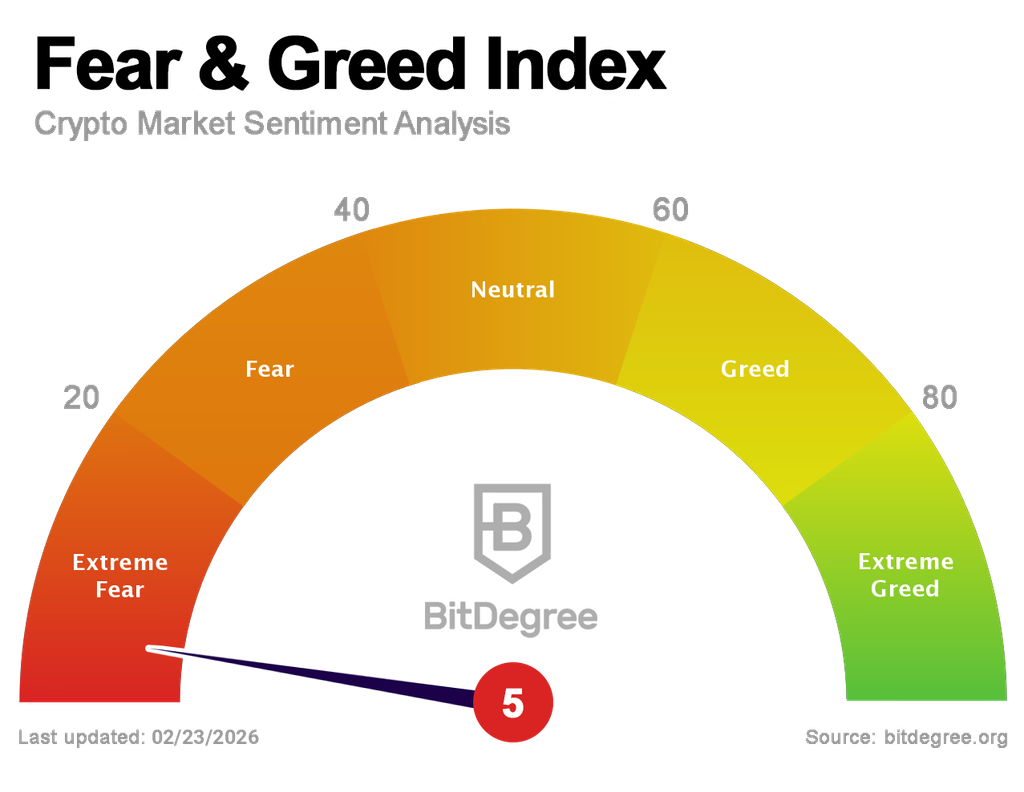
The Crypto Fear & Greed Index erased weekend gains and signalled “capitulation” as it fell to 5/100, or in other words, extreme fear, its lowest level since 2022. This is more than just a slight drop in confidence; it is a full-fledged psychological retreat not seen for many years.
Fear & Greed Index as of February 23, 2026 | Credit: BitDegree
When the index hits single digits, it suggests that “blood is in the streets” and that the average retail trader has moved from being cautious to being genuinely terrified of further losses. Hodlers are “giving up” at $65,000, with sentiment matching historic lows where prices often bottom but linger.
When combined with the news that major firms like Bitdeer are selling out their whole treasury, you have a recipe for the present “capitulation” phase, during which panic selling takes over the market.
What This Bitcoin Wipeout Signals for the Market Ahead
This $1.21T wipeout isn’t just noise, it’s a stress test for crypto’s maturity.
For historical parallels, past cycles show these flushes often precede rebounds, but macro risks like tariffs loom large. Investors should care because this shakeout separates speculation from adoption, position accordingly, as recovery hinges on sentiment shifts and fresh demand. Whether $65,000 becomes the new floor or just another pitstop on the way down, the story of Bitcoin is far from over. As seen previously, the greatest opportunities frequently occur while “fear” levels are at their highest.
A risk-off selloff, fuelled by liquidations, was triggered by renewed trade uncertainties and geopolitical concerns.
Are whales causing the BTC crash?
Yes, with the Exchange Whale Ratio at 0.64, whales are dominating inflows and adding sell pressure.
Why is gold rising while Bitcoin falls?
Gold acts as a safe haven during uncertainty, diverging from Bitcoin’s risk asset profile.
Is this the end of the bear market?
Not necessarily, sentiment at extreme fear often marks bottoms, but macro factors could extend the downturn.
Disclaimer:
The information provided in this article is for informational purposes only. It is not intended to be, nor should it be construed as, financial advice. We do not make any warranties regarding the completeness, reliability, or accuracy of this information. All investments involve risk, and past performance does not guarantee future results. We recommend consulting a financial advisor before making any investment decisions.
Curious about how technology and crypto reshape global finance, Elizaveta Savenko explores blockchain, AI, decentralized systems, their applications, and regulatory requirements. She contributes to research, educational initiatives, and industry collaborations, examining trends in digital assets and fintech innovation, increasing awareness of the crypto space and its impact on financial systems.


 Easy
Easy