Coinbase Partners with Moov to Bring Stablecoins to 1,000+ Community Banks
Share
Key Takeaways
New signals have boosted optimism that the CLARITY Act could pass in the coming months.
Reports of a March 1 deadline to settle reward provisions have intensified speculation.
Bill faces both industry pushback and institutional support.
Momentum behind the proposed CLARITY Act, a sweeping U.S. crypto market structure bill, picked up this week after Coinbase Chief Executive Brian Armstrong said he sees a path to compromise in the Senate.
Meanwhile, a March 1 deadline to resolve the reward dispute has fueled speculation that legislation could soon advance even quicker.
Try Our Recommended Crypto Exchanges
Sponsored
Disclosure
We sometimes use affiliate links in our content, when clicking on those we might receive a commission at no extra cost to you. By using this website you agree to our terms and conditions and privacy policy.
Armstrong Signals Possible CLARITY Act Compromise Within Months
In an interview with Fox Business on Thursday, Armstrong claimed there was a 90% chance the CLARITY Act would pass by “the end of April.”
Speaking to CNBC from Mar-a-Lago during the World Liberty Forum, Armstrong said Senate lawmakers have intensified efforts to move the legislation forward.
“The Senate has been incredible as well, so they’re meeting, as far as I can tell, daily on this to try to move this forward. And they just deserve a ton of credit,” Armstrong said.
He added that Coinbase has sought to play a constructive role behind the scenes, proposing solutions aimed at balancing the interests of crypto firms and banks.
We’re down to just a few points left.
We should have Clarity signed into law “within a few months.”
“All we’ve tried to do is behind the scenes, be constructive, lay out potential solutions that can be a good win-win outcome for crypto and the banks,” Armstrong said.
“I feel confident moving forward with these rewards in place for stablecoins,” he added.
Armstrong said a small list of issues remains, and he believes that if lawmakers reach a compromise, the bill will reach the President’s desk for signature within a few months.
White House Hosts Third Closed-Door Meeting
The White House on Thursday convened a third closed-door meeting between crypto industry representatives and traditional finance.
Coinbase Chief Legal Officer Paul Grewal wrote on X that “the dialogue was constructive and the tone cooperative,” claiming there was “more to come.”
Meanwhile, Ji Hun Kim, president and acting chief executive of the Crypto Council for Innovation, said the meeting was “constructive.”
“The conversation built upon previous meetings to establish a framework that serves American consumers while reinforcing U.S. competitiveness,” Kim said.
Earlier Hurdles Over Stablecoin Rewards
The bill’s path has been far from smooth.
In January, momentum slowed after Coinbase withdrew its support for a Senate draft, prompting lawmakers to delay a planned committee markup.
Armstrong objected to provisions that he said would restrict stablecoin rewards and potentially grant too much authority to the SEC relative to the CFTC.
After reviewing the Senate Banking draft text over the last 48hrs, Coinbase unfortunately can’t support the bill as written.
There are too many issues, including:
– A defacto ban on tokenized equities – DeFi prohibitions, giving the government unlimited access to your financial…
“We’d rather have no bill than a bad bill,” Armstrong wrote at the time.
Speculation around the bill accelerated after crypto-focused social media accounts have reported that the White House have set a March 1 deadline for lawmakers to resolve remaining disputes over stablecoin rewards.
💥BREAKING: White House sets March 1 deadline to resolve stablecoin reward dispute and advance the Clarity Act. pic.twitter.com/sU1jXxc0nm
The White House has not issued any public statement announcing a deadline.
Talking to the crowd at Mar-A-Lago, Armstrong said:
“For whatever reason, sometimes incumbent industries have trade groups, and they view the world with a zero-sum mindset.”
“We now live in this world where we have regulated U.S. stablecoins with rewards,” he added.
“You have to accept that as a reality and decide if you want to treat that as an opportunity or as a threat.”
Polymarket CLARITY Act Odds Jump
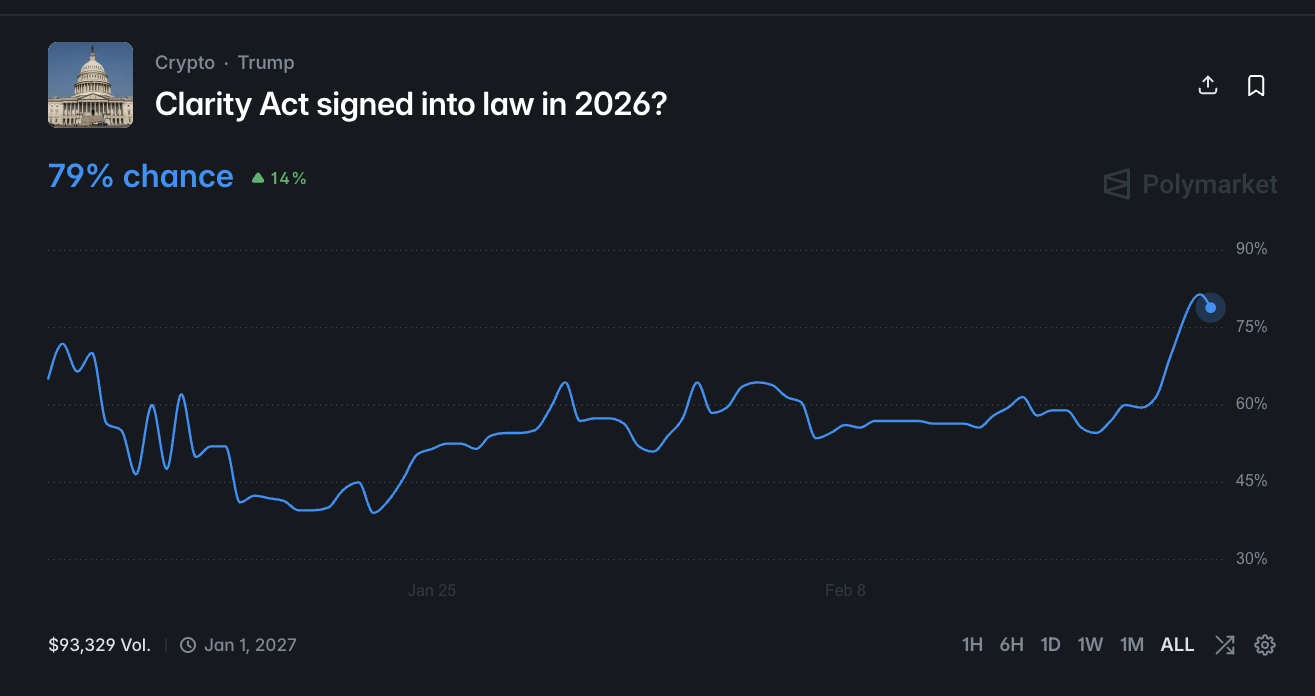
The renewed optimism has also been reflected on Polymarket, where contracts tied to whether the CLARITY Act would be signed into law in 2026 surged to around 90% at one point this week.
At the time of reporting, the percentage has dropped to 72%, though it is still higher than earlier in the year.
The spike followed Armstrong’s remarks and online discussion of the reported March 1 timeline, although many traders remain divided.
Polymarket odds remain high | Source: Polymarket
“Absolutely no way this is passed and signed into law this year. Current state of Senate negotiations is deteriorating,” said one user on Polymarket.
Another added: “Trump will sign the bill he said in front all the world leaders, they will update the bill so it gets passed this year.”
“Every crypto bro cheering this bill is either on Coinbase’s payroll or can’t read.”
“I read all 278 pages. You’re getting played,” he added.
Day, who says he has been involved in crypto since 2012, accused lawmakers of using the push for regulatory clarity to expand oversight and surveillance.
Every crypto bro cheering this bill is either on Coinbase’s payroll or can’t read. I read all 278 pages. You’re getting played.
I’ve been in crypto since 2012. That’s 14 years of watching governments pretend to be confused while quietly building the cage.
“Trump promised to make America ‘the crypto capital of the world.’ His party just delivered a surveillance framework that would make the CCP blush,” he wrote.
The post has now been shared thousands of times. It claims the legislation would require regulators to monitor crypto transactions in real time, impose sweeping registration requirements across the industry, and sharply curtail anonymous participation.
Day also claimed the rules would compel token issuers to provide regulators with source code, transaction histories and tokenomics data, while pushing users toward approved custodians.
However, advocates say that delays in passing the CLARITY Act are keeping major institutional investors on the sidelines and will unlock major liquidity when its passed.
“There are trillions of dollars in institutional capital on the sidelines waiting to get into [the cryptocurrency] space,” Witt wrote on X on Feb. 13.
Kurt Robson is a London-based reporter at CCN, specialising in the fast-moving worlds of crypto and emerging technology. He began his career covering local news in Cornwall after graduating from Falmouth University with First Class Honours in Journalism. There, he cut his teeth on everything from council meetings to missing swans.
He quickly rose through the ranks to become a frontline journalist at several of the UK’s leading national newspapers. Over the years, he has interviewed musicians and celebrities, reported from courtrooms and crime scenes, and secured multiple front-page exclusives.
Following the upheaval of the COVID-19 pandemic, Kurt shifted his focus to technology journalism—just ahead of the AI boom. With a natural curiosity and a trained eye for emerging trends, he has found a new rhythm in reporting on innovation.
At CCN, Kurt's work focuses on the cutting edge of crypto, blockchain, AI, and the evolving digital world. Drawing on his background in people-first reporting and his deep interest in disruptive tech, Kurt delivers stories that are insightful, entertaining, and human-centric.