S&P kept Tether’s USDT at its weakest stability score as higher-risk holdings rose to 28% of USDT in circulation, up from 24% a year earlier. | Credit: CCN.com
Share
Key Takeaways
USDT supply has plunged sharply, triggering a rare signal only seen at the 2022 Bitcoin bottom, when fear peaked after FTX collapsed.
Back then, heavy USDT redemptions marked the cycle low, followed by a powerful multi-year rebound as selling exhaustion set in.
Today, Bitcoin sits far higher after a strong bull run, suggesting any rebound may be slower, choppier, or require additional downside first.
The sharp drop in USDT supply, reminiscent of the panic following the FTX collapse, signals potential market turbulence—but history may not repeat exactly this time.
The rare contraction has traders watching closely, as it often coincides with major market turning points.
Yet today’s crypto ecosystem is far larger, more mature, and dominated by institutional players, suggesting any rebound could be slower, choppier, and less predictable.
Try Our Recommended Crypto Exchanges
Sponsored
Disclosure
We sometimes use affiliate links in our content, when clicking on those we might receive a commission at no extra cost to you. By using this website you agree to our terms and conditions and privacy policy.
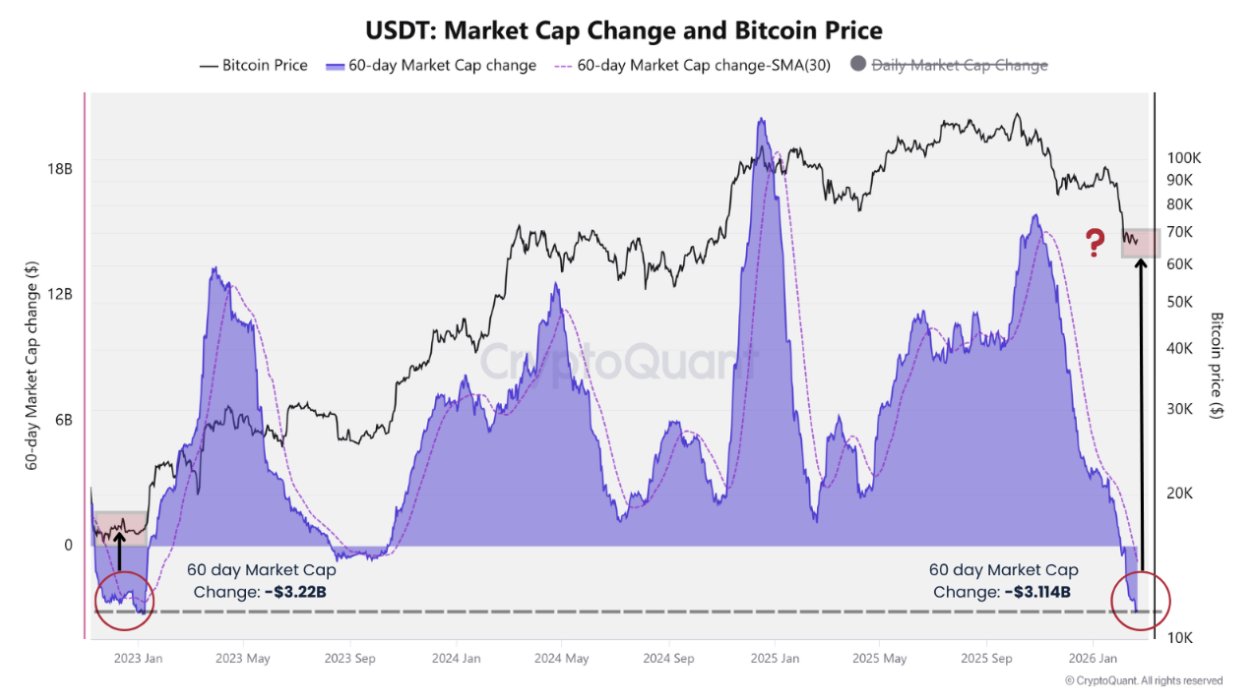
According to CryptoQuant, the 60-day change in USDT’s total supply has plummeted to a negative $3 billion—the second time in history.
Market observers are watching closely, noting that such redemptions historically come from large institutions or whales exiting the crypto system, rather than simple coin swaps.
“Think of USDT as the ‘cash’ everyone holds while waiting to buy or sell other coins,” the report explains. “When new USDT is minted, fresh money pours in; when redeemed, money leaves.”
Bloomberg reports that USDT is on track for its largest monthly decline since December 2022, having already fallen by roughly $1.5 billion in February 2026.
Daily outflows have surged, with three consecutive days seeing more than $1 billion removed from circulation in a 24-hour period.
USDT contraction falls to the level last seen in 2022. Credit: CryptoQuant.
Echoes of 2022: How the Last Signal Sparked a Rebound
Confidence in cryptocurrencies was shaken, and stablecoins like USDT came under scrutiny.
During that period, the 60-day USDT variation fell below -$3 billion, Bitcoin tumbled to around $16,000, and forced liquidations swept across exchanges.
Once selling pressure eased, USDT flows stabilized, and capital began re-entering the market.
Bitcoin climbed steadily in 2023, surged through 2024, and hit unprecedented highs by 2025.
Analysts point out that the pattern—a dramatic USDT contraction followed by a strong recovery—has repeated across previous cycles.
“Extreme liquidity stress has historically marked opportunity, but only once selling exhaustion is confirmed,” said CryptoQuant analyst Ignacio Moreno.
Why the Current Drop is Different
Today’s USDT contraction mirrors the 2022 signal visually but differs fundamentally.
Bitcoin is currently trading between $65,000 and $70,000, down nearly 45% from its all-time high of $126,000 set in 2025.
This decline comes after a period of uninterrupted USDT growth through early 2025, indicating that the recent shrinkage is more of a post-bull-run correction than a market capitulation.
“Extreme liquidity stress has historically marked opportunity, but only once selling exhaustion is confirmed,” said CryptoQuant analyst Ignacio Moreno.
Conversely, if flows stabilize or reverse soon, the market could pivot quickly—similar to the 2022–2023 rebound.
Unlike 2022, when panic drove Bitcoin to $16,000, today’s elevated prices mean many holders remain in profit, creating potential volatility on any bounce.
The market’s larger size and increased institutional presence suggest reactions could be slower and choppier.
USDT Metrics: A Must Watch
Market watchers are monitoring USDT redemptions closely.
Prashant Jha is a seasoned crypto journalist based in Delhi, India, with a Bachelor’s Degree in Computer Science Engineering. Passionate about the evolving world of blockchain and cryptocurrencies, he has been a dedicated voice in the industry since 2018. Prashant’s expertise lies in regulatory reporting, where he unravels complex legal and financial developments with clarity and precision. Before joining CCN in 2024, he honed his craft at Cointelegraph, establishing himself as a trusted name in crypto journalism.
His coverage spans major industry events, including the high-profile collapses of FTX, Three Arrows Capital (3AC), and LUNA, offering readers insightful analyses of their regulatory and market implications. Prashant’s technical background enables him to bridge the gap between intricate blockchain technology and its real-world applications, making his work accessible to novices and experts.
Beyond his professional pursuits, Prashant is an avid music enthusiast, often exploring diverse genres to unwind. A sports lover, he has a particular passion for cricket and frequently engages in discussions about the game. His multifaceted interests and sharp journalistic instincts make him a valuable contributor to CCN, where he continues shaping the crypto landscape's narrative.











 USDT’s Backing Gets More ‘Macro’ as Tether Adds 27 Tons of Gold