After a major dip, can Cronos price climb back up?
Share
Key Takeaways
Cronos price predictions for 2025 suggest a minimum of $0.082, an average of $0.13, and a potential high of $0.26.
2026 might be bearish, with forecasts ranging from $0.054 to $0.091 due to potential low liquidity and demand.
CRO recently broke out of a falling pennant on the weekly chart and a symmetrical triangle on the daily chart.
Not many altcoins have shown a bullish setup lately. But for CRO, the native cryptocurrency of the Cronos blockchain, things might begin to get better.
Year-to-date (YTD), the Cronos price is down 30%. However, the cryptocurrency’s price has risen nearly 50% in the last three months.
In this analysis, we examine what the Cronos price prediction might be for this year and the coming ones.
Cronos Price Prediction
This section discloses the potential Cronos price prediction for 2025, 2026, and 2030.
However, it is essential to remember that these forecasts are based on the reality of the current market. If things change, some of these predictions might be altered.
Minimum CROPrice Prediction
Average CRO Price Prediction
Maximum CRO Price Prediction
2025
$0.082
$0.13
$0.26
2026
$0.054
$0.068
$0.091
2030
$0.24
$0.53
$1
Cronos Price Prediction 2025
Although CRO’s price is down from its starting price in January, it will likely end the year higher than its current price. One potential catalyst that could drive this surge is the ETF application.
If approved, it would open the doors for investors to have more exposure to the altcoin. As such, demand could be higher and CRO’s price could climb to $0.19.
However, on average, the Cronos price prediction for 2025 could be around. $0.13, but it could slide to $0.082 at the minimum.
2026 might not be exactly bullish for CRO. By that time, demand for the cryptocurrency might be low, and it could struggle to attract liquidity.
If that happens, CRO’s price could trade between $0.054 and $0.091.
Cronos Price Prediction 2030
2030 might seem like a long time, but CRO adoption might have skyrocketed by then. This could be from an increased market share of Crypto.com and traction from the altcoin’s utility. Due to that, the price prediction for 2030 ranges from $0.24 to a possible new all-time high of $1.
Cronos Price Analysis
During the weekly timeframe, CRO’s price broke out due to a falling pennant. As seen below, the previous price decrease led to hitting lower lows and higher highs.
As a result, the lower and upper trendlines converged before the CRO breakout. In addition, there has been a bullish crossover on the Moving Average Convergence Divergence (MACD).
If sustained, CRO’s price might rally to $0.26. In a highly bullish scenario, the cost could rise to $0.40.
On the flip side, if momentum around CRO turns bearish, this prediction might not pass. In that scenario, CRO’s price might decline toward $0.053.
For the short-term outlook, CCN noticed that CRO’s price has broken out of a symmetrical triangle on the daily chart. This breakout neutralized the balance between bulls and bears, giving the former the upper hand.
The Money Flow Index (MFI) has continued to hit a high value. Should this trend continue, Cronos’ short-term prediction could be a rise to $0.13 near the 0.618 golden ratio.
However, if selling pressure increases, CRO might drop below the lower trendline of the triangle, causing the altcoin to drop to $0.074.
The Total Value Locked (TVL) to market cap ratio (TVL ratio) measures the valuation of a decentralized finance (DeFi) project by comparing its market capitalization to the total value of assets locked in its smart contracts.
This ratio shows the project’s utilization and links the platform’s health to locked asset value.
A ratio above 1.0 indicates overvaluation because the market cap exceeds the value of assets used in the platform. A ratio below 1.0 indicates undervaluation because the market cap is lower than the value of locked assets.
As of this writing, this ratio stands at 22.22, indicating that the CRO is overvalued.
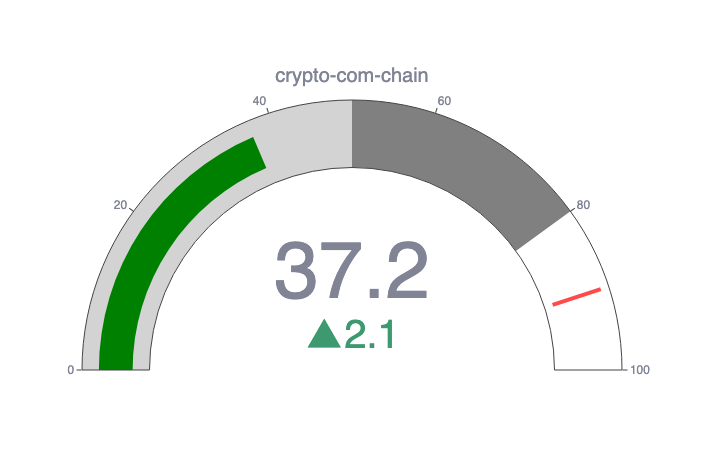
CCN Strength Index
The CCN Strength Index combines an array of advanced market signals to measure the strength of individual cryptocurrencies over the last 30 days.
Every day, it assigns a strength score, ranging from 0 to 100, to the top 500 assets by market capitalization on CoinMarketCap, focusing on both trend direction and the intensity of price movements.
0 to 24: Assets exhibit significant weakness, showing signs of sustained downtrend behavior.
25 to 35: The price tends to move within stable bounds with minimal volatility.
36 to 49: Assets begin a stable uptrend but without strong surges.
50 to 59: Consistent growth with moderate price advances, building momentum.
60+: Sharp price movements and high demand indicate more substantial volatility and trend shifts.
The index dynamically adapts to rapid changes. For example, an asset experiencing a 100% increase within a short timeframe would see a sharp jump in its score to reflect the intensity of the rise.
However, should that asset stabilize at this new price level, the score will gradually taper down and align with the dampened momentum as the movement normalizes.
The same principle applies to rapid declines: a sudden drop will spike the score downward, but the score will slowly adjust back up as volatility decreases.
We looked at the Cronos price history and found the times when the price was at its lowest across certain days, months, quarters, and even weeks in the year, suggesting the best times to buy Cronos.
Day of the Week
Friday
Week
11
Month
March
Quarter
First
Cronos Price History
Period
Cronos price
Last week (May 26, 2025)
$0.096
Last month (May 2, 2025)
$0.091
Three months ago (March 2, 2025)
$0.082
Last year (June 2, 2025)
$0.11
Five years ago (May 2, 2020)
$0.058
Launch price (Dec. 15, 2018)
$0.019
All-time high (Nov. 26, 2021)
$0.97
All-time low (Dec. 17, 2018)
$0.011
Who Owns the Most Cronos (CRO)?
On June 2, 2025, a Cronos wallet held more than 2.8% of the CRO supply.
0x5c7f8a570d578ed84e63fdfa7b1ee72deae1ae23. This wallet, listed as Cronos: WCRO Token, held 752,231,826 CRO or 2.83% of the supply.
0xeadf7c01da7e93fdb5f16b0aa9ee85f978e89e95. This wallet held 123,760,526 CRO or 0.47% of the supply.
0x8995909dc0960fc9c75b6031d683124a4016825b. This wallet held 65,427,259 CRO or 0.25% of the supply.
0xc9219731adfa70645be14cd5d30507266f2092c5. This wallet, listed as Crypto.com: CDC Withdrawal, held 32,741,317 CRO or 0.12% of the supply.
0xc882b111a75c0c657fc507c04fbfcd2cc984f071. This wallet held 23,205,860 CRO, or 0.09% of the supply.
Cronos Supply and Distribution
Supply and distribution
Figures
Total supply
30,000,000,000
Circulating supply (as of June 2, 2025)
29,866,984,656 (92.38% of total supply)
Holder distribution
The top 10 holders owned 4.02% of the supply as of June 2, 2025
From the Cronos Whitepaper
In its technical documentation or whitepaper, Cronos says it aims to be quick and inexpensive.
It says: “Cronos is a decentralized, open-source, energy-efficient public blockchain with high speed and low transaction fees.”
The documentation says the system is “designed to support the creator economy with Web3 applications such as DeFi and GameFi, ultimately serving as the foundational infrastructure for an open metaverse”. The whitepaper also says it will “serve the next billion Web3 users and help them experience the full promise of self-custody of their digital assets”.
Cronos (CRO) Explained
Cronos is the native cryptocurrency of the Crypto.com exchange. Originally named after the Singapore-based business, it changed in 2022 to represent “the next major phase in the adoption and utilization of Web 3.0 by hundreds of millions of users.” Cronos pays transaction fees on Crypto.com’s blockchain, and CRO can be staked or set aside.
This allows people to earn free subscriptions to Spotify and Netflix and secure better interest rates for their platform investments.
Crypto.com features a token-swap facility, a wallet, and a Visa card. Crypto entrepreneurs Kris Marszalek, Bobby Bao, Gary Or, and Rafael Melo founded it in 2016. Its coin was properly launched in late 2018, while the Cronos blockchain was fully released in November 2021.
How Cronos Works
The CRO coin is the native crypto for two platforms. In addition to the Crypto.com blockchain, which operates on a Proof-of-Stake (PoS) consensus mechanism, where people are chosen to add blocks to the blockchain based on how much CRO they hold, it also operates on the Cronos EVM chain.
This platform, linked to Ethereum (ETH), is designed so that anyone can use it to carry out transactions without the permission of a central authority. It was created with the Cosmos software development kit.
People can also buy, sell, and trade CRO on exchanges.
Is Cronos a Good Investment?
It is hard to say. CRO has been experiencing a significant downturn lately. We don’t know whether it can make something of a recovery when that would be, or what it would look like. A lot will depend on whether the market can fix itself.
As always with crypto, you should research before investing in CRO.
Will Cronos go up or down?
No one can say with any certainty right now. While many of the Cronos price forecasts are optimistic, price predictions have a habit of being wrong more often than not. Remember, too, that prices can and do go down and up.
Should I invest in Cronos?
Before deciding whether to invest in Cronos, you should research CRO and other similar coins and tokens, such as Binance (BNB). More importantly, you must ensure you never invest more money than you can afford to lose.
As of June 2, 2025, 26.86 billion CRO were in circulation out of a total supply of 30 billion.
Will Cronos reach $1?
It could do but, if it does, it will not be until the 2030s at the earliests.
Keep in mind that Cronos has never traded above the dollar.
What is the difference between Cronos and Crypto.com?
Crypto.com is a cryptocurrency exchange, while Cronos is the name of both the EVM-compatible blockchain and the crypto that serves as a native currency to both the Cronos chain and Crypto.com’s blockchain.
Victor Olanrewaju is a crypto analyst and reporter at CCN with deep roots in on-chain research and technical analysis. His crypto journey began in 2017, but it was the 2020 Uniswap airdrop that sparked a full-time pivot into the space.
With a foundation in copywriting, Victor honed his craft creating high-converting content for leading crypto brokers — most notably an XRP price prediction that ranked #1 on Google during the 2021 bull run.
He later joined AMBCrypto in 2022, where he combined storytelling with technical and on-chain analysis to cover key market narratives.
In 2024, he expanded his expertise at BeInCrypto, collaborating with analysts and using tools like Glassnode, Santiment, and IntoTheBlock to break down Bitcoin and altcoin trends.
At CCN, Victor covers the top cryptocurrencies, memecoins, macro shifts, blending real-time insights with deep-dive metrics.
He holds a Bachelor’s degree in Physics from the University of Ibadan, equipping him to simplify complex data for a wide audience. Follow his work or connect on LinkedIn or X.