XRP trades in a make-or-break range | Credit: Hameem Sarwar
Share
Key Takeaways
XRP defended the $1.80 support, helped by oversold conditions, steady ETF demand.
The rebound looks corrective, with the price confined inside a descending channel
Rising coin dormancy signals caution, suggesting XRP’s price rally may face resistance.
XRP’s price is making a make-or-break stand at $1.80. Earlier this week, sellers briefly pushed the price down to this level, sparking fears of an extended correction.
However, as of this writing, buyers have defended the $1.85 zone again, keeping bears out of the picture. Recent daily data also shows XRP trading back in the $1.90 area after that dip.
Yet, it does not seem like a full recovery is near. But how will XRP’s price fare in the short term?
Why $1.80 Support Held
First, the selloff created an “oversold” setup. When the price tagged the $1.80 region, it pushed many short-term indicators into dip-buy territory.
That often triggers systematic buying and short covering, which can explain the sharp reaction off the lows.
Next, spot ETF demand has helped absorb volatility. Since the launch of the Bitwise XRP ETF (ticker: XRP) on the NYSE in November 2025, the product has provided a cleaner institutional on-ramp to spot exposure.
That kind of flow can act like a cushion during drawdowns, because funds tend to average in rather than chase short-term candles.
Finally, the escrow calendar reduces the fear of “surprise supply.” Ripple’s escrow program typically unlocks up to 1 billion XRP at the start of each month.
But, historically, a large portion is re-escrowed rather than dumped into circulation.
With the next unlock set for Feb. 1, 2026, traders often price in re-locking behavior rather than assuming the full headline amount hits the market.
XRP 4-Hour Analysis
Looking at the 4-hour chart, XRP’s price is attempting a short-term recovery.
However, the broader structure remains restricted by a clearly defined descending channel on the 4-hour chart.
After bouncing from the lower boundary near $1.80, the price has pushed back toward the upper trendline and is now trading around $1.91, where prior support has flipped into resistance and aligns closely with the channel top.
The Supertrend is still overhead and red, reinforcing the idea that this move is a relief bounce rather than a confirmed trend reversal.
Also, the marked “next point of interest” near $2.18 remains the key level that would need to be reclaimed to shift momentum.
Meanwhile, the Money Flow Index (MFI) has risen, indicating improving buying volume. However, it is not yet at levels that suggest overheating.
As it stands, XRP is at a crucial level, with acceptance above the descending trendline opening room toward the $2.18 zone. On the flip side, rejection would likely keep the altcoin range-bound.
Notably, XRPL v3.0.0 is already live, introducing new amendments and fixes that strengthen network reliability.
Meanwhile, XLS-66d pushes the ecosystem closer to institutional DeFi by adding native lending for fixed-term, pooled-fund markets.
As a result, XRPL can support on-ledger credit rails and more advanced capital flows.
In addition, Ripple is leaning into zero-knowledge proofs (ZKPs) to deliver privacy without sacrificing compliance. That balance matters for tokenized finance and regulated on-chain activity.
Against this backdrop, the privacy-coin narrative has dominated this cycle.
Therefore, if XRPL’s privacy roadmap gains traction, XRP could see added demand, as traders position for a “privacy-enabled” utility upgrade rather than a payments-only use case.
On-Chain Data Reveals Risk
However, on-chain data from Glassnode preaches caution. At the time of writing, XRP’s exchange net position change has flipped positive after a prolonged period of heavy outflows. T
Through late December and early January, large red bars show hundreds of millions of XRP leaving exchanges, a pattern typically associated with reduced sell pressure, which coincided with price stability and a brief upside push.
Since mid-January, however, sustained green bars indicate that XRP is now flowing back onto exchanges at an increasing pace, even as the price trends lower.
This divergence suggests that holders are becoming more willing to move tokens to exchanges, either to take profit or to prepare for volatility.
XRP Exchange Net Position Change | Credit: Glassnode
As long as exchange inflows remain elevated, XRP’s price is likely to face continued resistance on rallies.
Besides that, on-chain data from Santiment shows a growing divergence between price and holder behavior. Notably, the Mean Dollar Invested Age (MDIA) has continued to rise while XRP’s price trends lower.
The steady climb in the average coin age indicates that long-held XRP is remaining dormant, with fewer older coins being spent or moved.
This pattern typically signals declining network activity and fading speculative demand. Furthermore, this suggests that recent sell pressure is being driven more by short-term holders, not long-term participants
While this dormancy can reduce immediate sell pressure, it also reflects a lack of strong buying pressure.
If sustained, this could leave XRP’s price vulnerable to further downside unless demand draws the dormant supply back into circulation.
Potential Impact on XRP Price
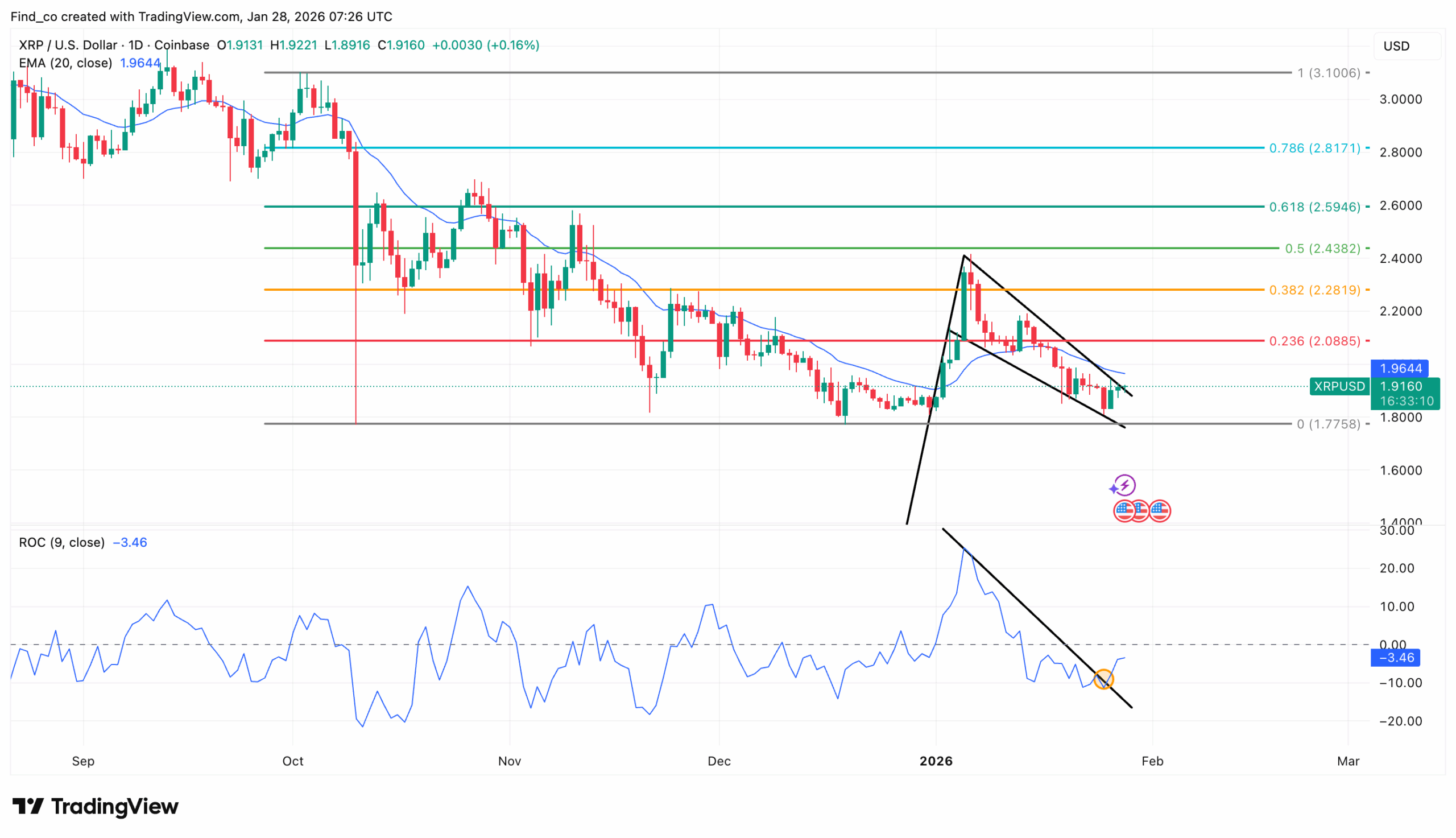
On the daily chart, XRP’s price is consolidating just above the $1.90 area, as shown in the image below, with a clear descending channel holding back every recovery attempt since the January spike.
The recent rebound failed near the 0.382 Fibonacci retracement around $2.28, reinforcing that sellers remain active on rallies, while the 20-day EMA continues to slope lower and act as dynamic resistance near $1.96.
Momentum indicators support this cautious tone, as the rate of change remains negative despite a small bullish curl, suggesting any upside is still corrective.
As long as XRP holds above the $1.80 support zone, downward pressure may stay contained.
However, it is also likely to break above the upper trendline of the descending channel. If that is the case, XRP’s price might rise to $2.09.
In a highly bullish scenario, the market value could reach $2.28.
On the contrary, if bears continue to keep bulls out of the picture, this prediction might not come to pass. Instead, the altcoin might decline to $1.78.
Disclaimer:
The information provided in this article is for informational purposes only. It is not intended to be, nor should it be construed as, financial advice. We do not make any warranties regarding the completeness, reliability, or accuracy of this information. All investments involve risk, and past performance does not guarantee future results. We recommend consulting a financial advisor before making any investment decisions.
Victor Olanrewaju is a crypto analyst and reporter at CCN with deep roots in on-chain research and technical analysis. His crypto journey began in 2017, but it was the 2020 Uniswap airdrop that sparked a full-time pivot into the space.
With a foundation in copywriting, Victor honed his craft creating high-converting content for leading crypto brokers — most notably an XRP price prediction that ranked #1 on Google during the 2021 bull run.
He later joined AMBCrypto in 2022, where he combined storytelling with technical and on-chain analysis to cover key market narratives.
In 2024, he expanded his expertise at BeInCrypto, collaborating with analysts and using tools like Glassnode, Santiment, and IntoTheBlock to break down Bitcoin and altcoin trends.
At CCN, Victor covers the top cryptocurrencies, memecoins, macro shifts, blending real-time insights with deep-dive metrics.
He holds a Bachelor’s degree in Physics from the University of Ibadan, equipping him to simplify complex data for a wide audience. Follow his work or connect on LinkedIn or X.