Bitcoin fell over 2% after the Bank of Japan raised interest rates to 1%, the highest since 1995, fueling fears of yen carry trade unwinding and tighter global liquidity. | Credit: CCN.com
Share
Key Takeaways
The BoJ increased its benchmark interest rate by 25 basis points to 1%, the highest level since 1995.
Bitcoin fell more than 2% over 24 hours, slipping to around $65,800 as investors reacted to the prospect of tighter global liquidity conditions.
Previous BoJ rate hikes since 2024 have often been followed by Bitcoin corrections of 20% to 30%, raising concerns about further downside pressure in the weeks ahead.
Bitcoin slid on Tuesday after the Bank of Japan (BoJ) raised interest rates to 1%, the highest borrowing cost in Japan since 1995, reinforcing the central bank’s shift away from decades of ultra-loose monetary policy.
The widely anticipated 25-basis-point increase weighed on risk assets, with Bitcoin extending its losses amid renewed concerns that tighter Japanese monetary conditions could trigger another round of yen carry trade unwinding.
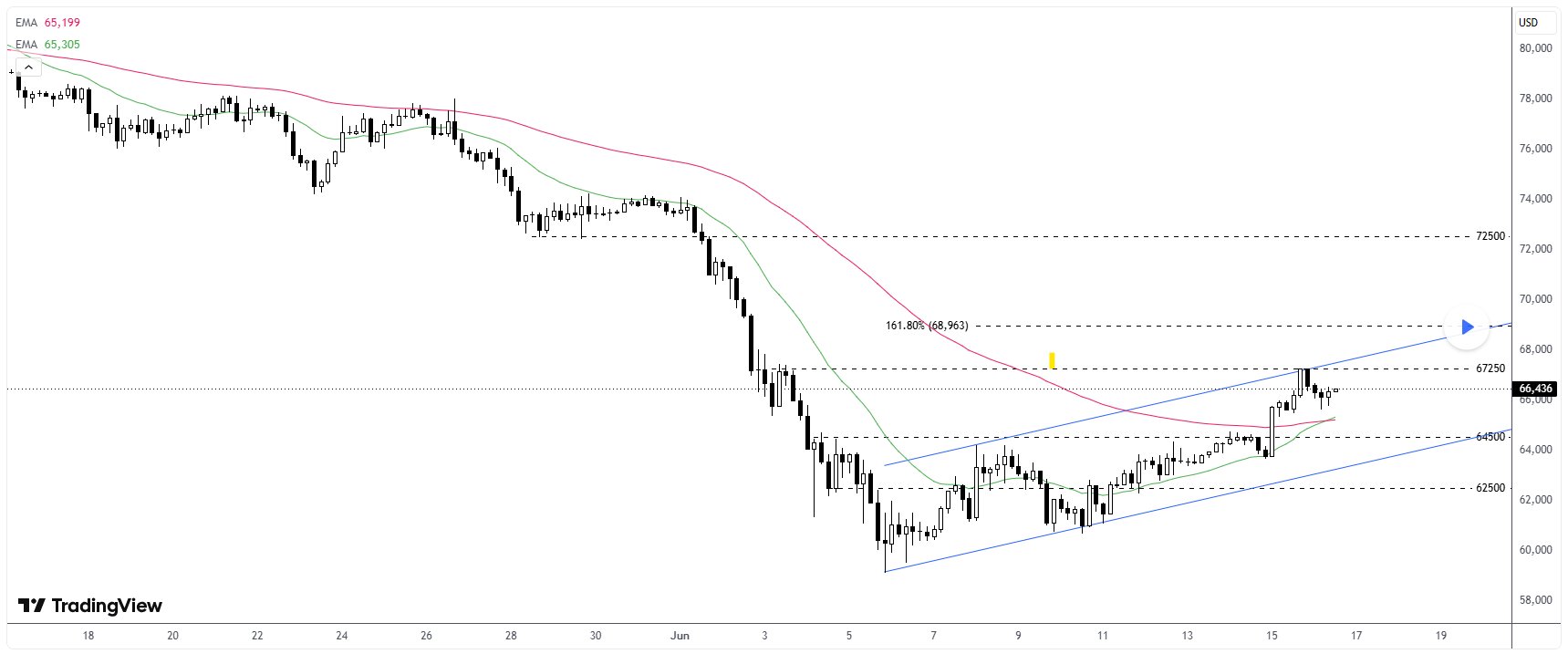
The world’s largest cryptocurrency fell more than 2% over the last 24 hours, trading near $65,800 after briefly touching an intraday low of $65,400.
While the decline was relatively modest compared with previous market reactions to BoJ tightening, traders remain cautious given the historical correlation between Japanese rate hikes and sharp corrections across crypto markets.
Try Our Recommended Crypto Exchanges
Sponsored
Disclosure
We sometimes use affiliate links in our content, when clicking on those we might receive a commission at no extra cost to you. By using this website you agree to our terms and conditions and privacy policy.
The Bank of Japan increased its benchmark interest rate from 0.75% to 1.0% in a 7-1 vote, marking its fifth rate hike since abandoning negative interest rates.
The move reflects the central bank’s growing confidence that inflationary pressures are becoming more entrenched in the Japanese economy.
In its policy statement, the BoJ cited rising energy costs and stronger price pass-through effects across businesses as key reasons behind the decision.
“The price pass-through stemming from rising crude oil prices has been progressing at a relatively fast pace in business-to-business transactions, which could spread to an increase in consumer prices across a wide range of items,” the central bank said.
Bank of Japan Raises Policy Rate by 25 Bps to 1.0%
The Bank of Japan said its Policy Board voted 7–1 on June 16 to raise rates by 25 bps, lifting the target for the uncollateralized overnight call rate to around 1.0%, effective June 17.
The rate decision came amid concerns that elevated oil prices, partly linked to geopolitical tensions in the Middle East, could sustain inflation above the BoJ’s target.
The central bank also reiterated plans to gradually reduce its government bond purchases beginning in April 2027, while continuing to buy approximately 2 trillion yen ($12.5 billion) in Japanese government bonds per month for now.
Bitcoin Faces Pressure From Carry Trade Concerns
Bitcoin’s decline reflects investor concerns that higher Japanese interest rates could disrupt the popular yen carry trade, a strategy in which investors borrow at low Japanese rates and deploy capital into higher-yielding assets such as US equities, bonds, and cryptocurrencies.
Historically, unwinding of carry trades has drained liquidity from global markets and pressured speculative assets. Since 2024, previous BoJ rate hikes have often been followed by Bitcoin corrections ranging from 20% to 30% in the weeks that followed.
Will Bitcoin prices recover further? | Credit: TradingView
However, analysts noted that the current market reaction has remained relatively contained because the Japanese yen weakened against the US dollar following the decision, trading near 160.3.
A stronger yen typically accelerates the unwinding of carry trades, while a weaker currency reduces immediate pressure on leveraged positions.
Additional support came from improving geopolitical sentiment after reports of a US-Iran peace agreement, which helped stabilize broader risk markets and limited Bitcoin’s downside.
Despite these factors, traders remain wary that further BoJ tightening could create additional volatility across digital asset markets in the coming months.
Technical Outlook Remains Mixed Despite Short-Term Recovery Signs
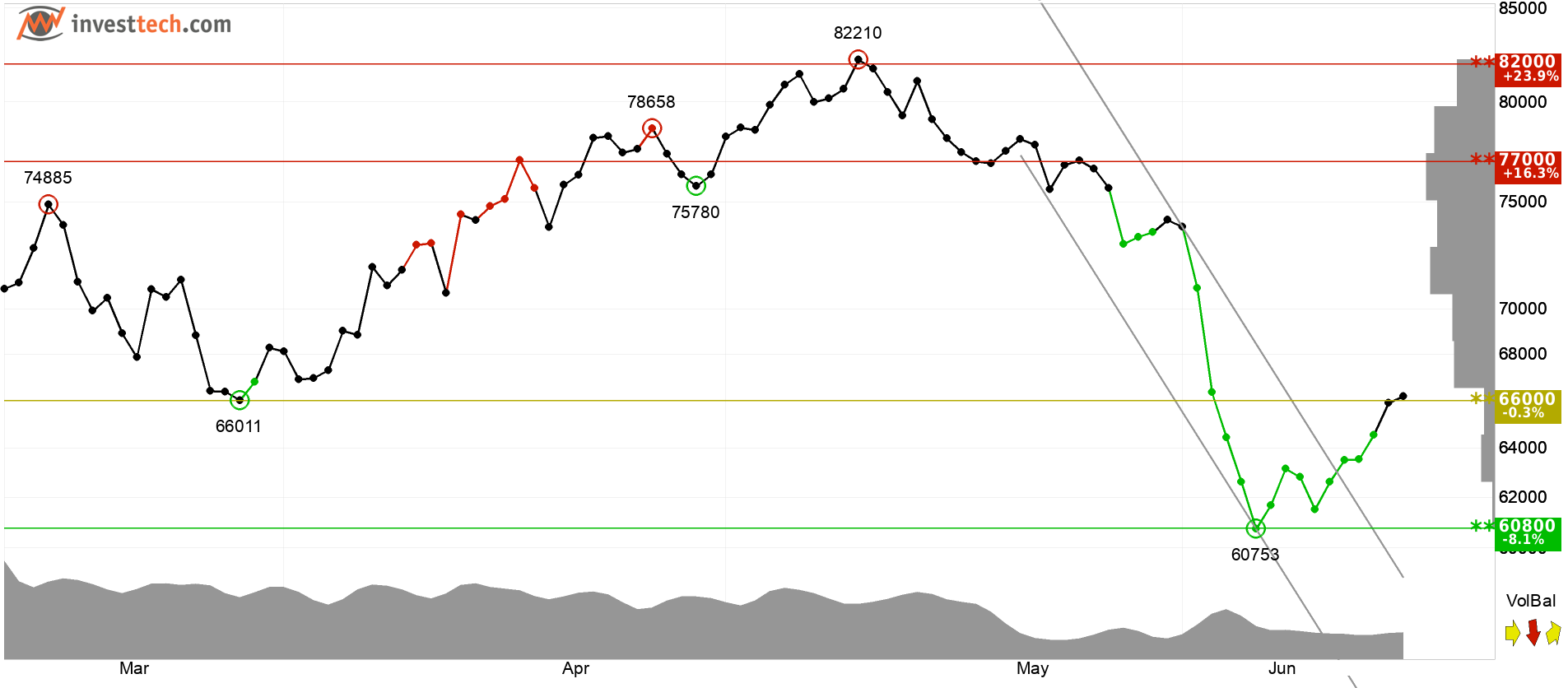
From a technical perspective, Bitcoin has shown signs of stabilizing after breaking above the upper boundary of its short-term falling trend channel.
The move suggests that bearish momentum may be slowing, while a break above the $66,000 resistance level could pave the way for additional upside.
However, market indicators remain mixed. A negative volume balance suggests selling activity continues to outweigh buying interest, keeping the cryptocurrency in a technically neutral position in the short term.
Bitcoin has shown signs of stabilizing. | Credit: Bitcoin has shown signs of stabilizing
The medium-term outlook remains similarly balanced. Although Bitcoin recently broke above resistance near $63,000, the broader trend channel remains bearish, reflecting persistent investor caution and growing pessimism.
Longer-term indicators remain more concerning. Bitcoin has fallen below key support at $74,000, which is now acting as resistance. Analysts are also monitoring a developing head-and-shoulders pattern, with support near $57,111 viewed as a critical level. A decisive break below that area could signal deeper downside risks.
For now, traders are closely watching both the Federal Open Market Committee (FOMC) meeting and the Bank of Japan’s future guidance, as global monetary policy remains a key driver of liquidity conditions and cryptocurrency market sentiment.
Giuseppe Ciccomascolo began his career as an investigative journalist in Italy, where he contributed to both local and national newspapers, focusing on various financial sectors.
Upon relocating to London, he worked as an analyst for Fitch's CapitalStructure and later as a Senior Reporter for Alliance News. In 2017, Giuseppe transitioned to covering cryptocurrency-related news, producing documentaries and articles on Bitcoin and other emerging digital currencies. He also played a pivotal role in establishing the academy for a cryptocurrency exchange website. Crypto remained his primary area of interest throughout his tenure as a writer for ThirdFloor.