“The crisis is already coded into the protocol. Mathematics doesn’t care about ideology.” Image credit: Hameem Sarwar/CCN
Share
Key Takeaways
Proof-of-work security relies heavily on block subsidies, not transaction fees, making mining economics increasingly fragile with each halving.
The 2028 Bitcoin halving intensifies pressure on miners, forcing them to consolidate or reinvent themselves as rewards fall to 1.5625 BTC per block.
Mining companies that diversify into verified compute, AI workloads, and zero-knowledge proving gain structural advantages over single-asset miners.
Bitcoin’s long-term security depends on sustainable miner revenue, not speculative price appreciation alone.
The security of Bitcoin and Dogecoin depends on a subsidy paid by speculators. That model is breaking. Here’s the inevitable shift and who will survive it.
Bitcoin’s proof-of-work (PoW) secures over half a trillion dollars with nothing but raw computational power. It’s an engineering marvel that solved the Byzantine Generals Problem and created digital scarcity.
While originally created as a joke, Dogecoin also relies on the same energy-intensive mining process to secure a multi-billion dollar network. But this massive energy expenditure that makes these networks secure also makes them economically precarious.
We’re approaching an event that few want to discuss. Not a collapse, but a forced evolution where the entire mining industry will have to fundamentally reinvent itself.
Bet on ESports with These Partners
Sponsored
Disclosure
We sometimes use affiliate links in our content, when clicking on those we might receive a commission at no extra cost to you. By using this website you agree to our terms and conditions and privacy policy.
Pull up any chart showing Bitcoin miner revenue, and you’ll see the problem immediately. Transaction fees, the actual utility people pay for, cover less than 10% of what miners earn.
The other 90% comes from block rewards, which are essentially subsidies paid by speculators betting on future price appreciation. The same imbalance plagues most PoW networks, where block subsidies, not fees, are the lifeblood of miner income.
This creates a vicious cycle. When the prices of Bitcoin, Dogecoin, or other PoW coins rise, mining becomes profitable. More miners join. Network difficulty adjusts upward. Operational costs increase for everyone. Now the entire network needs even higher prices just to maintain the same security level.
We’ve built a security model that’s a derivative of market sentiment. That’s not sustainable engineering; it’s a perpetual capital call on speculators.
“We’ve built a security model that’s a derivative of market sentiment. That’s not sustainable engineering.” | Image source: Leo Fan
Why the 2028 Bitcoin Halving Will Hit Mining Economics Harder
Previous halvings got absorbed by massive speculative waves. 2017 brought retail fear of missing out (FOMO).
2021 had institutional adoption narratives and money printer memes. Each time, new capital rushed in to paper over the fundamental economics.
That playbook is exhausted. Markets have matured. Capital has options like proof-of-stake (PoS) yields, L2 opportunities, and decentralized finance (DeFi) strategies that actually generate cash flow.
The “greater fool” theory that’s rescued mining economics twice already faces diminishing returns.
When Bitcoin halves again in 2028, block rewards drop to 1.5625 BTC. At today’s prices, that’s a 50% pay cut for securing the same network.
Either Bitcoin doubles in price (requiring another trillion in market cap), transaction fees suddenly 10x (killing usage), or something breaks.
The breaking has already started. Smaller mining operations are shuttering. Hash rate is concentrating into fewer, larger pools. The network still works, but it’s becoming the centralized monster that Satoshi tried to prevent.
When Miners Become Compute Providers
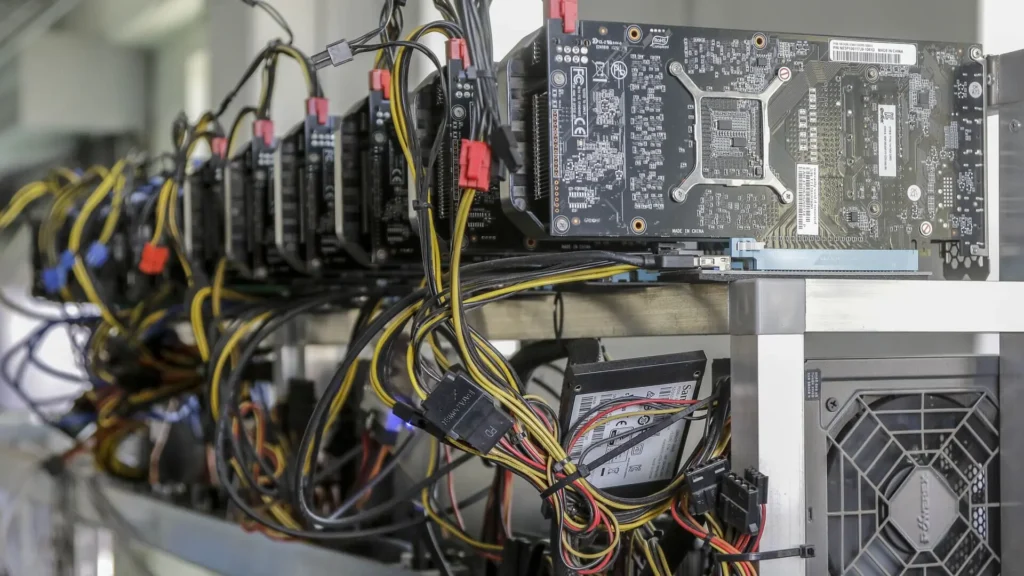
The smart money sees what’s coming. Mining hardware isn’t just for solving SHA-256 puzzles anymore. Those Application-Specific Integrated Circuit (ASIC) and Graphics Processing Unit (GPU) farms represent a massive, distributed computational infrastructure that could serve multiple masters.
MARA Holdings started offering cloud services. Hut 8 is pivoting to AI workloads. Some Dogecoin mining operations, often running on merged-mining setups with Litecoin, are exploring auxiliary compute services to diversify revenue streams.
These aren’t desperate moves; they’re evolutionary adaptations. The core innovation of PoW was never about wasting electricity. It proved that decentralized physical work was happening. That same principle applies to:
Running verifiable artificial intelligence (AI) inference for on-chain agents.
Scientific computing that needs trustless verification.
Decentralized rendering for gaming and metaverse applications.
Suddenly, miners aren’t dependent on a single token’s price. They’re infrastructure providers earning from Bitcoin block rewards plus fees from compute customers. Base income plus services revenue. The speculative subsidy loop breaks.
The Darwin Awards for Stubborn Miners
Two futures are emerging, and miners get to pick one.
The first path leads to a brutal contraction. Miners who refuse to adapt watch their margins compress with each halving. When the next bear market hits, they’ll capitulate. Fire sales of mining equipment. Hash rate plummets.
The survivors become profitable again, but the network is smaller, more centralized, and perceived as vulnerable. Bitcoin becomes digital gold, less secure than physical gold vaults.
The second path requires evolution. Miners transform into hybrid compute providers. They maintain network security as their civic duty (and base revenue stream) while selling verified computation to the broader crypto ecosystem. They become the physical infrastructure layer for Web3, not just Bitcoin maximalists burning coal.
If Bitcoin is digital gold, then the human brain is living lightning. One stores value. The other creates it. Bitcoin is the ledger of freedom. The brain is the engine of evolution. pic.twitter.com/bwsPMc3Uzf
What the Proof-of-Work Shift Means for Investors, Miners, and Crypto Markets
For holders, this transition actually strengthens the investment case. Miners become productive businesses with diversified revenue, not leveraged bets on number-go-up. The network maintains security through economic sustainability, not speculation.
For mining companies, watch who’s pivoting now versus who’s doubling down on single-asset mining. Core Scientific exploring AI? Smart. Is CleanSpark buying more Bitcoin miners? Risky.
For the broader ecosystem, we’re watching natural selection in real-time. The chains that help miners find alternative revenue survive. The ones that don’t will centralize until they’re basically corporate databases with extra steps.
Proof-of-Work at a Crossroads: Evolution or Extinction
The crisis is already coded into the protocol. Every four years, the pressure increases. The current model, in which speculators subsidize security, cannot persist for much longer. Mathematics doesn’t care about ideology.
But crisis drives innovation. The miners who recognize that their true asset is provable, distributed compute will thrive. They’ll secure Bitcoin while powering the entire verifiable computation economy. The stubborn ones will become cautionary tales in economic textbooks.
The next decade of crypto won’t be defined by proof-of-work versus proof-of-stake debates. It’ll be shaped by infrastructure that actually builds things. Miners who embrace their destiny as the foundational compute layer for a multi-chain, verifiable world will write the next chapter.
The rest will be footnotes about why pure proof-of-work was beautiful in theory but broken in practice.
Disclaimer:
The views, thoughts, and opinions expressed in the article belong solely to the author, and not necessarily to CCN, its management, employees, or affiliates. This content is for informational purposes only and should not be considered professional advice.
About the Author
Leo Fan
Leo Fan is the Founder & CEO of Cysic, the first full-stack compute network that delivers real-time ZKPs, hardware-accelerated AI computation, and tokenized access to high-performance hardware through ComputeFi.
With a PhD in cryptography from Cornell and a background spanning academic research, FPGA/ASIC design, protocol engineering, and next-generation hardware pipelines, Leo has helped transition ZKPs from theoretical constructs to industrial-scale systems.
At Cysic, Leo leads a multidisciplinary team designing ZK and AI-optimized ASICs, high-throughput GPU-provisioning clusters, and a decentralised compute network that transforms compute into a programmable on-chain asset.