The International Energy Agency (IEA) estimates that electricity demand from data centers, AI, and crypto will more than double by the end of 2026. | Image credit: Veronica Cestari / CCN
Share
Key Takeaways
Compute power and AI chips are becoming strategic assets for Bitcoin mining and national competitiveness.
The US mining sector still depends heavily on Chinese-linked ASIC manufacturing and semiconductor supply chains.
Bitcoin miners now compete directly with AI firms for electricity, data-center capacity, and computing resources.
Long-term crypto leadership may increasingly depend on access to chips, energy, and compute infrastructure.
Computational power has transitioned from a technical metric into the world’s most strategic asset.
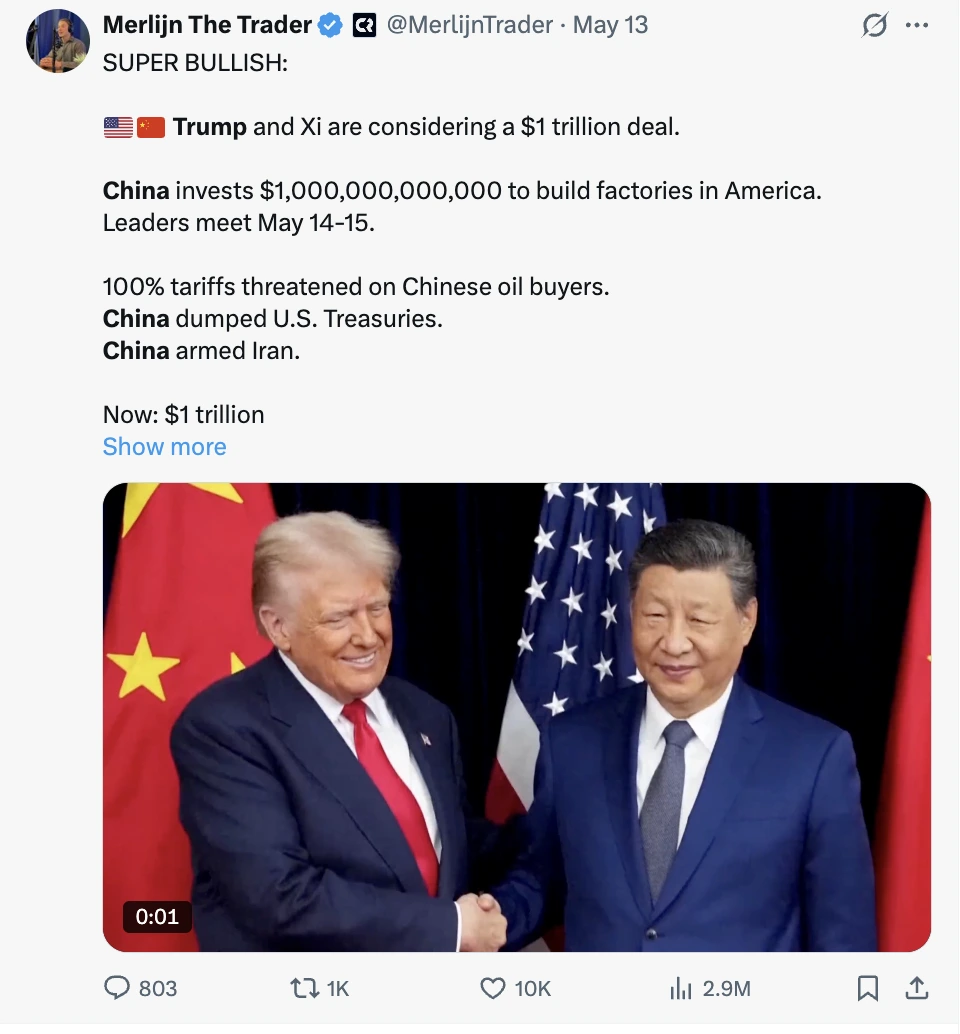
As Donald Trump meets Chinese President Xi Jinping this May 2026, global markets areanalyzing whether these high-stakes talks will ease the friction over AI chip exports, semiconductor tariffs, and flows of mining hardware.
While Bitcoin remains decentralized by design, the infrastructure powering the network still depends heavily on supply chains linked to China.
As of May 2026, industry data shows that while the US controls approximately 38% of the global Bitcoin hashrate (400 EH/s), a staggering 97% of the ASIC hardware powering those facilities is designed and manufactured by Chinese-owned firms.
Try Our Recommended Crypto Exchanges
Sponsored
Disclosure
We sometimes use affiliate links in our content, when clicking on those we might receive a commission at no extra cost to you. By using this website you agree to our terms and conditions and privacy policy.
Silicon Sovereignty: Trading H200s for Hardware Access
China’s April 2026 bulletin shows AI at the center of Beijing’s industrial strategy. Its 15th Five-Year Plan mentions AI more than 50 times and links it to manufacturing, defense, finance, health, logistics and national security.
For crypto markets, the implications extend beyond trade disputes. The competition increasingly revolves around chips, compute resources, data infrastructure and energy security.
Trump’s entourage includes tech leaders such as NVIDIA CEO Jensen Huang, Elon Musk, and Apple CEO Tim Cook, reflecting the growing importance of semiconductor supply chains, artificial intelligence, manufacturing networks and energy systems in US-China relations.
Trump-Xi summit | Source X @MerlijnTrader
Compute Convergence: The AI-Mining Hybrid Model
Bitcoin miners no longer compete only against each other. They compete directly with artificial intelligence firms for electricity, data-center space and computing infrastructure.
“The mining industry should watch this summit for two reasons, and neither is about Bitcoin’s price,” says Saša Čoh, CEO of NiceHash. “First, China still dominates ASIC manufacturing. Any movement on tariffs or export controls directly affects the cost of deploying mining hardware globally.”
Čoh says the growing focus on NVIDIA’s H200 chips also highlights a widening divide between AI infrastructure and Bitcoin mining. “The H200 chip diplomacy reinforces something we’re already seeing: AI compute and SHA-256 hashrate are pulling in different directions,” he says.
“Miners who stayed committed to Bitcoin rather than pivoting to AI won’t benefit directly from H200 deals,” Čoh adds. “What they need is better financial infrastructure around hashrate: stablecoin settlement, tools to manage the BTC-revenue-versus-fiat-costs mismatch. That won’t be resolved in Beijing.”
The overlap matters because semiconductor restrictions increasingly affect not only AI expansion, but also the economics of industrial Bitcoin mining infrastructure worldwide.
AI Infrastructure Is Rewriting Mining Economics
Public giants like Core Scientific, Hut 8, and Riot Platforms have pivoted toward AI and high-performance computing (HPC) as demand for data centers accelerates.
The International Energy Agency (IEA) estimates that electricity demand from data centers, AI, and crypto will more than double by the end of 2026.
This energy crunch is shaping Trump’s agenda. By seeking to stabilize global energy shipping routes and trade flows, the administration aims to prevent electricity and infrastructure costs from escalating further for American operators.
Why This Matters for the US Crypto Lifestyle Ranking
This geopolitical contest over semiconductors now connects directly to CCN’s Global Crypto Lifestyle Index: United States, where the US ranks among the world’s leading crypto economies due to strong institutional adoption, venture capital activity, and advanced financial infrastructure.
The next phase of crypto leadership extends beyond regulation and capital access. Sustaining the US advantage may increasingly depend on compute capacity, energy resilience, and long-term access to the silicon powering AI, Bitcoin mining, cloud systems, and HPC networks.
That shift matters because the same chips supporting AI expansion also secure Bitcoin’s industrial mining ecosystem. Access to advanced semiconductors now shapes hashrate growth, operational costs, infrastructure scalability, and national competitiveness.
However, these pressures extend beyond market cycles.
Structural Risks Emerging in 2026
The expansion of AI infrastructure and rising geopolitical tensions are creating new risks for the US crypto sector.
Hardware dependence: Despite expanding domestic manufacturing efforts, many US operators still rely on Chinese-linked semiconductor supply chains and ASIC production.
Energy competition: AI hyperscalers continue absorbing massive amounts of electricity and data-center capacity, increasing pressure on mining profitability across North America. The IEA estimates that electricity demand from data centers, AI, and crypto could more than double by 2026. Some researchers also argue that miners can help stabilize grids during periods of excess energy supply.
Semiconductor restrictions: Export controls, tariffs, and licensing rules increasingly influence access to advanced chips used for both AI computation and industrial-scale mining.
The Trump-Xi discussions may not trigger immediate market volatility for Bitcoin, but they could shape the economic foundations of the digital economy for years ahead.
In 2026, countries with access to chips, electricity, and computing infrastructure may hold a major advantage in both AI and crypto.
Dr. Lorena Nessi is an award-winning journalist and media technology expert with 15 years of experience in digital culture and communication. Based in Oxfordshire, UK, she combines academic insight with hands-on media practice.
She holds a PhD in Communication, Sociology, and Digital Cultures, and an MA in Globalization, Identity, and Technology.
Lorena has taught at Fairleigh Dickinson University, Nottingham Trent University, and the University of Oxford. She is a former producer for the BBC in London, with additional experience creating television content in Mexico and Japan.
Her research focuses on digital cultures, social media, technology, capitalism, and the societal impact of blockchain innovation.
She has written extensively on digital media and emerging technologies, with her work featured in both academic and media platforms. Her Web3 expertise explores how blockchain technologies shape culture, economics, and decentralized systems.
Outside of work, Lorena enjoys reading science fiction, playing strategic board games, traveling, and chasing adventures that get her heart racing. A perfect day ends with a relaxing spa and a good family meal.