Florida Passed Crypto Rules 37–0 — But Viral ‘CLARITY Act’ Claim Gets One Big Thing Wrong
Share
Key Takeaways
Bitcoin traded near $81,000 when the Senate Banking Committee advanced the CLARITY Act 15-9 in May.
CLARITY Act missed its July 4 signing target as three disputes stalled the needed Democratic votes.
Full Senate passage carries bigger stakes: Citi and Standard Chartered target $143,000 and $150,000.
Bitcoin’s reaction to the CLARITY Act’s most significant procedural win so far offers the clearest available data point on what full passage could do to price, and that data point now sits against a bill that just missed its highest-profile deadline.
The Senate Banking Committee advanced the CLARITY Act on May 14, 2026, in a 15-9 bipartisan vote, with all 13 Republicans supporting the bill, joined by Democrats Ruben Gallego and Angela Alsobrooks. Bitcoin traded near $81,000 around that vote, a committee-stage reaction to a bill still five procedural steps from law.
Full Senate passage carries larger price implications, with Citi targeting $143,000 and Standard Chartered targeting $150,000, both contingent on passage and citing regulatory clarity as the catalyst needed to unlock institutional inflows into spot ETFs and treasury adoption programs.
Deadline Came and Went
The bill sat at Calendar No. 423 on the Senate Legislative Calendar as July 4 passed, with no floor vote scheduled and no cloture motion filed. Passage odds on prediction markets fell to the 40-50% range, down from 82% in February.
The Senate returns July 13, leaving roughly three usable weeks before August recess, the window analysts have consistently called the last realistic gate for 2026 passage.
Three Fights, Not One Deadline
The delay is not procedural drift. Three interlocking disputes block the seven to nine Democratic votes needed to clear the 60-vote filibuster threshold.
The Office of Government Ethics released Trump’s 927-page financial disclosure on July 1, showing approximately $1.4 billion in cryptocurrency-related income during 2025, including $635 million from $TRUMP memecoin licensing and more than $500 million from World Liberty Financial token sales. An ethics amendment offered by Senator Chris Van Hollen failed 11-13 in committee, and Senator Kirsten Gillibrand has said enforceable language covering officials’ crypto holdings is a prerequisite for her floor support.
A second dispute concerns Section 604, which shields non-custodial software developers from money-transmitter registration, a provision law enforcement groups argue would impair criminal investigations.
A third concerns stablecoin yield: Coinbase earns roughly $1.35 billion annually in USDC rewards revenue, and the American Bankers Association argues the bill’s language creates a loophole around the GENIUS Act’s ban on issuer-paid interest.
What Claude Thinks Bitcoin Price Could Do If CLARITY Passes
According to Claude, bank targets on this bill deserve a more skeptical read than the headline numbers suggest. Citi’s $143,000 and Standard Chartered’s $150,000 are both explicitly conditional on passage, and both assume regulatory clarity unlocks a specific mechanism: more institutional inflows into spot ETFs and treasury adoption programs.
They are scenario-based estimates, not predictions of certainty, and both banks have moved their own numbers before as the bill’s timeline shifted. Standard Chartered cut its 2026 XRP target by 65% within this same stretch of coverage, which shows how sensitive these targets are to legislative timing rather than to any fixed view of fundamentals.
Claude’s honest expectation is that the reaction won’t be clean even if the bill clears the Senate. The committee vote already produced a live data point: Bitcoin traded near $81,000 around that event, a smaller, procedural step rather than final passage.
Full passage is a bigger catalyst in theory, but markets tend to front-run known catalysts incrementally rather than jump only on the day a vote happens, so much of the anticipated move may already be priced in by the time a floor vote occurs. The form the bill passes in matters just as much as whether it passes. The stablecoin-yield provision and Section 604 developer protections are still being negotiated, and a materially watered-down final text could land as a smaller catalyst than the version banks modeled their targets on.
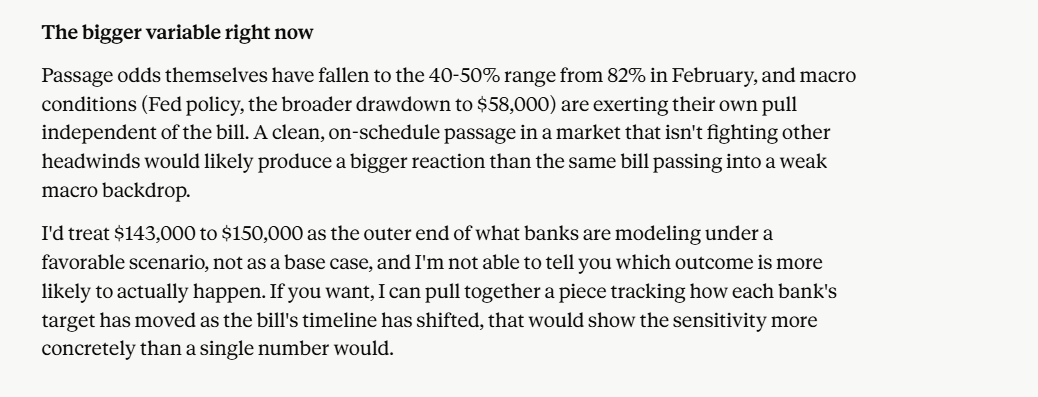
The bigger variable right now sits outside the bill entirely. Passage odds have fallen to the 40-50% range from 82% in February, and macro conditions, including Fed policy and the broader drawdown to $58,000, are exerting their own pull independent of CLARITY. A clean, on-schedule passage landing in a market that isn’t fighting other headwinds would likely produce a larger reaction than the same bill passing into a weak macro backdrop.
Taking all of that together, Claude treats $143,000 to $150,000 as the outer end of what banks are modeling under a favorable scenario, not as a base case, and it doesn’t think there’s enough reliable signal right now to say which outcome is more likely to actually play out. Tracking how each bank’s target has shifted alongside the bill’s timeline would show that sensitivity more concretely than any single price forecast can.
Bitcoin price prediction per Claude. | Source: Claude
Math Against the Clock
Republicans hold 53 seats, Senators Josh Hawley and Rand Paul are expected to vote no on substantive grounds, and only Gallego and Alsobrooks have signaled conditional Democratic support. Senate Majority Leader John Thune must also weigh CLARITY against FISA Section 702 reauthorization and the annual defense authorization bill, each capable of consuming a week of floor time on its own.
Not every signal is bearish. SEC Commissioner Hester Peirce said on the Searching for Mana podcast that she expects the CLARITY Act to pass the full Senate this summer, a notable claim from a sitting regulator and former Senate Banking Committee staffer.
If the ethics, developer-protection, and yield disputes resolve before August 7, the bill could still reach a floor vote this year. If not, the political variables compound: a midterm shift in Congress would likely force Democrats to demand a substantially revised text, pushing negotiation into an entirely new Congress.
For Bitcoin, the question committee passage already answered is directional. What remains open is magnitude, and that now depends on roughly fifteen working days.
Disclaimer:
The information provided in this article is for informational purposes only. It is not intended to be, nor should it be construed as, financial advice. We do not make any warranties regarding the completeness, reliability, or accuracy of this information. All investments involve risk, and past performance does not guarantee future results. We recommend consulting a financial advisor before making any investment decisions.
Dr. Guneet Kaur is a senior editor at CCN.com and a Science Fellow at Exponential Science. She is a fintech and blockchain expert with extensive experience in digital finance education, blockchain ecosystems, and cryptocurrency markets. She has worked with global media such as Cointelegraph, as well as education and blockchain platforms, to design and lead strategic content and learning initiatives. As an educator and assessor for top-tier executive programs, she bridges real-world fintech trends with academic insight.
Dr. Kaur is also a published researcher and peer reviewer across fintech and data science journals, including Financial Innovation Journal and International Journal of Big Data Intelligence and Applications. Her work spans data-driven analysis, Web3 innovation, and technical content development. With a strong foundation in both industry and academia, she translates complex financial technologies into practical applications, empowering learners, professionals, and institutions across the rapidly evolving digital finance landscape.