Key Takeaways
- Coinbase CEO Brian Armstrong returned to Capitol Hill.
- Senate Republicans released the latest draft of the 616-page CLARITY Act.
- The proposal includes new crypto-ethics restrictions, but Democrats have objected to leaving enforcement exclusively to the Department of Justice.
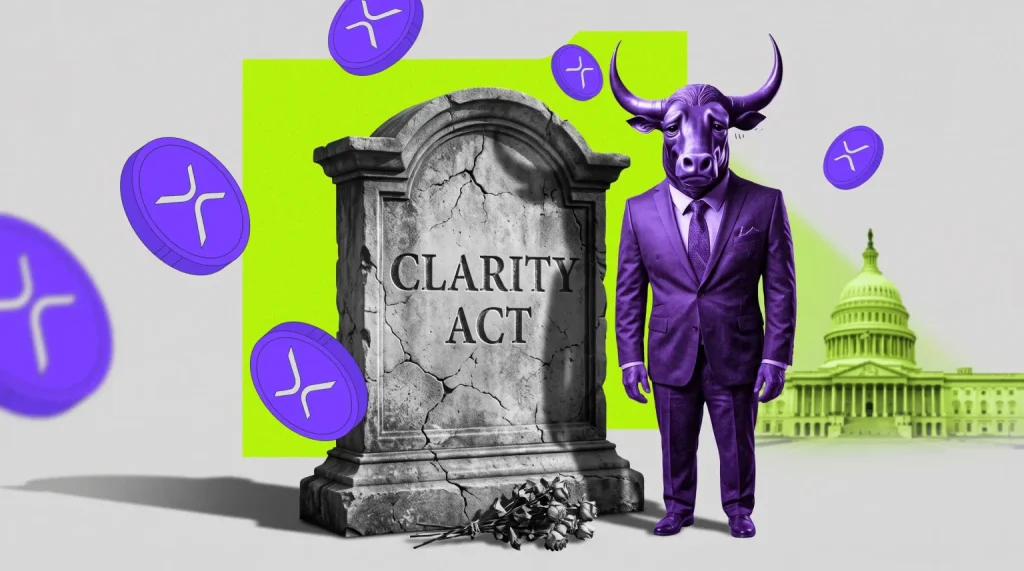
The CLARITY Act has entered a critical negotiating window after Senate Republicans released updated legislation ahead of a possible floor vote next week.
It comes as Coinbase CEO Brian Armstrong returned to Capitol Hill to support the legislation, describing it as being at the “one-yard line.”
As the legislation reaches a critical stage, analysts are debating whether XRP’s price can surge to $27 or fall below $1.
Coinbase CEO Returns to Support CLARITY Act
Armstrong returned to Washington as the crypto industry increased pressure on lawmakers to complete negotiations before the Senate’s August recess.
“This bill is at the one-yard line,” Armstrong said in a video recorded during the visit.
He argued that the absence of a dedicated federal crypto market structure framework had exposed consumers to bad actors and made it harder for legitimate companies to operate in the US.
Armstrong said the “status quo is not serving anyone in the US right now,” pointing to the collapse of FTX as an example of the damage consumers could face without appropriate protections.
He also thanked members of the Coinbase-backed Stand With Crypto organization for contacting their representatives.
Armstrong predicted that the bill could reach the full Senate floor within the next few weeks, although its lack of confirmed Democratic support remains a major obstacle.
Republicans Release CLARITY Act Ethics Provisions
Senate Republicans circulated the latest version of the CLARITY Act on Wednesday.
The draft attempts to resolve a prolonged dispute over the crypto interests of federal officials.
The agreed-upon ethics provisions would prevent the president, vice president, members of Congress, and other covered officials from issuing or sponsoring digital assets in exchange for compensation.
The proposal would also expand disclosure requirements for covered digital assets worth more than $1,000.
Violating officials could be forced to surrender profits and pay a civil penalty.
Sen. Cynthia Lummis praised Trump for accepting the restrictions.
“History will remember this as the moment a president chose a higher standard of ethics than the law required of him,” she said.
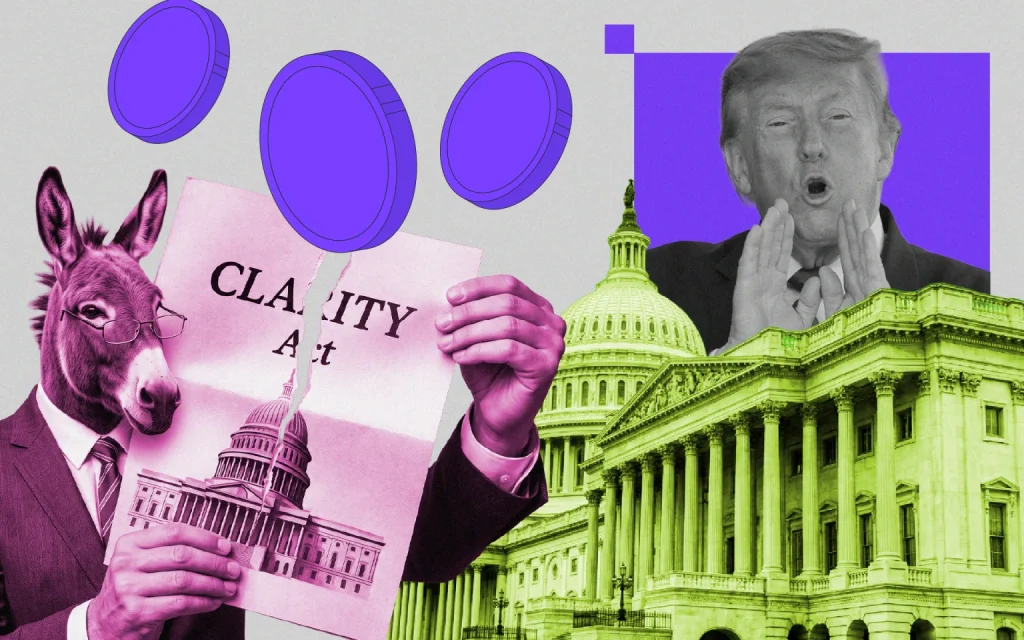
Meanwhile, Sen. Angela Alsobrooks described DOJ-only enforcement as “an unserious offer.”
“I wouldn’t support the bill if that’s the language,” she said, according to Politico.
The publication also reported that the updated language had not received approval from any Democrats.
Former CFTC Chairman Says CLARITY Act Might Not Pass
Former CFTC Chairman Christopher Giancarlo believes the legislation remains more likely to fail than pass.
Crypto in America host Eleanor Terrett reported that Giancarlo saw a “greater than 50% chance” that the CLARITY Act would not pass.
However, he reportedly said that the outcome would be “okay.”
Giancarlo argued that crypto development could continue under frameworks established by the Securities and Exchange Commission and CFTC.
He also suggested that progress made by regulators and the crypto industry during the next two years would be difficult for a future crypto-hostile administration to reverse.
Why Have the CLARITY Act’s Polymarket Odds Collapsed?
Prediction-market traders have become increasingly doubtful that the legislation will complete the full congressional process this year.
Polymarket showed the CLARITY Act with a 42% probability of becoming law at the time of writing, despite the release of the new text and Trump’s acceptance of the ethics package.
Yesterday, Fundstrat co-founder Tom Lee argued that prediction markets could be underestimating the legislation’s prospects.
Lee endorsed analysis from Fundstrat Head of Digital Asset Strategy Sean Farrell, who said conversations with groups close to negotiations indicated more optimism than market prices reflected.
Lee said Polymarket and Kalshi “likely underestimate odds of passage.”
Could XRP Reach $27?
The latest CLARITY Act developments have returned one of XRP’s more bullish long-term forecasts to focus.
Earlier this month, crypto analyst ChartNerds argued that XRP could eventually climb to $27 after completing its current market downturn.
The analyst said that historical XRP bear markets had lasted between 400 and 790 days and produced declines of 85% to 96%.
“In 2026, we’ve only corrected for about 350 days, and are down just 71% from the July 2025 ATH,” ChartNerds wrote on X.
According to the analyst, XRP’s bear markets have become shorter and less severe during successive cycles.
ChartNerds therefore suggested that the cryptocurrency could be approaching the period in which a long-term bottom historically forms.
“The territory for marking a historical bottom between now and EOY is fast approaching,” the analyst said.
The analyst instead suggested that XRP could enter an extended accumulation period after establishing a cycle low.
That phase could eventually produce “a major repricing toward FIB extension targets of $8/$13/$27 in the coming years,” ChartNerds said.
The targets are based on Fibonacci extension analysis, a technical method traders use to identify potential levels beyond a previous price range.
However, Fibonacci targets do not directly account for demand, adoption, or changing market conditions. The $27 forecast, therefore, remains highly speculative.
At approximately $1.13, XRP would need to increase almost 24 times to reach $27, equivalent to a gain of roughly 2,290%.
It would first need to recover its $3.65 record high before rising another 640% to reach ChartNerds’ highest target.
With approximately 62.47 billion XRP circulating, a price of $27 would give the cryptocurrency a market capitalization of around $1.69 trillion.
Motley Fool Analyst Predicts XRP Will Fall Below $1
ChartNerds’ bullish outlook contrasts sharply with a recent forecast from Motley Fool analyst Anthony Di Pizio.
Di Pizio argued that XRP faces structural challenges that favorable regulation and growth in Ripple’s payment business might not automatically resolve.
Banks do not need to use XRP to benefit from Ripple Payment; the network also supports fiat currencies. Ripple’s RLUSD stablecoin could also offer a less volatile alternative for some settlement activity.
Di Pizio additionally argued that XRP’s use as a bridge currency does not necessarily create lasting demand.
One institution buying XRP to initiate a payment could be offset by the recipient immediately selling the tokens for its preferred currency.
The analyst said XRP would only achieve a “real increase in value” if users discovered a compelling reason “to buy it and hold it for the long run.”
Instead, Di Pizio predicted that XRP would be trading “well below $1 five years from now.”
He suggested that a repeat of XRP’s 95% decline following its 2018 peak could eventually take the cryptocurrency toward $0.18.
What Would XRP Need to Do to Reach $27?
XRP would need to overcome several substantial price and valuation hurdles before reaching $27.
At approximately $1.13 at the time of reporting, XRP would have to increase almost 24 times, equivalent to a gain of roughly 2,290%.
Its first major challenge would be recovering its 2025 record high of approximately $3.65. Reaching that level would itself require an increase of more than 220%.
XRP would then need to rise another 640% from its previous record to reach $27.
With approximately 62.47 billion XRP currently in circulation, a $27 price would yield a circulating market capitalization of about $1.69 trillion.
Valuing the maximum supply of 100 billion tokens at the same price would result in a fully diluted valuation of $2.7 trillion.
Reaching that scale would likely require far more than the passage of one US bill.
The CLARITY Act could reduce regulatory uncertainty, clarify the responsibilities of the SEC and CFTC, and make it easier for regulated institutions to participate in digital asset markets.
However, it would not directly require banks, payment providers, or investors to purchase XRP.

Kurt Robson is a London-based reporter at CCN, specialising in the fast-moving worlds of crypto and emerging technology. He began his career covering local news in Cornwall after graduating from Falmouth University with First Class Honours in Journalism. There, he cut his teeth on everything from council meetings to missing swans.
He quickly rose through the ranks to become a frontline journalist at several of the UK’s leading national newspapers. Over the years, he has interviewed musicians and celebrities, reported from courtrooms and crime scenes, and secured multiple front-page exclusives.
Following the upheaval of the COVID-19 pandemic, Kurt shifted his focus to technology journalism—just ahead of the AI boom. With a natural curiosity and a trained eye for emerging trends, he has found a new rhythm in reporting on innovation.
At CCN, Kurt's work focuses on the cutting edge of crypto, blockchain, AI, and the evolving digital world. Drawing on his background in people-first reporting and his deep interest in disruptive tech, Kurt delivers stories that are insightful, entertaining, and human-centric.