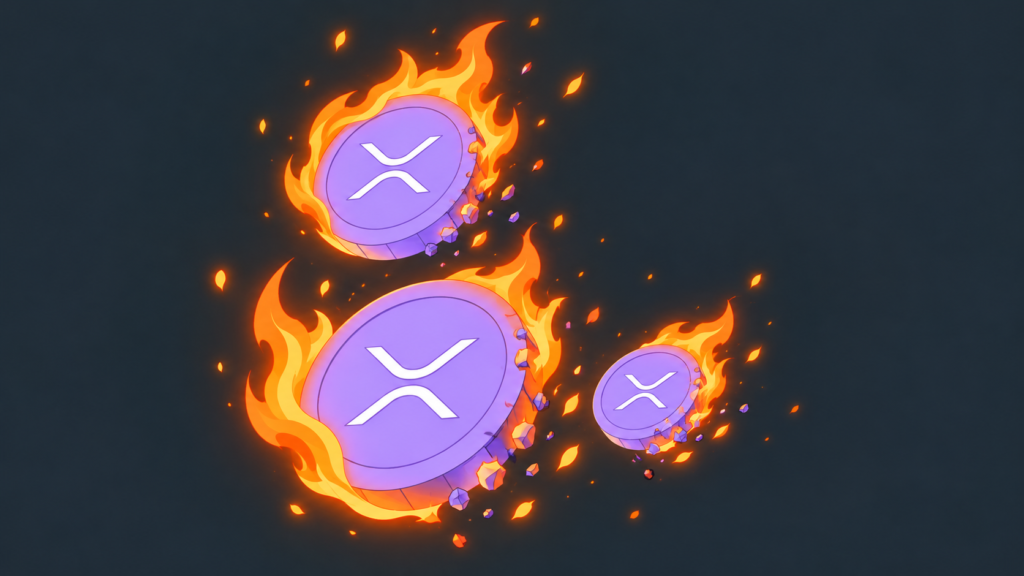
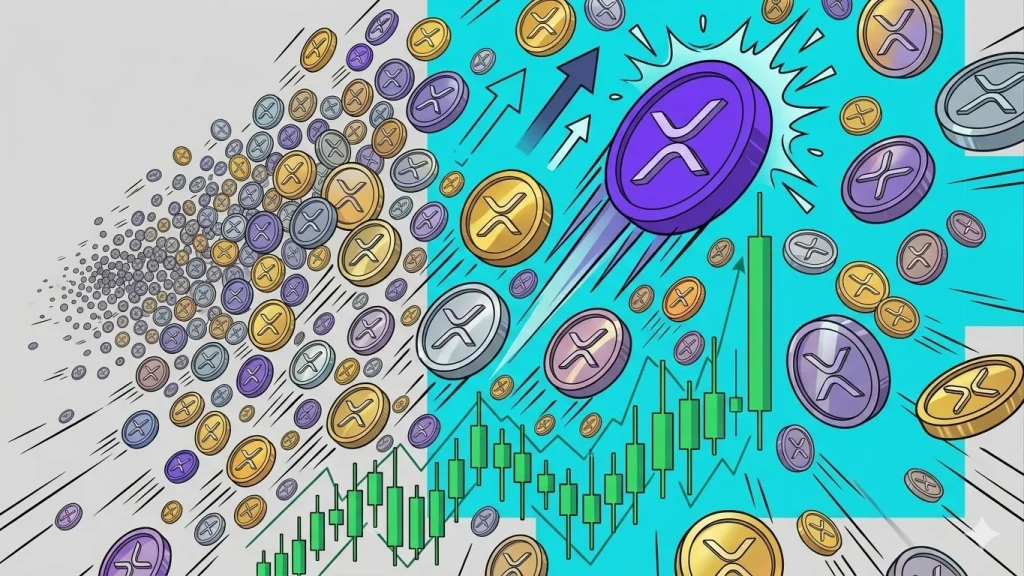
XRP bulls have been amplifying an argument that growing network usage could boost the token’s scarcity by permanently burning transaction fees.
The logic is simple — more transactions mean more XRP is destroyed, potentially tightening supply as adoption grows.
But could burning meaningfully support a $100 price?
Calculations using CryptoTuts’ published burn data reveal how slowly that process reduces XRP’s enormous supply — even under a hypothetical 1,000-fold increase in activity.
+81
Bitcoin
Ethereum
Tether
Build'N'Build
USD Coin
Solana
Ripple
Dogecoin
Cardano
Toncoin
Shiba Inu
Avalanche
TRON
Chainlink
Polkadot
Wrapped Bitcoin
Litecoin
Dai
NEAR Protocol
Bitcoin Cash
Monero
Stellar
Cosmos
Filecoin
Ethereum Classic
Aptos
Immutable
Unstoppable Ecosystem Token
Arbitrum
The Sandbox
Decentraland
Axie Infinity
Injective Protocol
Render Token
The Graph
Aave
Chiliz
Helium
PAX Gold
Compound
Lido DAO Token
THORChain
Stacks
Arweave
Sui
Uniswap
Pepe
Ondo
Mantle
Bittensor
Kaspa
Celestia
Artificial Superintelligence Alliance
Jupiter
Quant
Worldcoin
PayPal USD
Bonk
Flare
Sei
JITO
JasmyCoin
PancakeSwap
Floki Inu
Ethereum Name Service
SushiSwap
Kava.io
1inch Network
Tezos
Algorand
Flow
Curve DAO Token
MultiversX
Zcash
Basic Attention Token
Enjin Coin
Ethena
Hedera Hashgraph
VeChain
Conflux Network
XDC Network
Tether Gold
Bitget Token
Polygon Ecosystem Token
Pi Network
OKB
+76
Bitcoin
Ethereum
Tether
USD Coin
Solana
Ripple
Dogecoin
Cardano
Toncoin
Shiba Inu
Avalanche
TRON
Chainlink
Polygon Matic
Polkadot
Wrapped Bitcoin
Litecoin
Dai
NEAR Protocol
Bitcoin Cash
Stellar
Cosmos
Filecoin
Ethereum Classic
Aptos
Hedera Hashgraph
Immutable
Optimism
Arbitrum
VeChain
The Sandbox
Decentraland
Axie Infinity
Injective Protocol
Render
The Graph
Aave
Chiliz
Helium
PAX Gold
Compound
Lido DAO Token
Sui
Conflux Network
Lido Staked ETH
OKB
Uniswap
Pepe
Ondo
Mantle
First Digital USD
XDC Network
Artificial Superintelligence Alliance
Jupiter
Quant
Worldcoin
Bonk
Tether Gold
JITO
JasmyCoin
Core
Floki Inu
Ethereum Name Service
SushiSwap
1inch Network
Tezos
Algorand
Flow
Trust Wallet Token
Curve DAO Token
MultiversX
Basic Attention Token
Enjin Coin
Ethena
Ethena Staked USDe
Build'N'Build
Kava.io
Celestia
Sei
IOTA
Frax
+217
Bitcoin
Ethereum
Tether
Build'N'Build
USD Coin
Solana
Ripple
Dogecoin
Cardano
Toncoin
Shiba Inu
Avalanche
TRON
Chainlink
Polkadot
Polygon Matic
Wrapped Bitcoin
Litecoin
Dai
NEAR Protocol
Bitcoin Cash
Monero
Stellar
Cosmos
Filecoin
Ethereum Classic
Aptos
Hedera Hashgraph
Immutable
Optimism
Arbitrum
VeChain
The Sandbox
Decentraland
Axie Infinity
Injective Protocol
Render Token
The Graph
Maker
Aave
Chiliz
Helium
PAX Gold
Compound
Lido DAO Token
THORChain
Stacks
Arweave
Sui
Conflux Network
Lido Staked ETH
Bitget Token
Wrapped Ethereum
OKB
Uniswap
Pepe
Ondo
Mantle
First Digital USD
Bittensor
Kaspa
Celestia
XDC Network
Artificial Superintelligence Alliance
Jupiter
Quant
Worldcoin
PayPal USD
Bonk
Flare
Tether Gold
Sei
JITO
JasmyCoin
PancakeSwap
Core
Floki Inu
Ethereum Name Service
SushiSwap
Kava.io
1inch Network
Tezos
Algorand
Flow
Trust Wallet Token
Curve DAO Token
KuCoin Token
MultiversX
Gitcoin
Zcash
IOTA
Basic Attention Token
Frax
Ethena
Ethena USDe
Fasttoken
Pi Network
SATS
Adventure Gold
Audius
Alchemy Pay
Arkham
API3
Bounce Token
Altlayer
Aergo
Amp
Aevo
ARPA Chain
Astar
Ark
Ankr
AirSwap
Alpaca Finance
Blur
Badger DAO
Bancor
BakeryToken
Biconomy
Chromia
Celer Network
Celo
Shentu
Civic
Convex Finance
Cartesi
Cyber
COTI
DigiByte
DIA
ether.fi
FUNToken
FLUX
Firo
Ampleforth
Golem
GMX
Gnosis
Moonbeam
Holo
IoTex
ICON
Illuvium
JUST
Kadena
Liquity
Livepeer
Lisk
Memecoin
Manta Network
Treasure
Mask Network
MetisDAO
Origin Protocol
ORDI
Ontology
Osmosis
Powerledger
Phala Network
Pendle
Portal
Pyth Network
ConstitutionDAO
Polkastarter
Qtum
iExec RLC
Rocket Pool
Reserve Rights
Ronin
Ravencoin
Starknet
Storj
Status
Spell Token
Sun (New)
SuperVerse
Toko Token
Theta Fuel
Tellor
Tensor
LayerZero
Usual
Eigenlayer
Hamster Kombat
Catizen
Berachain
KAITO
Pudgy Penguins
Solayer
Bio Protocol
ChainGPT
Cookie DAO
Solv Protocol
Alchemix
Bitcoin SV
Movement
DeXe
Binance Staked SOL
Nexo
Wrapped eETH
Hyperliquid
Casper
Zilliqa
Secret
Nervos Network
TrueUSD
BitTorrent
Mina
Dash
STEPN
Gemini Dollar
UNUS SED LEO
Synthetix
APEcoin
Gala
Theta Network
Fantom
Cronos
Internet Computer
Binance USD
Several recent social media postings have captured the enthusiasm surrounding XRP’s burn mechanism:
“Everyone should be prepared for what’s about to happen with XRP and it has nothing to do with this week’s price chart.”
The post continues:
“Here’s what most people miss: every single transaction on the XRP ledger burns XRP. Not sent somewhere. Not stored. Gone. Permanently.”
Kamilah Stevenson’s video, “XRP Is Disappearing, And Nobody’s Talking About It,” puts the token’s shrinking supply in focus.
The investment logic is appealing, as greater use could generate more fee-paying transactions, thereby removing additional XRP, while adoption could create demand.
However, the amount being destroyed matters.
A supply that declines by a tiny fraction each year presents a different investment proposition than one that contracts rapidly.
CryptoTuts’ XRP burn tracker publishes supply observations and hypothetical activity calculations.
Its founder, identified on the site as Phil, distinguishes the project from price forecasting.
“I’m building this page as a data product, not a price story,” he writes in its methodology section, translated from German.
Elsewhere, the website describes the burn mechanism as “not a scarcity program.”
The following calculations are based on CryptoTuts’ observations.
According to CryptoTuts’ daily dataset, the total XRP burned rose from approximately 14.38 million on Sept. 15 to 14.41 million on Oct. 15.
That means around 24,745 XRP disappeared over 30 days, averaging roughly 825 XRP per day.
If that pace continued for a year, approximately 301,000 XRP would be destroyed —just 0.0003% of the nearly 100 billion XRP remaining.
The XRP Ledger’s documentation explains that transaction costs protect the network against spam and denial-of-service attacks.
The standard minimum fee is 10 drops, equivalent to 0.00001 XRP.
At the standard minimum of 100,000 transactions, 1 XRP is destroyed. So, in turn, one billion transactions paying that fee would destroy 10,000 XRP.
The following scenarios multiply the observed burn by 10, 100, and 1,000.
The assumption is that transaction counts increase while the average fee paid in XRP remains unchanged.
| Activity scenario | XRP burned over 30 days | Annualized XRP burn | Annual share of remaining supply |
|---|---|---|---|
| Observed baseline | 24,745 | 301,066 | 0.000301% |
| 10 times activity | 247,452 | 3,010,664 | 0.003011% |
| 100 times activity | 2,474,518 | 30,106,639 | 0.030111% |
| 1,000 times activity | 24,745,183 | 301,066,389 | 0.301110% |
Illustrative scenarios calculated using CryptoTuts’ Sept. 15–Oct. 15 observations.
Even with 1,000 times the transaction activity, unchanged average fees would mean roughly 301 million XRP burned annually.
That sounds substantial, but with nearly 100 billion XRP remaining, it represents just 0.3% of the supply.
Around 99.7% would remain after a year.
Extreme XRP targets have become a recurring feature of bullish commentary.
CCN recently examined Dom Kwok’s $1,000 forecast, Jake Claver’s $10,000 prediction for XRP by late 2026, and wealth coach Jacob Metzger’s bearish scenario at $100.
The central problem is that analyzing a supply calculation can not produce a price forecast.
Burning measures how many tokens have been removed. It does not measure how much buyers will pay for the remainder, how many holders will sell, or how liquidity will change.
The bullish argument has to be separated into two questions — whether adoption increases transaction burning and whether it creates sustained demand to acquire and hold XRP.
The first can be measured through network fees.
But the second requires sufficient evidence about how the token is used, held, and traded.
CryptoTuts’ data therefore offers a useful starting point for examining the burn narrative.
However, under the assumptions modeled here, even an extraordinary increase in activity produces a relatively modest annual reduction in supply.
Kurt Robson is a London-based reporter at CCN, specialising in the fast-moving worlds of crypto and emerging technology. He began his career covering local news in Cornwall after graduating from Falmouth University with First Class Honours in Journalism. There, he cut his teeth on everything from council meetings to missing swans.
He quickly rose through the ranks to become a frontline journalist at several of the UK’s leading national newspapers. Over the years, he has interviewed musicians and celebrities, reported from courtrooms and crime scenes, and secured multiple front-page exclusives.
Following the upheaval of the COVID-19 pandemic, Kurt shifted his focus to technology journalism—just ahead of the AI boom. With a natural curiosity and a trained eye for emerging trends, he has found a new rhythm in reporting on innovation.
At CCN, Kurt's work focuses on the cutting edge of crypto, blockchain, AI, and the evolving digital world. Drawing on his background in people-first reporting and his deep interest in disruptive tech, Kurt delivers stories that are insightful, entertaining, and human-centric.
You’re All Set!
Thanks for signing up. We’ll be in touch soon with the latest insights.