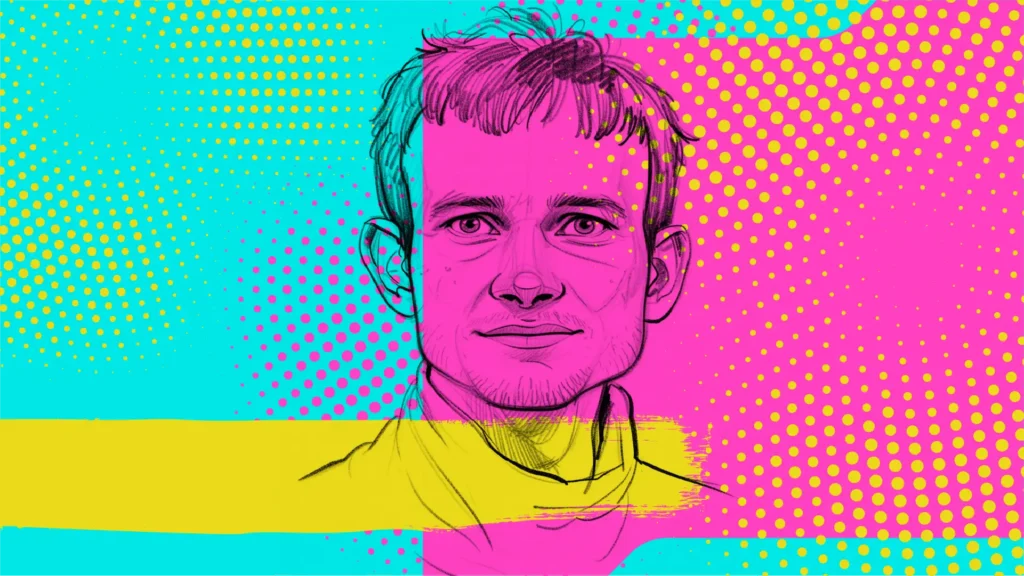
Fusaka is how Ethereum becomes truly mainstream.
Vitalik Buterin
Vitalik Buterin is the Canadian-Russian programmer who co-founded Ethereum, the second-largest blockchain and a core platform for decentralized finance (DeFi), non-fungible tokens (NFTs), and Web3.
He emerged as one of crypto’s defining figures by proposing Ethereum’s smart-contract architecture in 2013 and, in 2025, by resetting the network’s plan with a layer-2 centric roadmap, a leadership overhaul, and support for upgrades like Fusaka in an attempt to keep Ethereum competing at scale.
Origin and Background
Buterin discovered Bitcoin in 2011 as a teenager, only a few years after its release.
He began writing about it and quickly co-founded Bitcoin Magazine.
He went on to publish the Ethereum whitepaper in 2013 as an attempt to address his problems with the world’s introductory blockchain, and then helped assemble the founding team and launch the mainnet in 2015.
Major Contributions
- Conceived Ethereum’s 2013 whitepaper and co-founded the network, which by 2025 hosts a significant share of DeFi, NFT, and on-chain activity.
- Drove the Ethereum 2.0, proof-of-stake (PoS) transition. This significantly reduced Ethereum’s energy use and transformed Ethereum into a yield-bearing asset without compromising its uptime and economic activity.
- Helped shape Ethereum’s fee-burning mechanism through EIP-1559, which introduced a base-fee burn model and fundamentally changed ETH’s monetary policy, linking network usage directly to supply dynamics.
- Led Ethereum’s long-term scaling roadmap, including rollups, sharding, and modular blockchain architecture. His “Surge” roadmap emphasized layer-2 scaling and sharding to dramatically increase throughput while preserving decentralization.
- Proposed a new layer-2 security framework combining zero-knowledge proofs, optimistic rollups, and trusted execution environments to improve scalability and validation reliability across Ethereum’s ecosystem.
- Advocated decentralization, lightweight nodes, and safer staking mechanisms aimed at improving network accessibility and long-term sustainability.
Buterin’s contributions extend beyond technical development. Through research, blog posts, and governance influence, he has shaped Ethereum’s philosophy — emphasizing decentralization, scalability, and neutrality — while guiding the network through multiple architectural transitions.
Impact on the Industry (2025)
In 2025, Buterin shaped the crypto conversation by reassessing Ethereum’s long-standing reliance on layer-2 scaling. He argued that Ethereum’s base layer was improving faster than expected and that the role of layer-2 networks such as Base, Arbitrum, and Optimism should be reconsidered as the network evolves.
At the same time, Buterin supported the growth of Ethereum-based treasury strategies, discussing how companies could hold ETH on balance sheets in a similar way to corporate Bitcoin treasury models, while cautioning against excessive leverage that could threaten market stability.
Buterin also weighed in on the debate over layer-2 centralization, defending Coinbase-backed Base and emphasizing that such networks remain secured by Ethereum’s base layer and maintain non-custodial properties, countering criticism that they function like centralized systems.
Together, these positions placed Buterin at the center of Ethereum’s strategic shift in 2025 — balancing base-layer scaling, corporate adoption of ETH, and the evolving role of layer-2 networks as Ethereum competes with newer high-throughput blockchains.
Looking Ahead (2026 and Beyond)
Over Ethereum’s next phase, Buterin will focus on modular scaling, lighter nodes, and safer staking, which can help determine if the network can hold its own against newer blockchains.
Following the activation of the Fusaka upgrade in December 2025, Ethereum introduced Peer Data Availability Sampling (PeerDAS), allowing nodes to verify data without downloading the full blockchain. The change reduced hardware requirements and laid the groundwork for lighter nodes and more scalable layer-2 infrastructure.
Fusaka also expanded throughput and improved layer-2 capacity, positioning Ethereum to support a rollup-centric ecosystem while maintaining decentralization. The upgrade was designed to increase data availability, reduce validator load, and enable lower transaction fees across scaling networks.
Buterin has also outlined additional upgrades moving from research to implementation, aimed at improving decentralization, bandwidth, and consensus simultaneously — part of a broader effort to build “a fundamentally new and more powerful” Ethereum network.
If Fusaka and subsequent upgrades achieve their goals, Ethereum could strengthen its modular architecture, improve node accessibility, and enhance staking security. That would help future-proof the network while allowing ETH to remain the second-largest cryptocurrency by market capitalization as competition from newer blockchains intensifies.