Ether is consolidating after a 12% weekly surge as traders watch key support, ETF flows, technical indicators, and upcoming Fed move. | Credit: CCN.com
Share
Key Takeaways
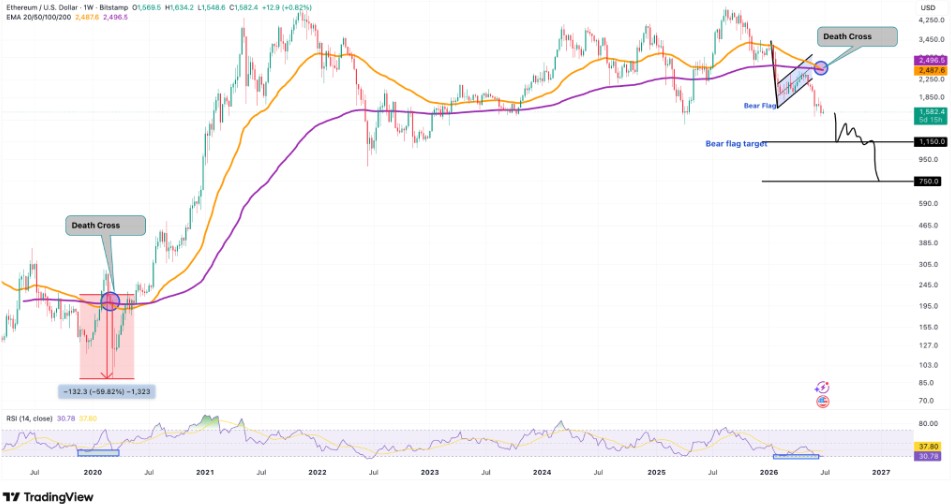
Ethereum confirms a weekly death cross as the 50-week EMA has crossed below the 200-week EMA.
Analysts are watching support around $1,150, while a severe bear-market scenario could see Ethereum fall toward $750.
Large holders sold approximately 550,000 ETH ($880 million) in one week, adding significant supply to the market.
Ethereum is facing renewed bearish pressure after confirming a rare “death cross” on its weekly chart, a technical pattern that has historically been associated with prolonged downtrends.
The signal comes at a time when the second-largest cryptocurrency is already struggling below key moving averages, while institutional investors continue pulling money from spot Ethereum exchange-traded funds (ETFs) and large holders reduce their exposure.
Although technical indicators alone cannot predict future prices with certainty, the combination of weakening momentum, persistent ETF outflows and heavy whale selling has fueled speculation that Ethereum could revisit levels below $1,000 if broader market conditions fail to improve.
Try Our Recommended Crypto Exchanges
Sponsored
Disclosure
We sometimes use affiliate links in our content, when clicking on those we might receive a commission at no extra cost to you. By using this website you agree to our terms and conditions and privacy policy.
The pattern typically reflects a shift from long-term bullish momentum toward sustained weakness rather than serving as an immediate sell signal.
Historically, Ethereum has experienced only a handful of weekly death crosses. The most notable occurred in early 2020, shortly before the COVID-19 market crash drove ETH down by more than 60%.
Ether’s “death cross” projects drop to $750. | Credit: TradingView/DailyForex
While every market cycle is different, many technical analysts believe the current setup shares similarities with previous major corrections.
Ethereum is currently trading below both its 50-week and 200-week moving averages, reinforcing the bearish structure.
Momentum indicators, including the Relative Strength Index (RSI) and Stochastic RSI, suggest oversold conditions, but they have yet to produce the bullish divergence that traders typically look for before calling a market bottom.
Several analysts also point to the confirmation of a bear flag pattern on higher timeframes. Based on traditional technical analysis, the measured move projects an initial downside target near $1,150.
If Ethereum were to experience a correction comparable to previous bear market cycles, the decline could theoretically extend toward the $750 region.
Whale Selling and ETF Outflows Continue to Pressure ETH
Technical weakness has been reinforced by deteriorating on-chain and institutional flows.
According to blockchain analyst Ali Charts, Ethereum whales sold approximately 550,000 ETH over the past week, representing roughly $880 million worth of tokens entering the market.
ETHEREUM: WHEN TO BUY?
Ethereum is approaching a historically support level that has defined its macro price action for years.
Since 2021, the $1,100 level has served as the ultimate bottom boundary of Ethereum's long-term price channel. Historically, every single test of this… https://t.co/LNkygeXO5npic.twitter.com/1NQMcvoXYL
Such large-scale distribution increases available supply and often weighs on price, particularly during periods of weak demand.
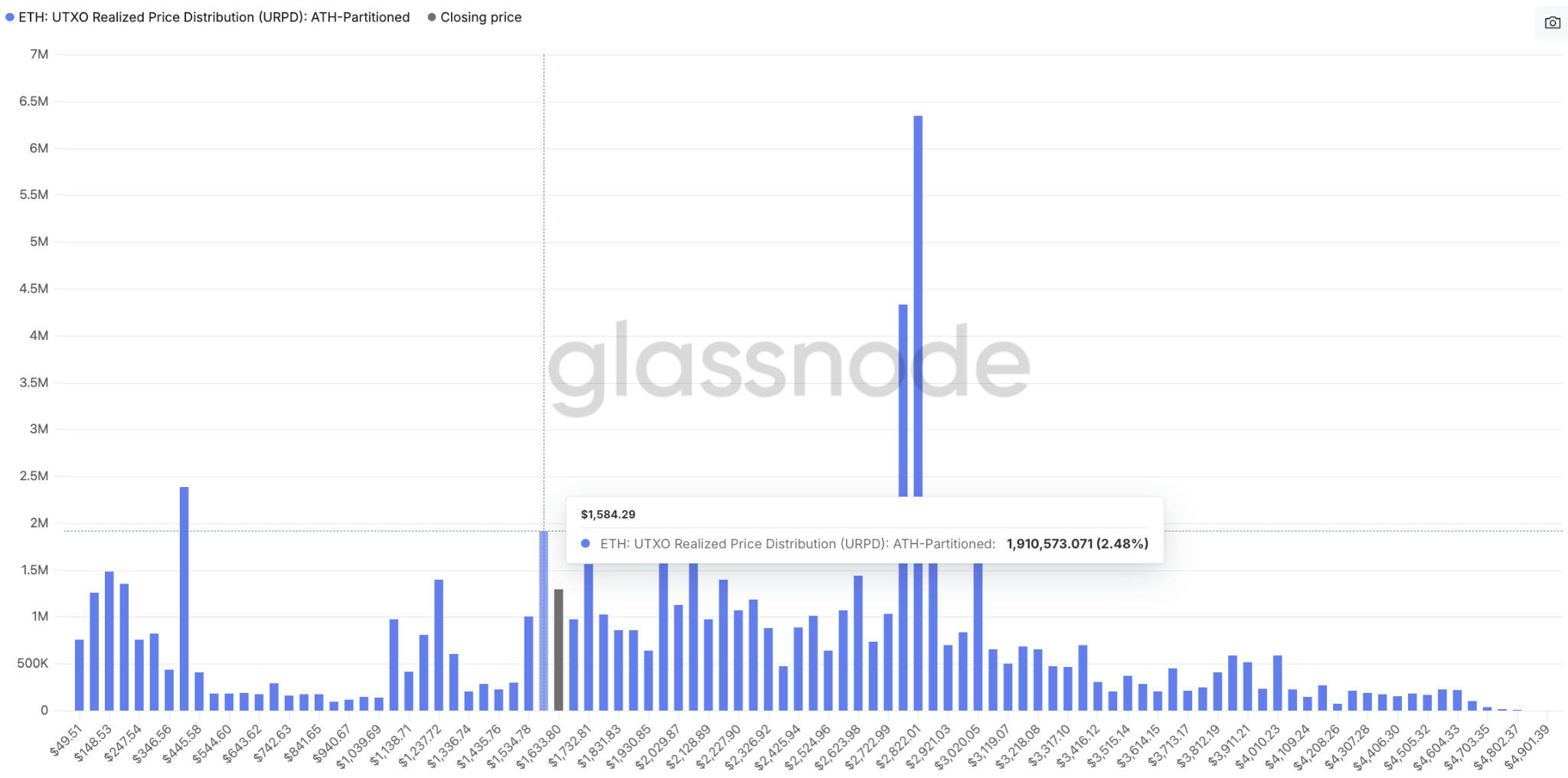
Glassnode’s UTXO Realized Price Distribution (URPD) data suggests that Ethereum is approaching a key support cluster around $1,580. Should that level fail to hold, trading activity becomes significantly thinner, leaving relatively little historical buying interest until approximately $1,240 and then near $1,090.
ETH/URPD. | Credit: Glassnode
At the same time, institutional demand has weakened considerably.
US spot Ethereum ETFs have now recorded eight consecutive trading sessions of net outflows, with investors withdrawing roughly $345 million during that stretch.
Monday alone accounted for around $30 million in redemptions, reflecting broader risk-off sentiment across digital asset investment products.
ETF flows have become one of the crypto market‘s most closely watched indicators because they represent sustained institutional participation. Extended periods of outflows can remove an important source of steady buying pressure, making it easier for bearish momentum to accelerate.
On-chain observers have also noted increased transfers from whale wallets to exchanges, a pattern that frequently precedes additional selling activity.
Could Ethereum Realistically Fall Below $1,000?
While sub-$1,000 Ethereum remains a bearish scenario rather than the base case, current market conditions suggest it cannot be ruled out.
Reaching that level would likely require several negative catalysts to align simultaneously, including continued ETF redemptions, further whale distribution and broader weakness across the cryptocurrency market, particularly in Bitcoin.
There are also signs that institutional accumulation is slowing. Ethereum treasury company BitMine Immersion, chaired by Fundstrat’s Tom Lee, purchased 27,084 ETH last week, increasing its holdings to approximately 5.7 million ETH.
However, the latest acquisition represented one of the firm’s smallest weekly purchases this year, suggesting even long-term buyers are becoming more selective during the current downturn.
Lee attributed part of the recent weakness to quarter-end portfolio repositioning, commonly known as “window dressing,” as investors reduce exposure to underperforming assets before reporting periods end.
He also noted that positive industry developments, including the launch of EthLabs and the Bank of England’s softer stance on stablecoins, have so far failed to offset negative market sentiment.
For bulls, the immediate objective remains reclaiming resistance around $1,600-$1,675 while stabilizing ETF flows and attracting renewed institutional demand. Failure to achieve that could leave Ethereum vulnerable to testing lower support zones around $1,240 and $1,090.
Disclaimer:
The information provided in this article is for informational purposes only. It is not intended to be, nor should it be construed as, financial advice. We do not make any warranties regarding the completeness, reliability, or accuracy of this information. All investments involve risk, and past performance does not guarantee future results. We recommend consulting a financial advisor before making any investment decisions.
Giuseppe Ciccomascolo began his career as an investigative journalist in Italy, where he contributed to both local and national newspapers, focusing on various financial sectors.
Upon relocating to London, he worked as an analyst for Fitch's CapitalStructure and later as a Senior Reporter for Alliance News. In 2017, Giuseppe transitioned to covering cryptocurrency-related news, producing documentaries and articles on Bitcoin and other emerging digital currencies. He also played a pivotal role in establishing the academy for a cryptocurrency exchange website. Crypto remained his primary area of interest throughout his tenure as a writer for ThirdFloor.













 Ethereum ETFs Lose Over $10 Billion in 2026 as ETH Breaks Key Support and Bearish Pressure Mounts