More Than 1,200 Crypto Firms Registered, Only 17% Earned MiCA Approval — Here's Why
Share
Key Takeaways
Only 17% of previously registered EU crypto firms secured MiCA authorization.
Paybis’s co-founder and CBDO says MiCA exposed weak governance, not just missing paperwork.
Compliance costs are reshaping Europe’s crypto market through consolidation and stricter oversight.
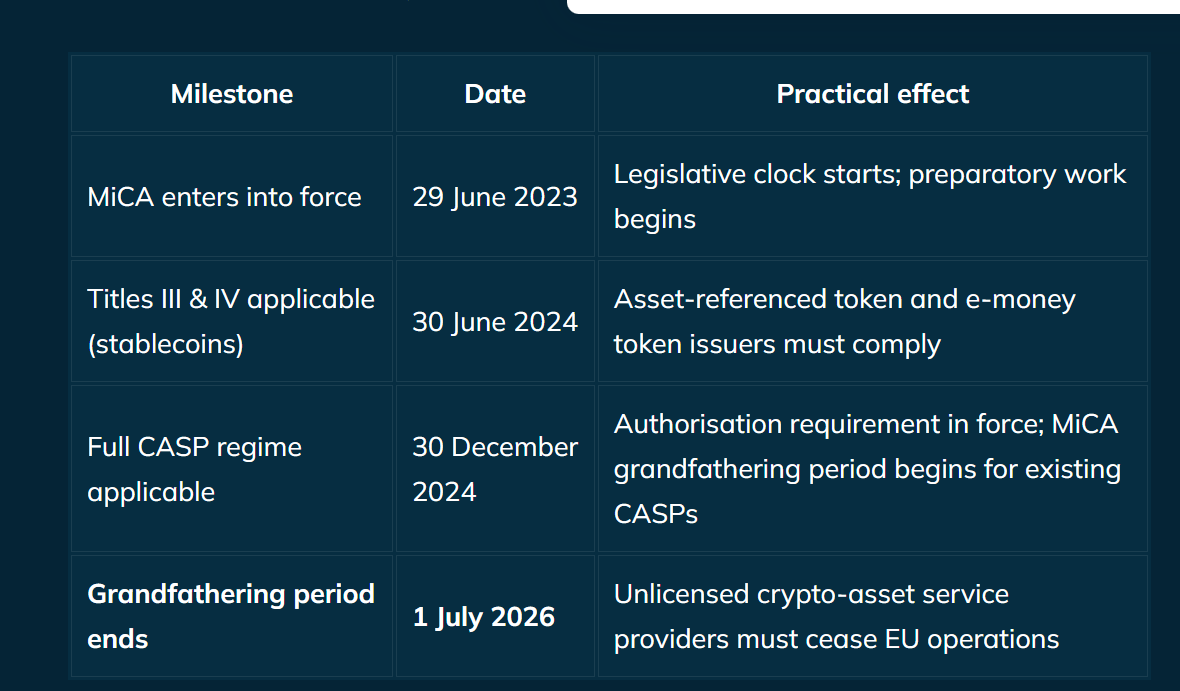
When the European Union designed MiCA, it gave the crypto industry 18 months to convert existing national registrations into a single, passportable license covering all 27 member states. Of the 1,200-plus firms that held those registrations, roughly 210 made it through.
The other 83% did not, and the question that number raises is whether those firms failed a reasonable test or whether the test was reasonable all along.
Konstantins Vasilenko, co-founder and CBDO of Paybis, a crypto exchange that secured its MiCA authorization while hundreds of competitors fell short, told CCN the answer lies in what the old registration system actually measured, and what it missed.
A Registration Was Never a License
“If only 17% of registered firms qualify under MiCA, it is hard to argue that the old registration label told the whole story,” Vasilenko said. “Many firms had permission to operate under the old system without the internal structure expected under a full financial regulatory regime.”
That gap between permission and infrastructure is what MiCA exposed. Across the EU, national VASP registration regimes varied significantly in what they required. Some jurisdictions ran demanding processes. Others asked for little beyond the right documents.
Estonia, which became one of the most popular crypto licensing hubs in Europe, issued 641 licenses by 2021, a number that had collapsed to 40 by early 2025 as regulators tightened standards ahead of MiCA’s arrival. The firms that built their European operations on lighter national registrations found themselves facing a regulator asking questions their organizations were not structured to answer.
“MiCA asks more practical questions,” Vasilenko said. “Who controls client assets? Who owns risk? What happens after a compliance breach? Can the firm prove that its procedures are followed in practice?”
Most Firms Treated It Like a Filing Exercise
For firms that did attempt the MiCA authorization process, the scale of the undertaking caught many off guard. Vasilenko said the single biggest mistake unsuccessful applicants made was treating the authorization as a project rather than an organizational transformation.
“Many firms underestimated the budget involved and the amount of senior attention this would require,” he said. “MiCA quickly exposes weak spots. Maybe the policy exists, but nobody owns it properly. Maybe the process works on paper, but the company cannot show how it is followed in practice.”
Paybis began preparing in 2023, two years before the deadline, giving the company time to work through what turned out to be a process that touched nearly every part of the business.
“The next 16 to 18 months were very hands-on,” Vasilenko said. “There was constant back-and-forth with regulators. Policies had to be rewritten, and some legal points had to be checked market by market. Internally, the challenge was making sure the teams were not working in silos.”
He added that getting through the authorization process was not the finish line.
“After the license, the work did not stop. The real test was whether the business could keep operating that way once the approval came through. MiCA cannot sit in a legal folder. It has to change how decisions are made every week.”
Does MiCA Favor the Biggest Players?
One criticism that has gained traction as the deadline passed is that MiCA’s compliance costs structurally favor large, well-funded exchanges over startups, effectively pricing smaller operators out of the European market regardless of how well-intentioned their businesses were.
Vasilenko said there is genuine truth in that criticism, even if it does not fully explain the 17% conversion rate.
“MiCA is expensive, and smaller firms feel that first. Legal work, compliance hiring, reporting and capital requirements all add up. For a small startup, that can change the economics of the business very quickly.”
He drew a direct parallel to how other financial sectors evolved.
“We have seen this pattern before in payments, electronic money and online brokerage. Once supervision becomes stricter, some firms invest, some combine with others, and some leave the market.” For European crypto users, the practical consequence is a narrower choice of platforms, particularly in smaller markets where only one or two exchanges may now hold authorization.
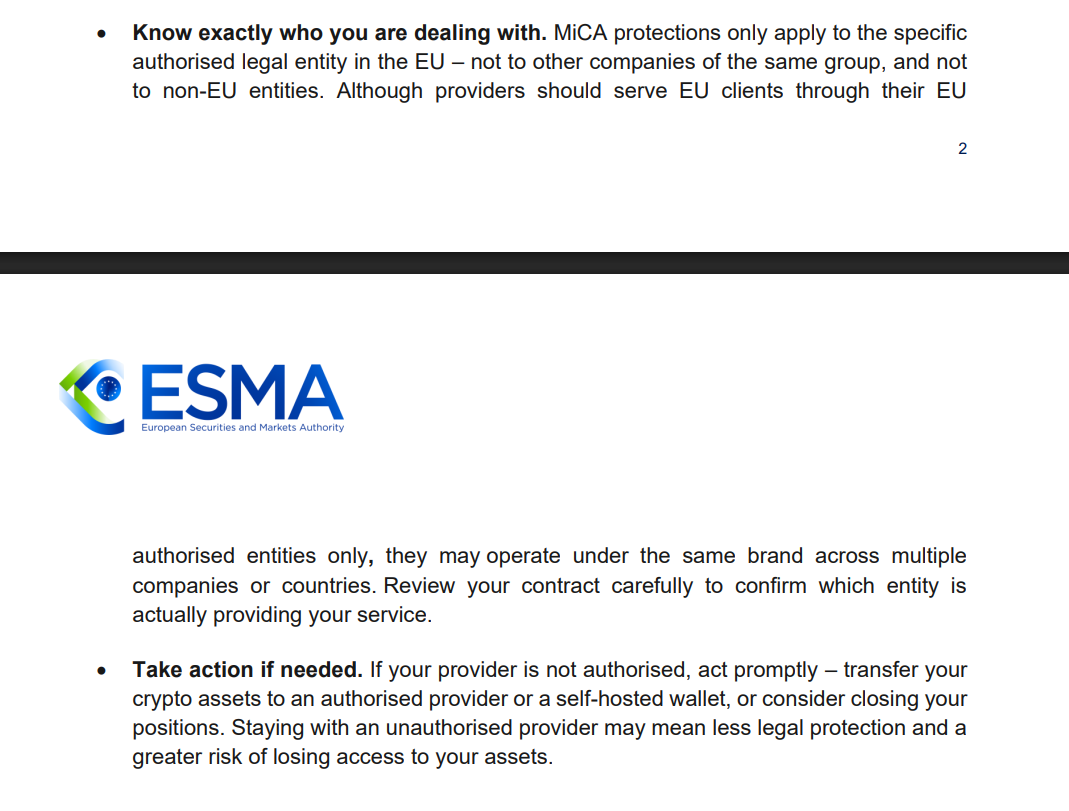
MiCA protections only apply to authorized EU entities. | Source: ESMA
But Vasilenko stopped short of describing the consolidation as a design flaw.
“I see that as a consequence of moving crypto closer to financial regulation, rather than a rule written only for the biggest exchanges. It may also make the market easier for larger investors to take seriously.”
Who Comes Back and Who Is Gone for Good
For the firms that missed July 1, the question is whether the exit from European markets is temporary or permanent. Vasilenko said the answer depends on why they missed the deadline in the first place.
“I would separate those firms into two groups,” he said. “Some may come back later if they are prepared to go through the full authorization process. Missing the deadline does not automatically mean leaving Europe forever. For others, the decision will be more permanent. If a business only worked under a lighter national registration, MiCA changes the economics. The cost of compliance and ongoing supervision may make Europe difficult to serve profitably.”
What he rejected was the idea that the departure of most previously registered firms represents a failure of European crypto policy.
“I would not describe this as crypto leaving Europe,” Vasilenko said. “Some firms will disappear from the EU market, at least for a time. The firms that stay will look much more like regulated financial businesses than early crypto startups.”
For users who spent years relying on VASP-registered platforms under the assumption that a European registration carried meaningful regulatory weight, the 17% figure carries a more uncomfortable implication.
It suggests that the oversight framework most of the industry operated under for the better part of a decade was never as robust as the registration label implied. MiCA did not raise the bar so much as it revealed how low the bar had always been.
Disclaimer:
The information provided in this article is for informational purposes only. It is not intended to be, nor should it be construed as, financial advice. We do not make any warranties regarding the completeness, reliability, or accuracy of this information. All investments involve risk, and past performance does not guarantee future results. We recommend consulting a financial advisor before making any investment decisions.
Dr. Guneet Kaur is a senior editor at CCN.com and a Science Fellow at Exponential Science. She is a fintech and blockchain expert with extensive experience in digital finance education, blockchain ecosystems, and cryptocurrency markets. She has worked with global media such as Cointelegraph, as well as education and blockchain platforms, to design and lead strategic content and learning initiatives. As an educator and assessor for top-tier executive programs, she bridges real-world fintech trends with academic insight.
Dr. Kaur is also a published researcher and peer reviewer across fintech and data science journals, including Financial Innovation Journal and International Journal of Big Data Intelligence and Applications. Her work spans data-driven analysis, Web3 innovation, and technical content development. With a strong foundation in both industry and academia, she translates complex financial technologies into practical applications, empowering learners, professionals, and institutions across the rapidly evolving digital finance landscape.