Insider trading concerns are growing at a rapid pace. | Source: CCN
Share
Key Takeaways
A $1.5 billion futures trade before Trump’s Iran announcement has triggered insider trading concerns.
Senator Chris Murphy called the move “mindblowing corruption.”
Prediction market platforms, including Kalshi and Polymarket, are tightening rules.
A senior U.S. senator has alleged potential insider trading after a roughly $1.5 billion futures position was placed about five minutes before President Donald Trump’s surprise announcement that the U.S. would halt planned strikes on Iran.
The move, which the senator described as “mindblowing corruption,” comes as an analytics platform revealed a single bettor has made $1 million in war betting since 2024 — even as prediction market operators have moved to tighten rules.
Try Our Recommended Crypto Exchanges
Sponsored
Disclosure
We sometimes use affiliate links in our content, when clicking on those we might receive a commission at no extra cost to you. By using this website you agree to our terms and conditions and privacy policy.
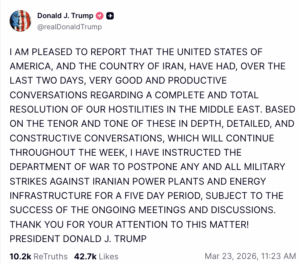
U.S. equity and oil futures saw a sudden burst of activity early Monday, just minutes before Trump disclosed that Washington had engaged in talks with Iran and would pause planned military action.
Around 6:50 a.m. in New York, trading volumes in S&P 500 e-mini futures rose sharply during typically thin premarket conditions. Activity in West Texas Intermediate crude futures also jumped at roughly the same time.
Donald Trump paused planned military strikes. | Source: Truth Social
Markets reacted immediately, with stock futures climbing more than 2.5% ahead of the opening bell, while crude futures fell by roughly 6%.
Data flagged by market-tracking account Unusual Whales indicated that traders bought approximately $1.5 billion in S&P 500 futures five minutes before the announcement, while selling about $192 million in oil futures.
Political Backlash
The activity prompted a sharp response from Connecticut Senator Chris Murphy, who slammed the move as “mindblowing corruption.”
In a post on X, Murphy called for answers on who may have been involved in the “$1.5 billion bet.”
He wrote: “Who was it? Trump? A family member? A White House staffer?”
$1.5 BILLION. Let me say it again – a $1.5 BILLION BET.
Bigger than any futures purchases made at the time.
5 minutes before Trump's post.
Who was it? Trump? A family member? A White House staffer?
Others pushed back on aspects of Murphy’s characterization.
Investor Adam Cochran said the figure referred to notional exposure rather than cash deployed, and emphasized that the trades took place in regulated futures markets overseen by U.S. authorities.
Cochran argued that, if wrongdoing occurred, it would fall squarely within the jurisdiction of regulators such as the SEC and CFTC, and urged congressional scrutiny of enforcement agencies.
“This fraud is fleecing American pension funds, and is something the SEC and CFTC have *clear* jurisdiction over,” he wrote.
5 minutes before Trump’s announcement:
* $1.5B notional worth of S&P500 (ES) futures are bought in a single clip.
* $192M notional of oil futures (CL) sold.
More than 4x-6x any other trade size during the market close.
— Adam Cochran (adamscochran.eth) (@adamscochran) March 23, 2026
Adding: “You should be dragging the SEC and CFTC commissioners before Congress to question them on this.”
Another X user fired back at Murphy: “You realize the irony in your comment? I’m guessing not.
“YOU actually have the power to do something about this and get to the root of the problem. Instead, you post about it on X/Twitter.”
Prediction Markets Tighten Rules
The episode comes amid predictions that markets will strengthen safeguards against insider trading and manipulation amid recent controversies.
Kalshi said it is rolling out new systems designed to block individuals with potential inside knowledge—such as political candidates or participants in sporting events—from trading on related contracts.
Rival platform Polymarket has also updated its policies, explicitly prohibiting users from trading on outcomes that may involve confidential information.
The rules apply broadly to participants, including policymakers, corporate insiders, and athletes, according to statements reported by ABC News.
Single Trader Made $1M On War Bets
Prediction markets have faced mounting criticism in recent months after reports that some users placed successful wagers ahead of wartime events, including conflicts involving Iran and Venezuela.
According to an exclusive CNN report, a single trader generated nearly $1 million in profits since 2024 by placing a series of highly accurate wagers tied to U.S. and Israeli military actions involving Iran.
These included bets ahead of Israeli strikes in October 2024, U.S. airstrikes on Iranian nuclear facilities in June 2025, and a joint U.S.-Israeli offensive earlier this year.
Blockchain analytics firm Bubblemaps’ Chief Executive Nick Vaiman told CNN that the timing, scale, and consistency of the trades pointed to what he described as “strong signaling” of potential insider activity.
However, the identities behind the accounts remain unknown.
Growing Insider Trading Scrutiny
Last month, it was reported by the Guardian that at least seven “suspected insiders” made $1.5 million betting on prediction polls related to a U.S. strike on Iran.
“Five of these accounts are new accounts that have made no other bets; one more appears to have also bet only on strikes last weekend,” the publication reported.
It added that an account which went by “Magamyman” had previously made several bets on U.S. and Israeli strikes against Iran.
The allegations have prompted calls for regulatory scrutiny.
Entrepreneur and X influencer Martin Varsavsky wrote that if the claims are accurate, they represent “a huge integrity issue.”
“Prediction markets only work when the public trusts they are not being gamed during a crisis,” Varsavsky wrote.
This has already led U.S. lawmakers to begin regulating betting platforms.
A bipartisan group of senators introduced legislation that would restrict certain types of contracts, particularly those tied to sports, in a move that could significantly impact the business models of firms such as Kalshi and Polymarket.
Kurt Robson is a London-based reporter at CCN, specialising in the fast-moving worlds of crypto and emerging technology. He began his career covering local news in Cornwall after graduating from Falmouth University with First Class Honours in Journalism. There, he cut his teeth on everything from council meetings to missing swans.
He quickly rose through the ranks to become a frontline journalist at several of the UK’s leading national newspapers. Over the years, he has interviewed musicians and celebrities, reported from courtrooms and crime scenes, and secured multiple front-page exclusives.
Following the upheaval of the COVID-19 pandemic, Kurt shifted his focus to technology journalism—just ahead of the AI boom. With a natural curiosity and a trained eye for emerging trends, he has found a new rhythm in reporting on innovation.
At CCN, Kurt's work focuses on the cutting edge of crypto, blockchain, AI, and the evolving digital world. Drawing on his background in people-first reporting and his deep interest in disruptive tech, Kurt delivers stories that are insightful, entertaining, and human-centric.













 New DEATH BETS Act Would Stop Betting on Wars and Death, Say US Lawmakers