Robinhood Chain may generate modest Ethereum fees today, but its tokenized stocks could onboard millions of new users into Ethereum. | Credit: CCN.com
Share
Key Takeaways
Robinhood launched Earn, offering users up to 7% APY on USDG through DeFi lending.
Yield comes from Morpho lending markets, where institutional borrowers pay interest for liquidity.
Lloyd’s-backed insurance covers technical risks, but yield and market risks remain variable.
Robinhood began rolling out its Earn product to eligible US users on July 1, offering an estimated 7% APY on USDG, its dollar-backed stablecoin, through what the company calls the first decentralized lending product available directly inside the main Robinhood app.
The launch puts onchain yield in front of 27.7 million funded customers holding $377 billion in platform assets.
EXCLUSIVE: Robinhood is going to pay 7% on dollars to 27.7 million customers.
In this Interview Johann Kerbrat, their SVP of Crypto explains how it all works.
Robinhood Earn lives inside the main investing app. You can buy the USDG stablecoin in a few taps, and it gets deployed… pic.twitter.com/yuS8PY6qQu
For context, that rate is roughly triple what leading high-yield savings accounts pay. The obvious question is who funds the difference. The answer sits in the product’s plumbing.
The mechanics are visible onchain. Funds supplied through Robinhood Earn are deposited into a Morpho vault, then allocated across Morpho lending markets. Borrowers post collateral from protocols such as Spark, Ethena, and Maple to borrow USDG, and the yield paid to users comes from the interest charged on those loans.
Those borrowers are largely market makers and liquidity providers who need USDG to run spot and perpetuals trading. In plain terms, a retail deposit is funding a professional trader’s leverage, and the depositor collects the interest.
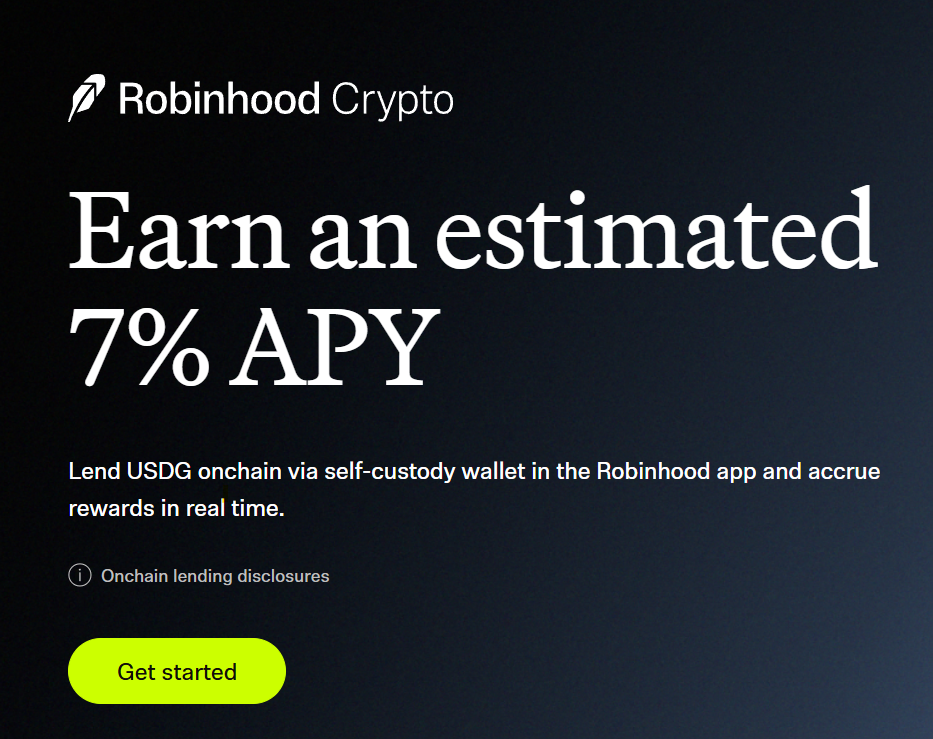
Robinhood Earn allows people to lend their dollar-backed USDG through a self-custody wallet at an estimated 7% APY. | Source: Robinhood
Johann Kerbrat, Robinhood’s SVP and General Manager of Crypto and International, told the Tokenized Podcast that this borrower demand, not any Robinhood subsidy, generates the target rate.
The infrastructure carrying it is substantial. Morpho holds roughly $6.6 billion (as of June 2026) in total value locked across chains, and the first vault is curated by Steakhouse Financial and incorporates Maple Finance’s syrupUSDG, an institutional credit product built on the Paxos-issued Global Dollar. Maple has originated more than $22 billion in institutional loans since 2022.
Insurance Is the Retail-Grade Differentiator
DeFi lending has always paid these rates.
What it lacked was a backstop, and 2026 has already produced over $1 billion in exploit losses. Robinhood’s answer is insurance procured through Lloyd’s of London and RELM covering losses from cyber or smart contract exploits. Kerbrat describes it as one of the largest programs ever built for a crypto product.
The fine print matters.
Lloyd’s coverage does not function as principal insurance. It addresses specific technical failure scenarios, not general market or credit losses. Robinhood itself is not a party to the Morpho relationship, does not manage the vault, and takes no responsibility for downstream protocols the vault deploys into. And the 7% figure is variable: if lending demand weakens, the yield can drop well below that level.
Why the Timing Matters
The launch lands at a strained moment for Robinhood’s crypto arm.
Q1 crypto revenue fell 47% year over year to $134 million, and native-app crypto trading volume dropped 48% to $24 billion, weeks after a 10% workforce cut. Earn converts idle customer cash into recurring revenue rather than depending on trading volume.
The competitive implication is larger. DeFi protocols spent a decade fighting for retail users.
Robinhood just made a Morpho vault look like a savings account, and the market noticed: HOOD shares jumped 8.4% as investors responded to Robinhood’s broader push into onchain finance, including the Robinhood Chain launch.
Whether the 7% survives as a durable rate or fades as an acquisition incentive should be visible in vault data within the quarter.
Disclaimer:
The information provided in this article is for informational purposes only. It is not intended to be, nor should it be construed as, financial advice. We do not make any warranties regarding the completeness, reliability, or accuracy of this information. All investments involve risk, and past performance does not guarantee future results. We recommend consulting a financial advisor before making any investment decisions.
Dr. Guneet Kaur is a senior editor at CCN.com and a Science Fellow at Exponential Science. She is a fintech and blockchain expert with extensive experience in digital finance education, blockchain ecosystems, and cryptocurrency markets. She has worked with global media such as Cointelegraph, as well as education and blockchain platforms, to design and lead strategic content and learning initiatives. As an educator and assessor for top-tier executive programs, she bridges real-world fintech trends with academic insight.
Dr. Kaur is also a published researcher and peer reviewer across fintech and data science journals, including Financial Innovation Journal and International Journal of Big Data Intelligence and Applications. Her work spans data-driven analysis, Web3 innovation, and technical content development. With a strong foundation in both industry and academia, she translates complex financial technologies into practical applications, empowering learners, professionals, and institutions across the rapidly evolving digital finance landscape.