“No, we want the infrastructure that we’re building to be ubiquitous.” | Image source: CCN
Share
Crypto trading has moved beyond a single platform model. Over the past few years, liquidity has spread across multiple blockchains, while new tokens launch daily across decentralized exchanges (DEXs).
This shift has created a fragmented environment where access matters as much as pricing.
At the same time, DEXs still dominate most of the volume, offering speed, tight spreads, and a simple user experience that many decentralized platforms still struggle to match.
This contrast defines the current market stage. Decentralized systems provide openness and direct access to assets, but they introduce complexity.
Users must often manage wallets, understand gas fees, and move funds across chains before completing a trade. These steps create friction that slows adoption, even as demand for on-chain trading grows.
Trading terminals aim to solve this problem. They aggregate liquidity, simplify execution, and reduce the steps required to trade across chains.
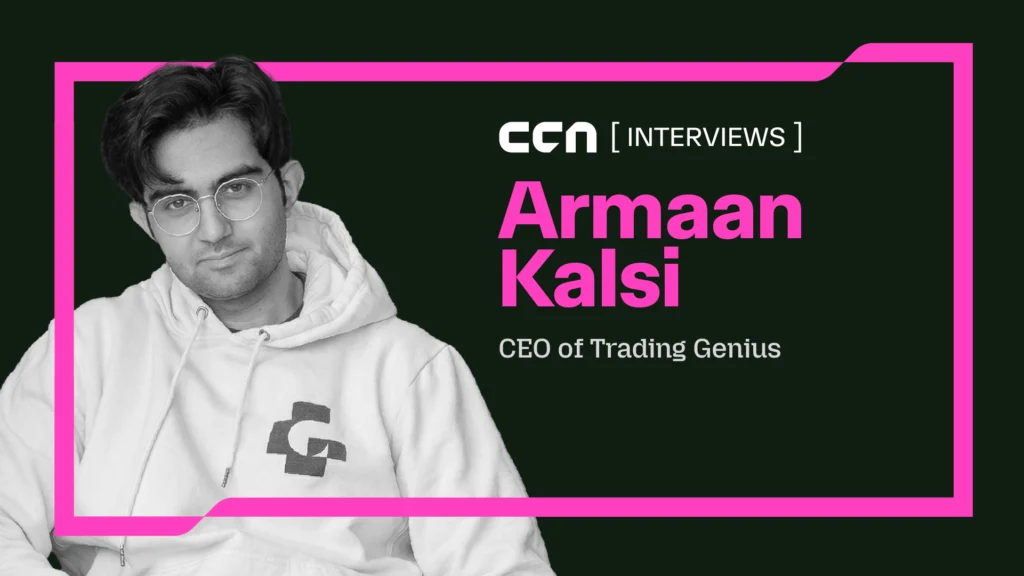
In this interview, Armaan Kalsi, CEO of Genius, explains how his platform approaches these challenges. He discusses the limits of current infrastructure, why centralized exchanges still hold advantages, and how terminals could become the default interface for crypto trading.
Watch the full interview here:
What Genius Is and Why Cross-Chain Access Matters
Kalsi describes Genius as a platform designed to simplify access across fragmented markets.
“Genius is a cross-chain trading terminal, which basically means it is a way to access more than 500 dexes across over 10 chains.”
The platform connects users to multiple networks through a single interface. Instead of navigating different wallets and bridges, users can execute trades across chains without leaving the terminal.
Kalsi explains the core idea behind the design.
All assets across supported blockchains can be accessed through a single interface, with the platform handling the complexity of network switching in the background.
This approach aims to replicate a familiar experience while maintaining decentralization.
“In the same way that on centralized exchanges, the user is thinking, okay, I have money, I want to buy an asset. We want to bring that UX effectively to crypto.”
Why Armaan Kalsi Rejects Traditional Crypto UX
Kalsi argues that many of the current limitations in crypto come from outdated user experience patterns.
“I think number one, you have to really say no aggressively to the UX that has dominated user behavior in crypto for the last eight or nine years, right?”
This includes repeated approvals and multiple signatures for a single transaction, along with the need to understand gas fees.
The platform removes or reduces these steps to make trading more accessible.
At the same time, Kalsi emphasizes that centralized exchanges remain dominant for clear reasons.
He identifies three main factors: user experience, market structure, and privacy. Each shapes how users choose where and how to trade.
From Blockchain Data To Trading Infrastructure
Kalsi’s focus on trading came from analyzing on-chain activity during his previous venture. Early expectations suggested that a wide range of use cases would move on-chain, from everyday transactions to services. The data showed something different.
“What the data was showing was that people were just trading, trading, trading.”
This pattern stood out. Trading remained the dominant activity, far beyond other use cases that many expected to grow.
That insight led to a clear shift in direction. Instead of building tools to interpret blockchain data, Kalsi chose to focus on improving the core experience behind that activity. The problem was not only about access, but also about how users interacted with markets.
Terminal Wars Explained: Why Interfaces Are Gaining Control
Kalsi explains the idea of “terminal wars” as a shift in how users access markets.
“Terminal wars just refers to the fact that there was a lot of volume bumped through decentralized terminals over the last two years.”
This trend became clear during periods of high speculation, particularly with meme coins. Traders focused on speed and early access, often choosing direct on-chain tools over traditional platforms.
He argues that this behavior reflects a deeper shift. Access to new assets matters more than the interface itself, especially when timing defines profitability.
“And what it means more than anything is that people value access to opportunity more than they value, let’s say the centralized exchange UX per se.”
Looking ahead, Kalsi links this trend to a broader structural change. If more assets move on-chain, including equities and derivatives, the way users access markets will need to evolve.
He points to a growing belief in the industry that tokenized assets will increasingly live on-chain. In that scenario, simple swap tools will not be enough to handle more complex financial products.
As a result, platforms that provide efficient, unified access across chains could take a central role.
What Comes After Meme Coins in Crypto Markets
“Speculation reinvents itself every three years in crypto.”
Kalsi outlines previous phases.
The market has gone through several phases, starting with early token sales, followed by non-fungible tokens (NFTs), and more recently, memecoins.
He suggests a possible next step.
“I think a good guess is prediction markets.”
These markets combine multiple forms of speculation.
“As far as I can see right now, prediction markets are basically sports betting and crypto pricing option platforms.”
Multi-Chain Inefficiencies and User Fatigue
Despite improvements, cross-chain trading still introduces friction.
“I think people sometimes get confused because we’ve made it very easy to go from chain A to chain B.”
Delays can still occur and there is another issue.
“I’s fatigue. It’s management fatigue.”
Users must manage multiple assets across networks.
“You have 500,000 different assets on 50 different chains. At some point, you need to figure out a way to manage all of them.”
The goal is to reduce this burden.
Privacy in Crypto Trading and Its Trade-Offs
Privacy remains difficult to achieve in decentralized environments, where transactions are visible by default. Instead of trying to hide activity at execution, Genius focuses on structuring how funds move before trades take place, reducing direct links between wallets.
This approach comes with limitations.
“The trade-off is that it takes time in order to give you that privacy.”
Preparing funds in this way adds steps and reduces speed, which creates a gap compared to centralized platforms.
Kalsi acknowledges that matching that level of discretion during execution is still not possible.
“And we’re far ways away from like proper centralized exchange parity at the point of execution.”
What Success Looks Like for Genius as Infrastructure
“I don’t think there’s a core metric,” he says.
Instead, he emphasizes adoption.
“No, we want the infrastructure that we’re building to be ubiquitous.”
The long-term goal is clear.
“We just want to be the chain default.”
Crypto trading continues to evolve as markets expand across chains and asset types. This growth increases complexity while raising expectations for speed and simplicity.
Kalsi’s approach focuses on bridging this gap. Genius aims to combine ease of use, efficient execution, and practical privacy tools into a single interface.
The competition between centralized exchanges and decentralized terminals remains unresolved. However, the direction is clear.
As more assets move on-chain, the platforms that control access may define the next phase of crypto infrastructure.
Disclaimer:
The information provided in this article is for informational purposes only. It is not intended to be, nor should it be construed as, financial advice. We do not make any warranties regarding the completeness, reliability, or accuracy of this information. All investments involve risk, and past performance does not guarantee future results. We recommend consulting a financial advisor before making any investment decisions.
Dr. Lorena Nessi is an award-winning journalist and media technology expert with 15 years of experience in digital culture and communication. Based in Oxfordshire, UK, she combines academic insight with hands-on media practice.
She holds a PhD in Communication, Sociology, and Digital Cultures, and an MA in Globalization, Identity, and Technology.
Lorena has taught at Fairleigh Dickinson University, Nottingham Trent University, and the University of Oxford. She is a former producer for the BBC in London, with additional experience creating television content in Mexico and Japan.
Her research focuses on digital cultures, social media, technology, capitalism, and the societal impact of blockchain innovation.
She has written extensively on digital media and emerging technologies, with her work featured in both academic and media platforms. Her Web3 expertise explores how blockchain technologies shape culture, economics, and decentralized systems.
Outside of work, Lorena enjoys reading science fiction, playing strategic board games, traveling, and chasing adventures that get her heart racing. A perfect day ends with a relaxing spa and a good family meal.


 Easy
Easy