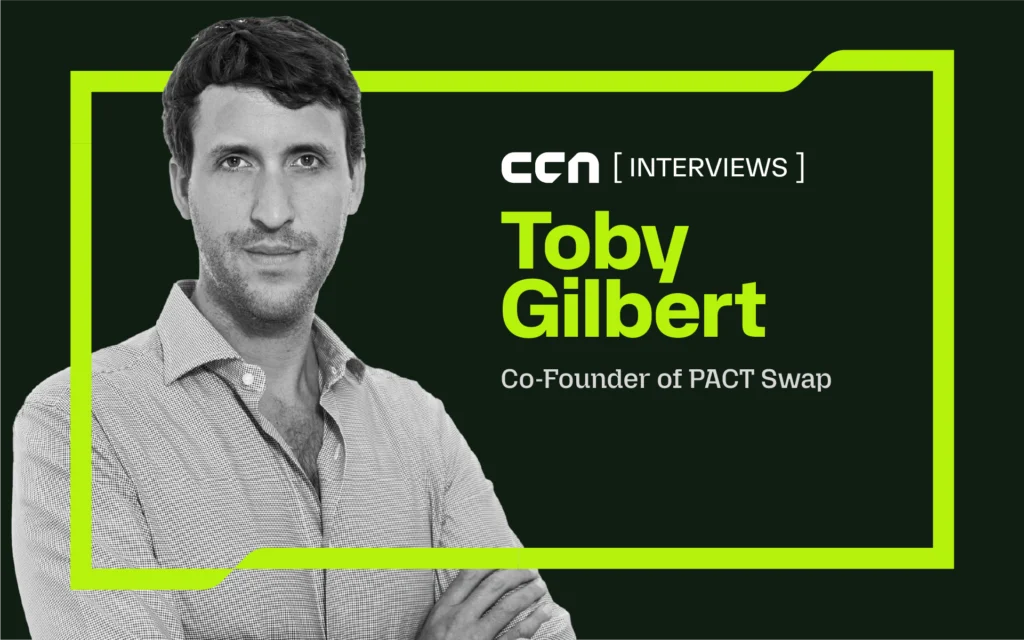
The rise of cross-chain decentralized finance has exposed structural weaknesses in how assets move between blockchains. | Image source: CCN
Share
Global demand for interoperability in decentralized finance (DeFi) continues to grow as users move assets across multiple blockchains.
Different networks operate independently, each with its own rules, architecture, and consensus mechanisms. This fragmentation creates friction, especially when users attempt to transfer assets between chains.
Cross-chain bridges emerged as a solution, but they have also become one of the most vulnerable points in the crypto ecosystem.
Repeated exploits have exposed weaknesses in how these systems operate, raising concerns about security, liquidity, and long-term sustainability.
PactSwap aims to address these challenges with a different architecture.
In this interview, Toby Gilbert, co-founder of PactSwap, explains why traditional bridge models fail and how deterministic smart contracts can reduce risk and outlines a different approach based on deterministic smart contracts and trade-level collateral.
Watch the full video here:
Why Cross-Chain Bridges Remain Vulnerable
Blockchains do not naturally communicate with each other.
“You have to think of them as like different operating systems.”
Gilbert compares them to separate operating systems. Assets on one chain cannot move directly to another without an intermediary.
Traditional bridges solve this problem by introducing an additional layer that verifies and transfers assets between networks.
This approach creates a new point of failure.
“The security properties of blockchains are one of their strongest features… but when you glue a blockchain in between those blockchains that have far weaker security, that becomes the Achilles heel.”
“That becomes an attack vector for hackers to be able to try and grab the assets whilst they’re moving between the chains.”
Most major exploits in DeFi have targeted these intermediary layers rather than the underlying blockchains themselves.
If one side of the transaction fails to deliver the agreed asset, the system automatically penalizes the responsible party.
“If they don’t deliver the original asset, then they lose their collateral,” Gilbert says.
This structure creates direct incentives to complete trades while protecting the counterparty.
Collateral requirements often exceed the value of the trade, ensuring that failure carries a financial cost.
Handling Market Shocks and Failed Trades
Volatility and technical failures can disrupt multiple transactions at once.
PactSwap’s model handles this by enforcing collateral rules on each trade independently.
If one side of a trade completes and the other does not, the system compensates the affected user.
“The collateral is automatically slashed and the aggrieved party is compensated.”
This approach avoids systemic risk accumulation.
Each transaction operates as a contained unit, reducing the chance of cascading failures.
Simplifying User Experience Without Reducing Complexity
From a user perspective, the process appears simple.
Users interact with a standard interface without needing to understand the underlying mechanics.
Behind the scenes, the system replaces complex infrastructure with automated smart contract logic.
“It is simplified for the user… but behind the curtain is where it’s being simplified,” he states.
This distinction reflects a broader trend in crypto.
Developers focus on reducing visible friction while managing protocol-level complexity.
Rethinking Consensus in Cross-Chain Systems
PactSwap does not introduce a new consensus mechanism.
Instead, it relies on the existing consensus of each blockchain.
“We are still relying upon the consensus of the underlying chain… but we are not introducing an extra layer of consensus.”
This removes redundancy and avoids inefficiencies.
The system reads verified data from each chain and reacts without adding another verification layer.
Market Lessons After the ICO Era
The interview also highlights broader issues in the Web3 ecosystem.
Many projects prioritized speed over long-term stability during earlier market cycles.
Gilbert argues that this approach contributed to weak infrastructure and unmet promises.
Investors now demand clearer revenue models and measurable outcomes.
The market has started to shift. Investors now question how projects generate revenue and whether they can sustain themselves without relying on token sales.
This shift affects how new projects position themselves and how capital flows into the sector.
Revenue, Tokens, and Sustainable Growth
PactSwap plans to introduce a token model, but not as the primary source of funding.
The system generates revenue through trading activity.
“Part of the collateral for every trade is deducted and then that goes into a fee pool.”
Part of the value flows back to token holders through a revenue-sharing mechanism.
This model aims to reduce reliance on token sales.
The goal is to create a system where usage drives value rather than speculation alone.
Liquidity Fragmentation and the Role of Aggregators
Liquidity remains fragmented across multiple decentralized exchanges.
Users often rely on aggregators to find the best price across platforms.
These tools route trades to the most efficient liquidity source.
PactSwap positions itself as a low-cost provider within this system.
“We are up to 95% cheaper than every single one of them.”
Lower fees attract liquidity providers, who can maintain competitive pricing while adding margins.
Aggregators then direct more trading volume toward the platform.
“As long as you’ve got strong liquidity providers… and you work with aggregators, it funnels the traffic down towards us.”
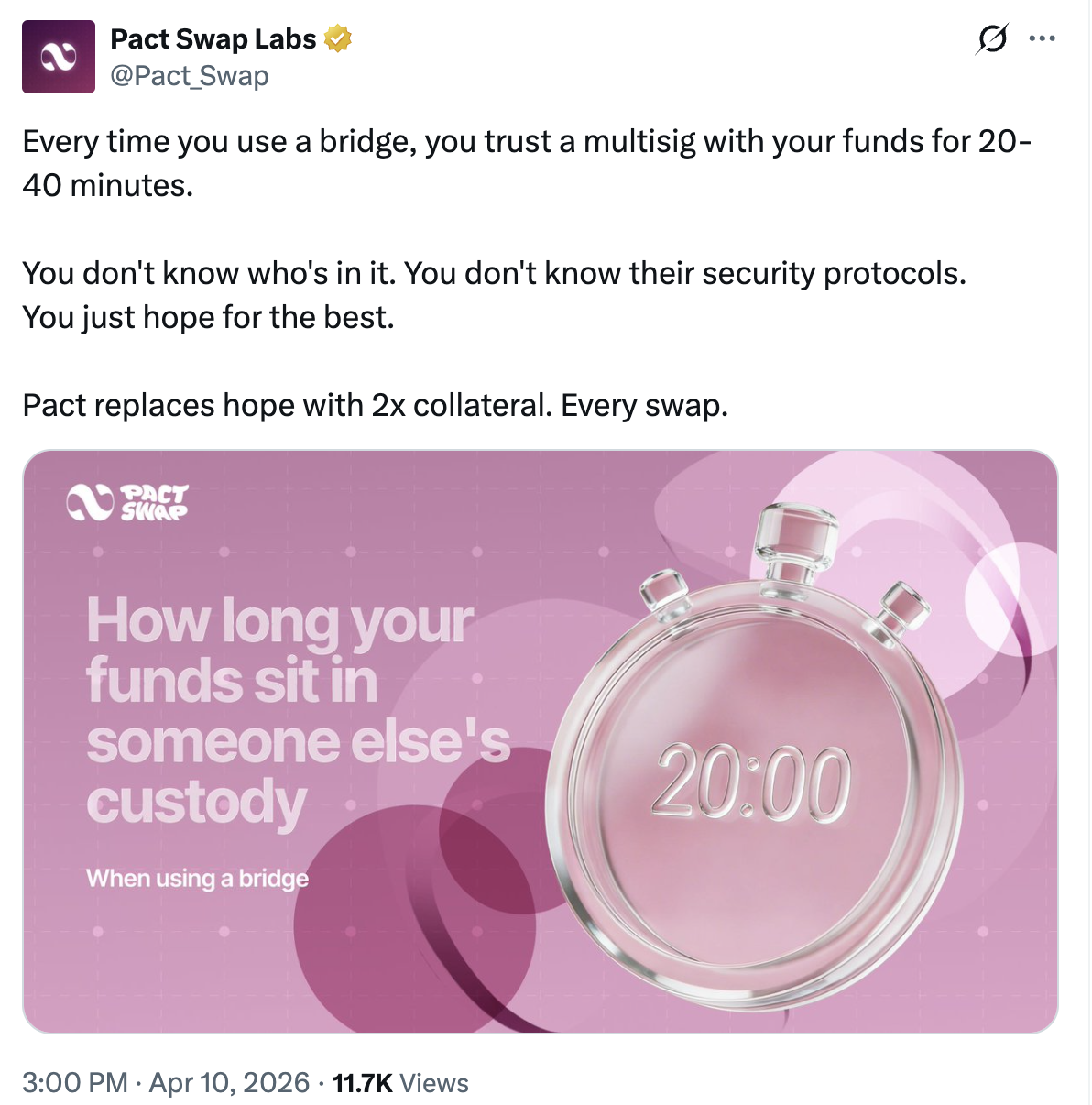
From trust to collateral | Source: X @Pact_Swap
Regulatory Uncertainty and Future Growth
Decentralized exchanges operate in a shifting regulatory environment.
While current frameworks remain unclear, increased adoption may attract closer scrutiny.
Gilbert notes that success could introduce new risks.
“If you get to a point where you’re very successful… there could be regulatory risk.”
Short-term goals focus on measurable growth.
These include building a strong user base and reaching consistent daily trading volumes.
At the same time, projects must remain adaptable to changing regulations across jurisdictions.
A Different Direction for Cross-Chain DeFi
Cross-chain infrastructure remains one of the most complex areas in crypto.
Traditional bridge models solved interoperability but introduced new vulnerabilities.
PactSwap’s approach removes the intermediary layer and shifts risk management to individual transactions.
This design aims to improve security, reduce costs, and align incentives between participants.
“This is an entirely different approach to what you’ve seen before.”
The broader challenge remains unresolved.
DeFi continues to evolve as developers test new architectures, balance efficiency with security, and respond to changing market conditions.
Some solutions may reduce risk, others may redistribute it.
The next phase of cross-chain innovation will likely depend on how effectively projects address both.
Disclaimer:
The information provided in this article is for informational purposes only. It is not intended to be, nor should it be construed as, financial advice. We do not make any warranties regarding the completeness, reliability, or accuracy of this information. All investments involve risk, and past performance does not guarantee future results. We recommend consulting a financial advisor before making any investment decisions.
Dr. Lorena Nessi is an award-winning journalist and media technology expert with 15 years of experience in digital culture and communication. Based in Oxfordshire, UK, she combines academic insight with hands-on media practice.
She holds a PhD in Communication, Sociology, and Digital Cultures, and an MA in Globalization, Identity, and Technology.
Lorena has taught at Fairleigh Dickinson University, Nottingham Trent University, and the University of Oxford. She is a former producer for the BBC in London, with additional experience creating television content in Mexico and Japan.
Her research focuses on digital cultures, social media, technology, capitalism, and the societal impact of blockchain innovation.
She has written extensively on digital media and emerging technologies, with her work featured in both academic and media platforms. Her Web3 expertise explores how blockchain technologies shape culture, economics, and decentralized systems.
Outside of work, Lorena enjoys reading science fiction, playing strategic board games, traveling, and chasing adventures that get her heart racing. A perfect day ends with a relaxing spa and a good family meal.


 Easy
Easy