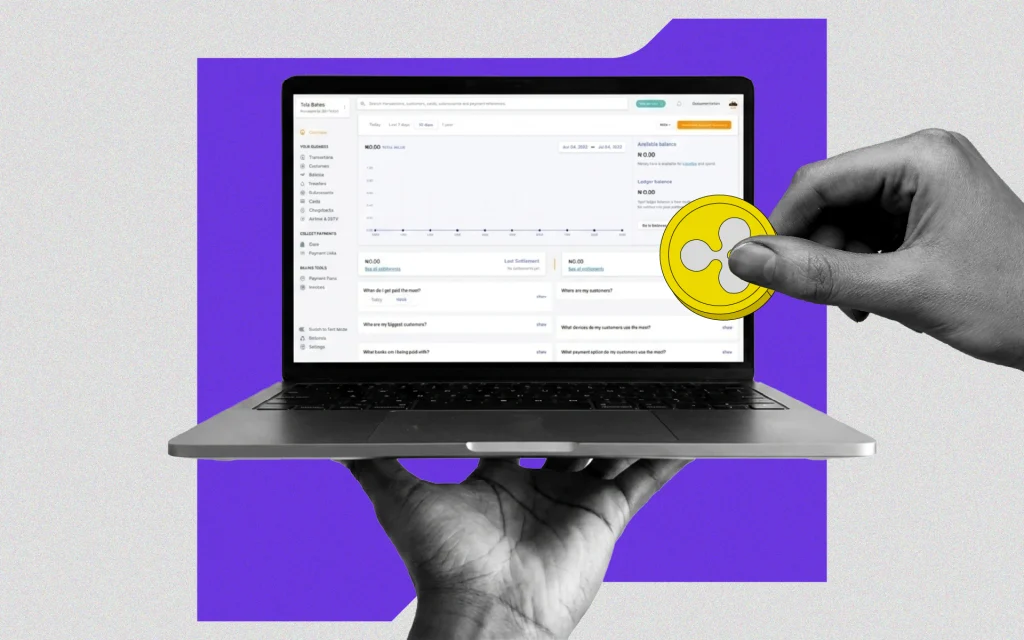
Ripple’s investment in Flutterwave brings RLUSD, Ripple Payments, and XRPL to Africa’s leading fintech, boosting XRP’s payments narrative. | Credit: CCN.com
Share
Key Takeaways
Ripple invests in Flutterwave’s $3.2 billion-valued Series E round, marking one of its most significant strategic bets on African payments infrastructure.
Flutterwave will integrate Ripple’s RLUSD stablecoin, Ripple Payments network, and the XRP Ledger (XRPL) into its payment ecosystem.
Africa’s cross-border payments market is the primary target, with the companies aiming to reduce settlement delays and lower foreign exchange costs.
Ripple’s strategic investment in African fintech giant Flutterwave is strengthening the institutional narrative around XRP, shifting attention from speculative trading toward real-world payment infrastructure.
Announced as part of Flutterwave’s Series E funding round, which values the company at $3.2 billion, the partnership will integrate Ripple’s USD-backed stablecoin RLUSD, Ripple Payments, and the XRP Ledger (XRPL) into Flutterwave’s cross-border payments network.
The deal comes at a time when XRP has been attracting renewed investor interest. The token recently climbed above the closely watched $1.20 level, supported by growing ETF inflows and whale accumulation.
While XRP’s price rally has cooled in recent sessions, the Flutterwave agreement provides a fresh example of Ripple’s expansion of its enterprise payments footprint beyond crypto markets.
Try Our Recommended Crypto Exchanges
Sponsored
Disclosure
We sometimes use affiliate links in our content, when clicking on those we might receive a commission at no extra cost to you. By using this website you agree to our terms and conditions and privacy policy.
Ripple and Flutterwave Target African Cross-Border Payments
The partnership is centered on three key initiatives. Flutterwave will integrate RLUSD as a settlement asset across high-volume payment channels and its Send App remittance corridors, utilize the XRP Ledger to accelerate transaction clearing, and connect its domestic payments infrastructure with Ripple Payments through a unified API.
The move aims to address longstanding inefficiencies in African cross-border payments, including slow settlement times, high foreign exchange costs, and fragmented payment networks.
By combining local payment methods such as bank transfers, mobile wallets, and cards with blockchain-based settlement technology, Ripple and Flutterwave aim to enable real-time payments with greater liquidity and pricing transparency.
Big news! 🌍🚀@Ripple has made a strategic investment in Flutterwave as part of our Series E fundraising round.
We’ve spent years building our stablecoin infrastructure and today it’s live commercially with select merchants.
Flutterwave has emerged as one of Africa’s largest fintech companies, having processed more than $50 billion in payments across over one billion transactions.
The company has also raised more than $500 million to date and has increasingly focused on integrating digital asset infrastructure into its payments ecosystem.
“Flutterwave has built one of the most advanced payment networks in Africa, and as its infrastructure evolves, stablecoins are becoming central to that story,” said Reece Merrick, Ripple’s Managing Director for the Middle East and Africa.
Flutterwave founder and CEO Olugbenga “GB” Agboola described the investment as a catalyst for expanding stablecoin-enabled payments and strengthening Africa’s role in the global digital economy.
XRP Gains Another Institutional Use Case
While RLUSD is expected to play a central role in settlement, the agreement also highlights the XRP Ledger’s growing importance as a transaction infrastructure layer for enterprise payments.
For years, Ripple has promoted XRPL as a network capable of supporting fast, low-cost transfers for financial institutions.
The Flutterwave integration provides another example of the technology deployment in a large-scale commercial environment rather than solely within crypto-native ecosystems.
Market has increasingly focused on Ripple’s efforts to expand institutional adoption through payments, tokenization, and stablecoins.
According to Santiment data, wallets holding at least one million XRP now control 74.1% of the token’s supply after adding approximately 1.53 billion XRP over the past six months.
Analysts note that institutional partnerships like Flutterwave may strengthen confidence in XRP’s long-term utility, particularly as blockchain networks compete to demonstrate real-world adoption.
Former Goldman Sachs analyst and EasyA co-founder Dom Kwok recently argued that XRP’s value proposition lies in the applications built on the XRPL, suggesting that growing utility could ultimately drive demand for the token.
Despite the strategic significance of the Flutterwave announcement, XRP’s market response has remained relatively restrained. After surging to an intraday high of $1.25, the token retreated to around $1.22 as traders locked in profits and broader crypto markets softened.
The pullback highlights a recurring challenge for XRP investors: enterprise adoption does not necessarily translate directly into immediate token demand.
While the Flutterwave partnership expands Ripple’s payments ecosystem, much of the transaction volume could be settled in RLUSD rather than XRP.
XRP has broken the ceiling of a falling trend. | Credit: InvestTech
Nevertheless, institutional interest in XRP-related products remains robust. XRP exchange-traded funds attracted approximately $10.68 million in inflows during the week ended June 12, bringing cumulative inflows close to $1.44 billion.
Beyond short-term price action, however, the Flutterwave investment reinforces Ripple’s broader strategy of positioning XRPL and its associated products as foundational infrastructure for global payments.
If adoption continues to expand across emerging markets, the deal could become another milestone in XRP’s evolution from a trading asset to a key component of institutional financial networks.
Disclaimer:
The information provided in this article is for informational purposes only. It is not intended to be, nor should it be construed as, financial advice. We do not make any warranties regarding the completeness, reliability, or accuracy of this information. All investments involve risk, and past performance does not guarantee future results. We recommend consulting a financial advisor before making any investment decisions.
Giuseppe Ciccomascolo began his career as an investigative journalist in Italy, where he contributed to both local and national newspapers, focusing on various financial sectors.
Upon relocating to London, he worked as an analyst for Fitch's CapitalStructure and later as a Senior Reporter for Alliance News. In 2017, Giuseppe transitioned to covering cryptocurrency-related news, producing documentaries and articles on Bitcoin and other emerging digital currencies. He also played a pivotal role in establishing the academy for a cryptocurrency exchange website. Crypto remained his primary area of interest throughout his tenure as a writer for ThirdFloor.