Ripple Joins UK Treasury Taskforce to Scale Tokenized Bond and Repo Markets
Share
Key Takeaways
Ripple joins BlackRock, JPMorgan, Goldman Sachs, and 50 others in a government-backed taskforce targeting live tokenized repo trials by spring 2027
Productivity gains from full adoption could add £33 billion to annual UK economic output and £14 billion in yearly tax revenue by 2035
Tokenized RWAs on the XRP Ledger have grown from $150 million to $4 billion in one year, with more than 500 products now live on the network
HM Treasury published the first report from its Wholesale Digital Markets Champion, Chris Woolard CBE, on July 13, addressed directly to the Chancellor, launching a 54-firm taskforce with a mandate to move tokenized repo, fixed income, and funds from sandbox pilots into live markets within 12 months.
The City of London Corporation is acting as secretariat. Ripple is named in the report as a credentialed institutional participant driving the process rather than a crypto entrant to be managed.
The distinction is significant. Ripple joins BlackRock, JPMorgan Chase, Goldman Sachs, Morgan Stanley, UBS, Barclays, HSBC, Euroclear, Bloomberg, Coinbase, and Circle as one of the firms selected for the taskforce based on their role in institutional financial infrastructure rather than a commercial interest in promoting the technology.
Onchain funds, bonds and repo aren't experiments. They're already happening, delivering onchain financial instruments that are cheaper, better and faster than their legacy equivalents.
The UK has the capital markets depth and regulatory credibility to be a global leader in… pic.twitter.com/ELEP4x9UGL
Woolard spent eight years at the Financial Conduct Authority, including a spell as interim chief executive, before taking the wholesale digital markets role in April 2026. His report carries the full weight of a Treasury commission and is addressed to the Chancellor rather than to an industry audience.
Try Our Recommended Crypto Exchanges
Sponsored
Disclosure
We sometimes use affiliate links in our content, when clicking on those we might receive a commission at no extra cost to you. By using this website you agree to our terms and conditions and privacy policy.
Two Ripple assets secured their place in the taskforce:
The first is Ripple Prime, the prime brokerage acquired through the $1.25 billion purchase of Hidden Road, which holds both an FCA investment firm license and a cryptoasset registration covering spot and derivatives across foreign exchange and digital asset markets. That dual licensing gives Ripple a regulated institutional presence that most crypto-native firms lack.
The second is the Santander UK relationship, cited in the report as a white-label example in which the bank fronts the customer relationship while Ripple’s rails move the money. A major UK retail bank using Ripple as invisible infrastructure in production is the kind of reference a government taskforce can cite without reservation.
UK Treasury names Ripple as its convergence model for wholesale tokenization. | Source: @BankXRP
Ripple’s XRPL infrastructure underpins more than 500 products, including the JPMWH and Ondo Short-Term Government Bond Fund, which together represent nearly $2.5 billion in tokenized value on the ledger. Total tokenized RWAs on XRPL reached $4 billion, up from $150 million a year ago.
Nine Action Groups, One Spring 2027 Deadline, and a Feedback Window Until September 4
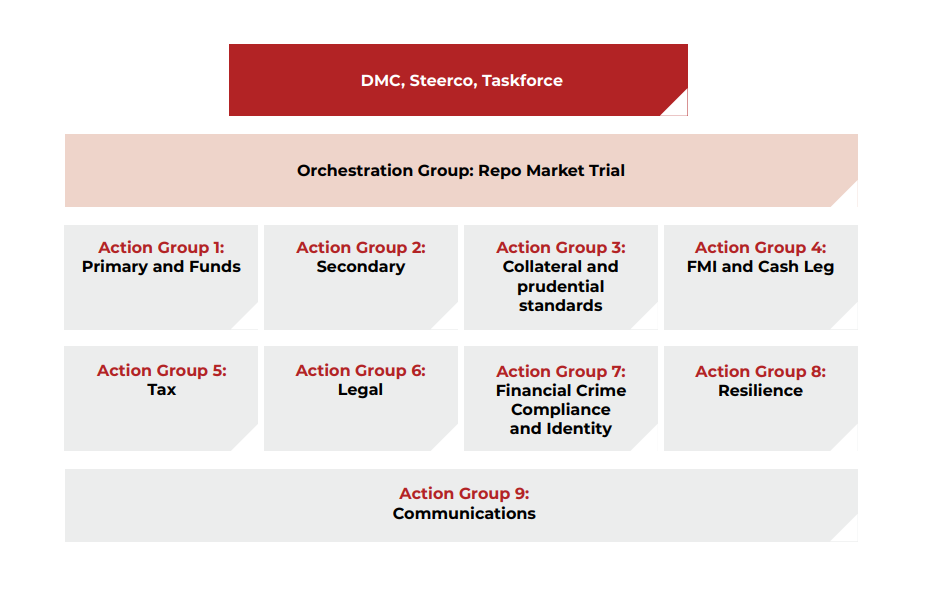
The taskforce’s 54 members are being organized into nine specialized action groups, each responsible for a specific segment of the market structure. The immediate priority is tokenized repurchase agreements.
Repo markets involve short-term borrowing against collateral, typically government bonds, and are the highest-velocity, highest-liquidity corner of wholesale finance. Demonstrating that tokenized repo can settle atomically, instantaneously, and with verifiable finality is the proof case that justifies expanding the framework to bonds, funds, and eventually commodities.
structure of the Taskforce across the Action Groups and the Orchestration Group. | Source: theglobalcity.uk
The Woolard report proposes a hybrid model that layers permissioned institutional networks atop permissionless public chains. BlackRock’s BUIDL is cited as the template, issued on Ethereum with a Securitize compliance wrapper providing the institutional guardrail.
The report explicitly flags that chain reorganizations on public blockchains pose unresolved settlement-finality risks at the wholesale level, signaling that the taskforce is not proposing to move UK government bonds onto raw permissionless infrastructure but onto architectures that combine public liquidity pools with institutional compliance layers.
Feedback from market participants is open until September 4, 2026, after which the nine action groups will be finalized. A live tokenized repo trial is targeted for spring 2027. Woolard’s second report to the Chancellor is expected in July 2027. A cross-authority regulatory roadmap for wholesale market digitalization will be published before the end of 2026, followed by consultations on rule changes in 2027.
XRPL’s Tokenized Asset Ecosystem Continues to Expand
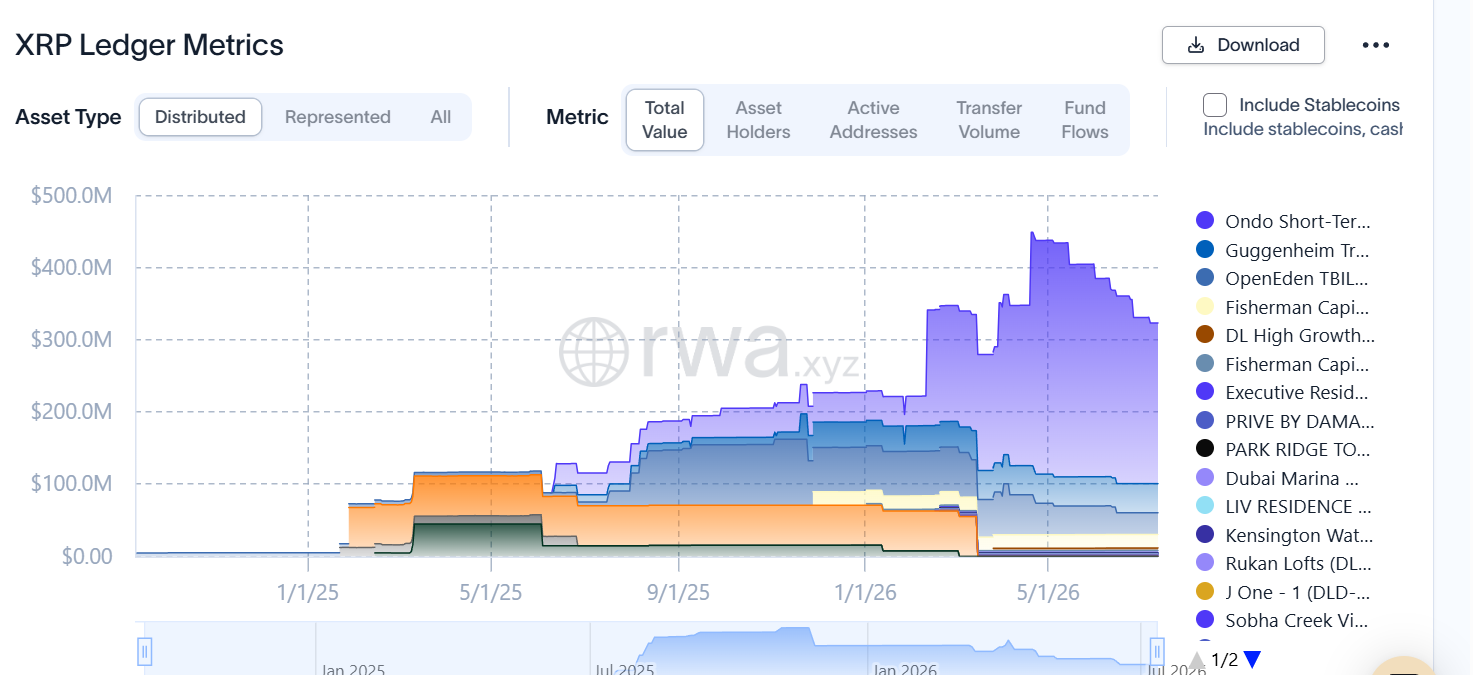
Ripple’s growing role in the UK Treasury taskforce is supported by the rapid expansion of tokenization activity on the XRP Ledger. According to RWA.xyz, the XRPL now hosts $3.97 billion in represented real-world asset (RWA) value, alongside $322.9 million in distributed asset value across 373 tokenized assets. The network’s RWA holder base has grown to 167 wallets, up nearly 44% over the past 30 days, reflecting increasing institutional participation despite softer transfer activity.
Stablecoin usage on the XRPL has also continued to grow. The network’s stablecoin market capitalization has surpassed $1.01 billion, rising 12.2% over the past month, while the number of stablecoin holders increased to nearly 60,000.
Although monthly transfer volumes have moderated from recent highs, the figures reinforce XRPL’s evolution beyond payments into a broader institutional tokenization platform supporting stablecoins and real-world assets.
XRP Price at $1.07: Institutional Adoption Running Far Ahead of Price
XRP trades at $1.07 on July 13, down approximately 71% from its $3.66 peak in July 2025 and 68% below January 2026 highs near $3.40. The divergence between Ripple’s institutional trajectory and XRP’s price performance is the defining tension in the asset’s investment narrative.
In the past 12 months, Ripple has secured a MiCA license, acquired Hidden Road for $1.25 billion, joined HM Treasury’s taskforce, integrated XRPL into UK institutional infrastructure through Santander, and watched tokenized RWAs on XRPL grow twenty-sixfold to $4 billion. XRP has lost roughly two-thirds of its value across the same period.
Three factors explain the disconnect:
Digital assets posted a third consecutive quarter of losses in Q2 2026, the longest losing streak since the 2022 bear market, compressing the entire asset class regardless of individual project fundamentals. Bitcoin ETFs recorded their largest quarterly outflow since launch in Q2.
The Federal Reserve’s June dot plot signaled potential rate hikes in 2026, removing the liquidity support that drove the late 2025 crypto rally.
And the CLARITY Act, which most analysts identify as the single largest remaining regulatory catalyst for XRP price recovery given its digital commodity classification implications, is priced at 39% to 43% on Polymarket, down from 74% a month ago.
The taskforce membership signals what Ripple is becoming in institutional finance. The XRP price signals that institutional infrastructure and token appreciation are not yet the same trade.
Disclaimer:
The information provided in this article is for informational purposes only. It is not intended to be, nor should it be construed as, financial advice. We do not make any warranties regarding the completeness, reliability, or accuracy of this information. All investments involve risk, and past performance does not guarantee future results. We recommend consulting a financial advisor before making any investment decisions.
Dr. Guneet Kaur is a senior editor at CCN.com and a Science Fellow at Exponential Science. She is a fintech and blockchain expert with extensive experience in digital finance education, blockchain ecosystems, and cryptocurrency markets. She has worked with global media such as Cointelegraph, as well as education and blockchain platforms, to design and lead strategic content and learning initiatives. As an educator and assessor for top-tier executive programs, she bridges real-world fintech trends with academic insight.
Dr. Kaur is also a published researcher and peer reviewer across fintech and data science journals, including Financial Innovation Journal and International Journal of Big Data Intelligence and Applications. Her work spans data-driven analysis, Web3 innovation, and technical content development. With a strong foundation in both industry and academia, she translates complex financial technologies into practical applications, empowering learners, professionals, and institutions across the rapidly evolving digital finance landscape.