Ripple Lays Out Four Stage Plan to Protect XRPL From Quantum Threats
Share
Key Takeaways
Ripple partnered with Project Eleven to prepare the XRP Ledger for future quantum computing threats.
The collaboration will include a full security audit of XRPL’s validator, wallet, custody, and networking infrastructure.
XRP fundamentals remain strong despite the token trading roughly 60% below its 2025 highs.
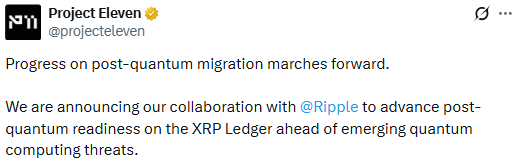
Ripple is taking a major step toward future-proofing the XRP Ledger (XRPL) against the looming threat of quantum computing, announcing a new collaboration with post-quantum cryptography firm Project Eleven.
The partnership comes at a time when XRP is gaining momentum from rising institutional adoption, surging tokenized real-world assets (RWAs), and growing ETF inflows, all while the token still trades roughly 60% below its 2025 highs.
Project Eleven revealed that the collaboration will focus on preparing XRPL for the “quantum era” by auditing the blockchain’s infrastructure for vulnerabilities and implementing quantum-resistant security solutions. The initiative includes a comprehensive assessment of validator systems, wallets, custody architecture, and networking layers, alongside the development of hybrid cryptographic signatures and quantum-secure custody wallets.
Try Our Recommended Crypto Exchanges
Sponsored
Disclosure
We sometimes use affiliate links in our content, when clicking on those we might receive a commission at no extra cost to you. By using this website you agree to our terms and conditions and privacy policy.
Ripple and Project Eleven Push XRPL Toward Quantum Readiness
According to Project Eleven CEO and Co-founder Alex Pruden, most blockchain discussions around quantum computing have remained theoretical, while Ripple is approaching the issue as an engineering challenge requiring immediate preparation.
“Every major blockchain is exposed to the same cryptographic vulnerability, but most of the response has stayed at the research stage,” Pruden said. “This engagement is about execution.”
Project Eleven signed a partnership with Ripple. | Credit: Project Eleven X profile
RippleX Head of Engineering J. Ayo Akinyele echoed that sentiment, warning that the quantum threat is no longer hypothetical. He noted that XRPL already possesses key infrastructure advantages, including validator coordination mechanisms and key rotation capabilities that could help the network transition more smoothly to post-quantum standards.
The collaboration aims to deliver practical solutions rather than experimental research. Project Eleven plans to provide working code implementations, real-world performance benchmarks, and a roadmap for production deployment.
The urgency surrounding post-quantum security is growing globally. The US government has already set a 2035 deadline for federal systems to migrate away from vulnerable encryption methods, while major technology firms including Google and Cloudflare are targeting 2029 for internal transitions.
Adding to the momentum, the National Institute of Standards and Technology (NIST) last week advanced nine new digital signature schemes in its post-quantum cryptography standardization process, including SQIsign, HAWK, and FAEST.
The timing of Ripple’s announcement is particularly notable because XRP’s ecosystem metrics have been accelerating even as the token remains significantly below previous highs.
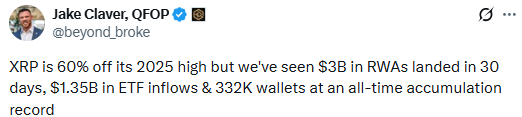
Crypto analyst Jake Claver highlighted that RWAs on the XRP Ledger surpassed $3 billion, representing a 59% increase in just one month. According to Claver, the network now hosts 291 projects, with growth compounding consistently over the past two years.
Meanwhile, XRP-focused exchange-traded funds continue attracting capital. Spot XRP ETFs recorded $25.8 million in net inflows on May 11, their largest daily inflow since January. Total cumulative ETF inflows have now climbed to approximately $1.35 billion, with Franklin Templeton’s XRPZ leading recent activity.
Claver argued that institutional investors may view ETF approvals less as short-term price catalysts and more as long-term accumulation vehicles through regulated investment products.
Here’s Where XRP Price Could Go Next
Claver believes Ripple’s growing institutional footprint and its proactive approach to quantum security could strengthen investor confidence in XRP over the long term.
From a technical perspective, XRP remains in a recovery phase after its sharp correction from 2025 highs. However, improving on-chain activity, ETF demand, and accelerating RWA adoption are increasingly being viewed as supportive catalysts for another breakout cycle.
Jake Claver expects XRP to be influenced by RWAs growth. | Credit: Jake Claver X profile
If XRP can maintain momentum above key psychological support zones, analysts believe the token could attempt a move toward the $1.50-$2 range in the medium term, particularly if institutional inflows continue rising. A stronger crypto market rally combined with additional Ripple ecosystem expansion could potentially reopen the path toward previous cycle highs above $3.
At the same time, quantum-readiness initiatives may eventually become a competitive differentiator among blockchain networks. Investors are increasingly focused not only on scalability and adoption, but also on long-term infrastructure resilience.
Ripple’s partnership with Project Eleven signals that the company is betting that security preparedness will matter just as much as speed and utility in the next phase of blockchain adoption.
Disclaimer:
The information provided in this article is for informational purposes only. It is not intended to be, nor should it be construed as, financial advice. We do not make any warranties regarding the completeness, reliability, or accuracy of this information. All investments involve risk, and past performance does not guarantee future results. We recommend consulting a financial advisor before making any investment decisions.
Giuseppe Ciccomascolo began his career as an investigative journalist in Italy, where he contributed to both local and national newspapers, focusing on various financial sectors.
Upon relocating to London, he worked as an analyst for Fitch's CapitalStructure and later as a Senior Reporter for Alliance News. In 2017, Giuseppe transitioned to covering cryptocurrency-related news, producing documentaries and articles on Bitcoin and other emerging digital currencies. He also played a pivotal role in establishing the academy for a cryptocurrency exchange website. Crypto remained his primary area of interest throughout his tenure as a writer for ThirdFloor.












 Ripple CEO Says He Was ‘Never an XRP Maxi’ as Former CTO Admits Selling Most of His Holdings