Key Takeaways
- Exporters settle in stablecoins on Polygon; UK importers settle in a simulated digital pound, testing atomic dual-currency settlement within a single trade flow.
- Portable SME credit profiles are anchored onchain as verifiable smart contracts, readable by any permitted lender without a new credit assessment.
- Phase 2 has concluded; the findings will feed into a go/no-go assessment by the Bank of England and HM Treasury later in 2026, before any parliamentary decision.
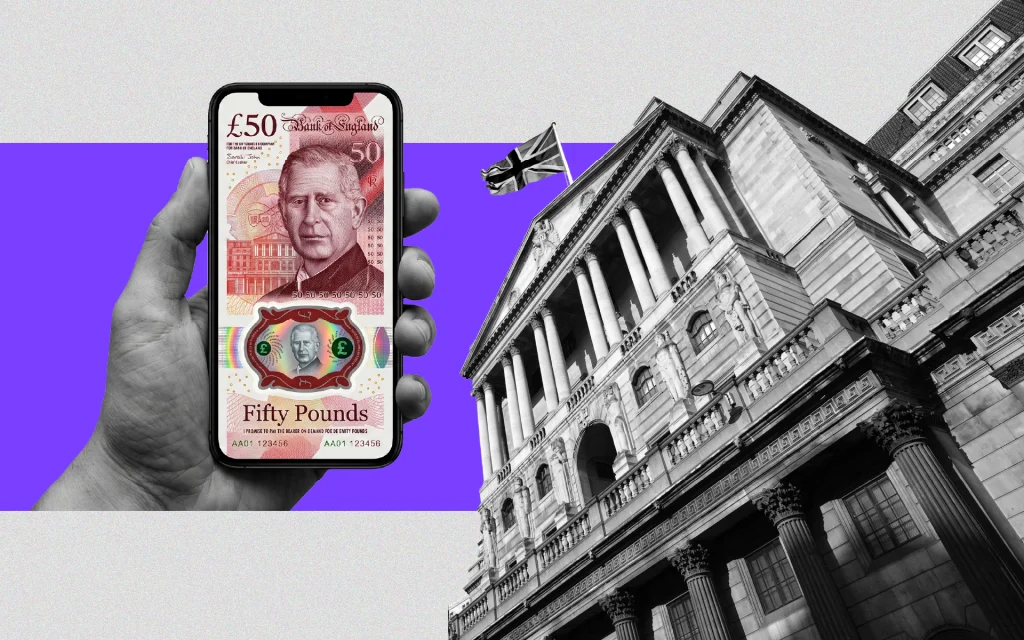
The Bank of England has selected Polygon Labs, NOBO Finance, and Dun & Bradstreet to run the next round of its Digital Pound Lab, testing how a central bank digital pound and private stablecoins could settle different parts of the same cross-border trade deal.
The consortium is one of 12 participant groups in Phase 2. No real customers or real funds are involved. The Bank has been explicit that participation does not imply a decision to issue a digital pound.
The consortium will test two connected workstreams. The first develops a reusable SME credit profile using transaction data, Dun & Bradstreet commercial intelligence, and Polygon-based smart contract infrastructure.
The second test involves invoice factoring, where exporters receive stablecoin advances while UK importers complete final settlement in digital pounds.
Polygon’s Open Money Stack manages stablecoin transactions on one leg. A simulated digital pound environment facilitates central bank-led settlement on the other.
Why the Dual-Currency Architecture Is an Interesting Argument
The experiment’s structural design embeds the most significant policy argument: the Bank of England is not testing whether a digital pound can replace stablecoins. It is testing whether a digital pound and privately issued stablecoins can settle different legs of the same transaction simultaneously.
That distinction matters enormously. The more important question may not be whether a digital pound can compete with stablecoins, but whether central bank money, private digital currencies, and commercial financial infrastructure can settle transactions across the same economic workflow. Phase 2 is answering that coexistence question in a simulated environment before it becomes a live policy decision.
On the importer’s side, final settlement flows through the Bank of England’s simulated digital pound rail. The two legs, stablecoin on one side, digital pound on the other, are coordinated through Polygon’s Open Money Stack orchestration layer. If that coordination works cleanly in simulation, it removes one of the central objections to digital pound adoption, namely that a CBDC and private stablecoins would compete for the same role rather than complement each other in a tiered system.
Portable Credit Identity: The Underreported Innovation
The credit profile workstream deserves equal attention to the settlement mechanics. The pre-qualified credit outcome is anchored on the Polygon Chain as a smart contract. Any lender, with the SME’s permission, can query the profile on-chain and read its verified outcome, rather than initiating a new assessment.
The profile is not a score in a private database. It is a verifiable credential on a public blockchain, governed by consent rules encoded in the smart contract itself.
For small businesses that export and import goods, trade finance remains slow and costly because verification is split across multiple parties and settlement can take days. Large companies can afford this delay through treasury operations, but smaller firms face a cash squeeze between shipping goods and receiving payment.
Dun & Bradstreet, whose D-U-N-S number system has been the global standard for business identity since 1963, provides the commercial intelligence that anchors the credit profile’s data foundation.
Polygon provides the infrastructure that makes it portable and verifiable without the original issuing institution’s involvement at each query. NOBO Finance provides the trade finance platform that connects those components to an actual lending workflow.
Phase 1 Established the Foundation; Phase 2 Feeds the Go/No-Go Decision
NOBO previously completed Phase 1, demonstrating conditional B2B escrow payments designed for trade finance use cases. Phase 2 expands that foundation by bringing in Dun & Bradstreet’s commercial intelligence and Polygon Labs’ blockchain infrastructure.
Phase 2 itself has concluded, and the Bank has said it plans to publish further findings from both phases. The Bank of England and HM Treasury remain in the design phase, which is due to end in 2026.
The work underway will feed into a joint assessment of whether the UK should proceed to the next stage of development. Even if policymakers decide to move forward, a digital pound could not be introduced without primary legislation approved by Parliament.
Polygon is not a neutral infrastructure choice in the context of UK digital finance. Polygon’s network processed 743 million transactions in the second quarter of 2026, a 160% jump from the same period the previous year, driven largely by stablecoin transfers.
Polygon has settled more than $2.6 trillion in stablecoin transactions to date and counts Revolut and Stripe among its users. The Bank is testing its hypothetical CBDC against infrastructure that is already processing production-scale stablecoin volume rather than against a purpose-built sandbox.
That decision to use live public blockchain infrastructure rather than a permissioned testnet is itself a policy signal.
The Bank of England subsequently finalized stablecoin rules in June, removing previously proposed limits on individual holdings of systemic stablecoins.
The framework set an initial £40 billion issuance limit per token and allowed issuers to hold up to 70% of their reserves in short-term government debt, compared with the 60% level proposed earlier.
Phase 2 therefore runs alongside a finalized stablecoin regulatory framework, meaning the policy environment for the private leg of the dual-currency model is already defined.
What remains undefined is whether the public leg, the digital pound itself, will ever move beyond simulation.
Top Trending Crypto Articles
The information provided in this article is for informational purposes only. It is not intended to be, nor should it be construed as, financial advice. We do not make any warranties regarding the completeness, reliability, or accuracy of this information. All investments involve risk, and past performance does not guarantee future results. We recommend consulting a financial advisor before making any investment decisions.

Dr. Guneet Kaur is a senior editor at CCN.com and a Science Fellow at Exponential Science. She is a fintech and blockchain expert with extensive experience in digital finance education, blockchain ecosystems, and cryptocurrency markets. She has worked with global media such as Cointelegraph, as well as education and blockchain platforms, to design and lead strategic content and learning initiatives. As an educator and assessor for top-tier executive programs, she bridges real-world fintech trends with academic insight.
Dr. Kaur is also a published researcher and peer reviewer across fintech and data science journals, including Financial Innovation Journal and International Journal of Big Data Intelligence and Applications. Her work spans data-driven analysis, Web3 innovation, and technical content development. With a strong foundation in both industry and academia, she translates complex financial technologies into practical applications, empowering learners, professionals, and institutions across the rapidly evolving digital finance landscape.