MoneyGram Brings 80+ Years of Remittance Infrastructure to Stablecoins With MGUSD Launch
Share
Key Takeaways
MoneyGram is launching MGUSD through a massive established distribution system with hundreds of thousands of retail locations and tens of millions of users.
MGUSD is built into the MoneyGram app as a self-custodial USD wallet.
The stablecoin is issued by Bridge, secured by Fireblocks custody, and deployed on the Stellar network.
Competitors like Western Union, PayPal, and Visa are also adopting stablecoins, but MoneyGram is pushing direct consumer use from launch.
MoneyGram has launched MGUSD, its own native US dollar stablecoin, going live in the United States on June 2 with plans for global expansion across a network serving more than 60 million active customers in nearly 500,000 retail locations worldwide.
For a company founded in 1940, moving money across borders before the internet existed, entering the stablecoin market is not a pivot. It is an evolution that has been building quietly for five years.
Introducing MGUSD. MoneyGram's native U.S. dollar stablecoin.
Where most stablecoin launches originate in crypto-native ecosystems chasing liquidity pools and DeFi yield, MGUSD begins with something far more valuable: distribution at scale across corridors where currency instability and limited banking access are daily realities for tens of millions of people.
Built for the Underbanked, Not the Crypto Crowd
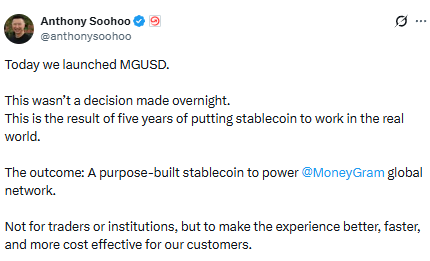
MoneyGram CEO Anthony Soohoo described the launch of MGUSD as the result of a long-term build rather than a sudden move.
He said the rollout was not decided overnight and reflects five years of working with stablecoin technology in real-world payment flows.
He emphasized that MGUSD is purpose-built to support MoneyGram’s global network, rather than being aimed at traders or financial institutions.
According to him, the goal is to improve the customer experience by making cross-border money transfers faster, more efficient, and more cost-effective.
MGUSD will be embedded directly into the MoneyGram mobile app, giving customers a self-custodial wallet to hold a dollar-denominated balance and transfer funds through the company’s global payments infrastructure.
For users in markets facing currency depreciation, the practical value is immediate: a stable dollar balance accessible around the clock, without requiring a bank account.
More than 70% of MoneyGram’s transactions are already digital, meaning the infrastructure for rapid adoption is already in customers’ hands. MGUSD does not need to find an audience. It has one.
Regulated Infrastructure Powers MGUSD
Bridge, a Stripe company, serves as the regulated issuer under the GENIUS Act framework, while M0’s smart contract infrastructure manages token minting and burning, with the stablecoin deployed on the Stellar blockchain at launch.
Fireblocks provides the custody layer, with MoneyGram holding MGUSD in Fireblocks wallets before distributing to customer self-custodial wallets embedded in the app.
Choosing Stellar was deliberate. MoneyGram’s relationship with the Stellar Development Foundation spans more than 5 years, beginning with USDC-powered remittance infrastructure and progressing toward its own token.
Denelle Dixon, CEO of the Stellar Development Foundation, described MGUSD as “a testament to what’s possible when you build with purpose, and a meaningful step forward in our shared mission to create better financial infrastructure for the global economy.”
Western Union Moved First, But MoneyGram Moved Harder
MGUSD arrives as the stablecoin race among traditional payments companies accelerates sharply. Western Union launched USDPT on Solana in early May 2026, though it took a measured approach, initially targeting agent settlement in select corridors rather than retail customers directly. PayPal and Visa have also integrated stablecoin infrastructure into cross-border settlement systems.
MoneyGram went directly to consumer wallets from day one. That distinction matters because retail distribution has historically been the hardest part of financial infrastructure to build. MoneyGram has spent 80+ years building precisely that.
MGUSD also did not arrive without groundwork. In May 2026, MoneyGram enabled crypto-to-cash withdrawals for Kraken users and was appointed as an anchor remittance validator on the Tempo blockchain project.
In December 2025, it partnered with Fireblocks to enable stablecoin settlement. Tuesday’s launch is not a standalone announcement. It is the culmination of a deliberate, multi-year infrastructure buildout that most observers underestimated.
Market Timing Could Not Be Better
Citi’s June 2026 tokenization report projects that the stablecoin market will reach $1.9 trillion by 2030, identifying regulated on-chain money as the foundational enabler of the broader tokenized asset economy.
MGUSD, backed by MoneyGram’s distribution reach, issued under the GENIUS Act, and custodied by Fireblocks, represents exactly the kind of regulated, retail-accessible instrument that projection depends on materializing.
Global remittances process roughly $860 billion annually. Even a modest share of those flows moving through stablecoin rails at MoneyGram’s scale would represent one of the most compelling proof points the entire sector has seen.
MGUSD is live in the United States. The corridors that need it most come next.
Disclaimer:
The information provided in this article is for informational purposes only. It is not intended to be, nor should it be construed as, financial advice. We do not make any warranties regarding the completeness, reliability, or accuracy of this information. All investments involve risk, and past performance does not guarantee future results. We recommend consulting a financial advisor before making any investment decisions.
Dr. Guneet Kaur is a senior editor at CCN.com and a Science Fellow at Exponential Science. She is a fintech and blockchain expert with extensive experience in digital finance education, blockchain ecosystems, and cryptocurrency markets. She has worked with global media such as Cointelegraph, as well as education and blockchain platforms, to design and lead strategic content and learning initiatives. As an educator and assessor for top-tier executive programs, she bridges real-world fintech trends with academic insight.
Dr. Kaur is also a published researcher and peer reviewer across fintech and data science journals, including Financial Innovation Journal and International Journal of Big Data Intelligence and Applications. Her work spans data-driven analysis, Web3 innovation, and technical content development. With a strong foundation in both industry and academia, she translates complex financial technologies into practical applications, empowering learners, professionals, and institutions across the rapidly evolving digital finance landscape.