Hyperliquid overtakes Coinbase in trading volume. | Credit: RDNE Stock project via Pexels.
Share
Key Takeaways
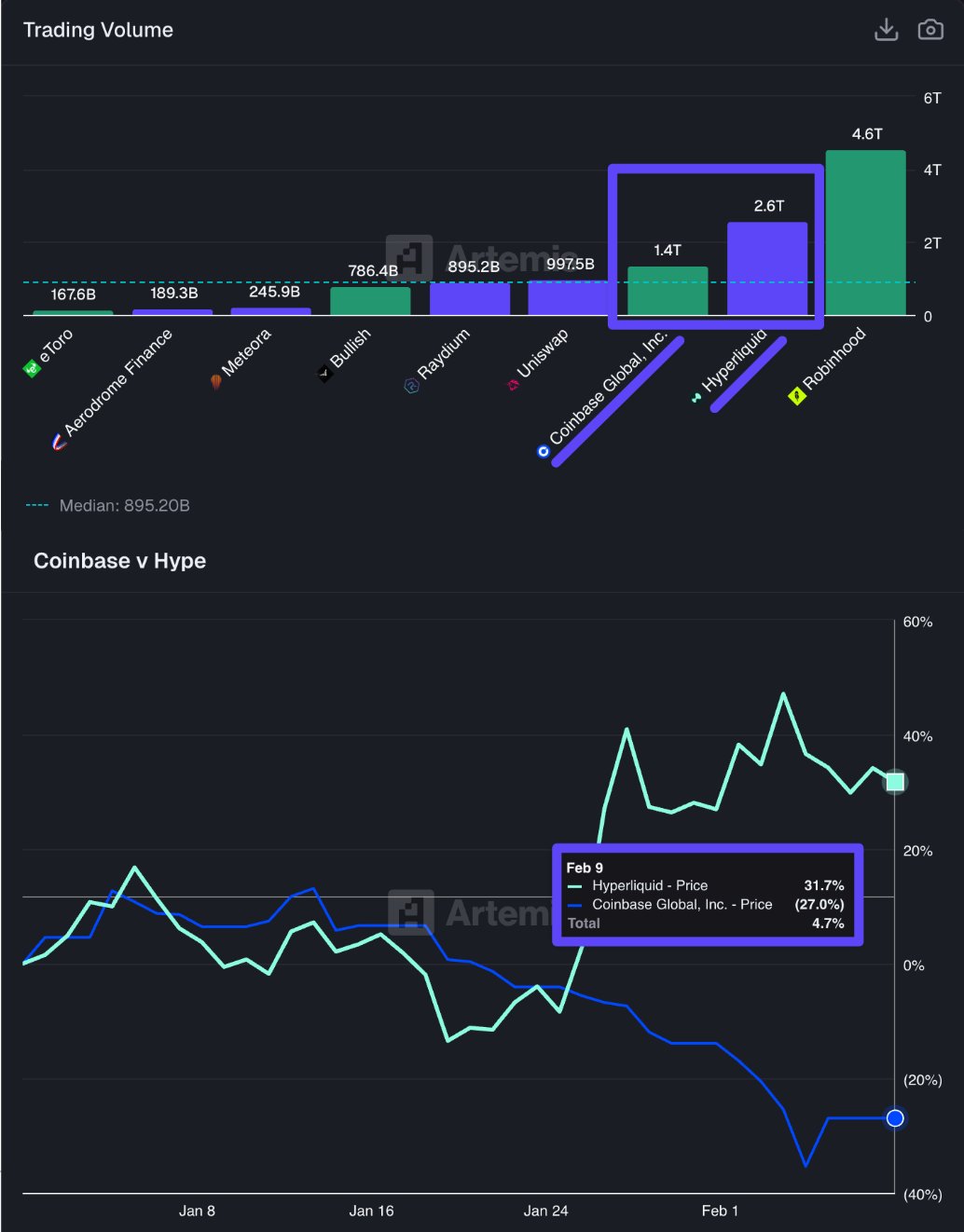
Hyperliquid nearly doubled Coinbase’s 2025 notional volume to $2.6 trillion, driven by high-leverage perpetual contracts on its layer-1 chain.
The platform commands over 70% of the open interest in decentralized perpetuals, currently at $4.1 billion.
HYPE trades resiliently around $31 amid volatility, boosted by major listings and innovations like HIP-3.
Hyperliquid, a decentralized exchange focused on perpetual futures trading and built on its own layer-1 blockchain, is emerging as a serious competitor to established centralized platforms such as Coinbase.
Recent data from analytics firm Artemis finds that Hyperliquid is outperforming Coinbase across several metrics that matter most to derivatives traders, including trading volume, market share, and revenue efficiency.
While Coinbase is one of the most recognized crypto exchanges globally, its exposure to high-leverage derivatives is limited by compliance requirements.
Hyperliquid, by contrast, operates within a decentralized framework that allows for greater flexibility in product design and leverage offerings—an approach that has attracted substantial trading activity.
Try Our Recommended Crypto Exchanges
Sponsored
Disclosure
We sometimes use affiliate links in our content, when clicking on those we might receive a commission at no extra cost to you. By using this website you agree to our terms and conditions and privacy policy.
On certain days in early February, decentralized perpetuals overall reached as much as $70 billion in daily volume. Hyperliquid would contribute an estimated 30% to 35% of that total.
Over rolling 30-day periods, monthly perpetuals trading across the sector have ranged between $225 billion and $258 billion. Hyperliquid would consistently rank among the top contributors.
Revenue Efficiency and Product Expansion
Beyond volume and market share, Hyperliquid’s revenue profile highlights its operational efficiency.
Artemis estimates that the platform generated roughly $844 million in fees during 2025.
In recent daily snapshots, fees have reached around $1.1 million, translating into approximately $1.6 million in revenue.
Daily revenue peaked at nearly $4.3 million in January 2026, driven by high trading activity and incentive programs.
Compared with centralized exchanges that maintain larger operational teams and infrastructure, Hyperliquid operates with a relatively lean structure.
Revenue is distributed among liquidity providers, HYPE stakers, and ecosystem development initiatives.
These markets previously recorded open interest highs of around $1.1 billion, broadening the platform’s appeal.
Valuation Considerations
Artemis valuation models suggest that Hyperliquid may be undervalued relative to traditional peers.
Using a sum-of-the-parts approach, analysts estimate the exchange’s core business—including perpetuals, spot trading, and HIP-1 functionality—at roughly $48.8 billion to $50.6 billion, based on 2025 earnings multiples from Coinbase and Robinhood.
The platform’s layer-1 HyperEVM component is valued separately at an estimated $2.2 billion to $9.0 billion, based on fee-to-valuation ratios observed in networks such as Solana and Ethereum.
As of February 9–10, 2026, the HYPE token was trading between $30.70 and $31.96, following a short-term pullback of about 6.5% over 24 hours.
Despite broader market weakness, the token has shown relative resilience, supported by reduced token unlocks, platform integrations, and sustained trading activity.
Average daily trading volume for HYPE exceeds $300 million, aided by listings on major centralized exchanges.
A Shifting Derivatives Landscape
Hyperliquid’s rise reflects a broader shift within digital asset markets toward decentralized derivatives platforms.
While centralized exchanges such as Coinbase continue to play a critical role in regulated access and fiat on-ramps, decentralized platforms are increasingly capturing activity from traders seeking flexibility, leverage, and rapid product innovation.
Ongoing developments—including expansion into options and prediction markets—could further strengthen Hyperliquid’s position.
However, market conditions, regulatory developments, and user risk preferences will continue to shape how decentralized and centralized exchanges compete in the evolving crypto derivatives landscape.
Prashant Jha is a seasoned crypto journalist based in Delhi, India, with a Bachelor’s Degree in Computer Science Engineering. Passionate about the evolving world of blockchain and cryptocurrencies, he has been a dedicated voice in the industry since 2018. Prashant’s expertise lies in regulatory reporting, where he unravels complex legal and financial developments with clarity and precision. Before joining CCN in 2024, he honed his craft at Cointelegraph, establishing himself as a trusted name in crypto journalism.
His coverage spans major industry events, including the high-profile collapses of FTX, Three Arrows Capital (3AC), and LUNA, offering readers insightful analyses of their regulatory and market implications. Prashant’s technical background enables him to bridge the gap between intricate blockchain technology and its real-world applications, making his work accessible to novices and experts.
Beyond his professional pursuits, Prashant is an avid music enthusiast, often exploring diverse genres to unwind. A sports lover, he has a particular passion for cricket and frequently engages in discussions about the game. His multifaceted interests and sharp journalistic instincts make him a valuable contributor to CCN, where he continues shaping the crypto landscape's narrative.