Key Takeaways
- Germany’s government is moving toward abolishing the country’s tax exemption for crypto sold after more than one year.
- The preferred government model would reportedly treat crypto as investment income, subjecting gains to a flat 25% tax plus Germany’s solidarity surcharge.
- The proposal remains under development and has not yet become law, meaning Germany’s existing one-year exemption remains in force.
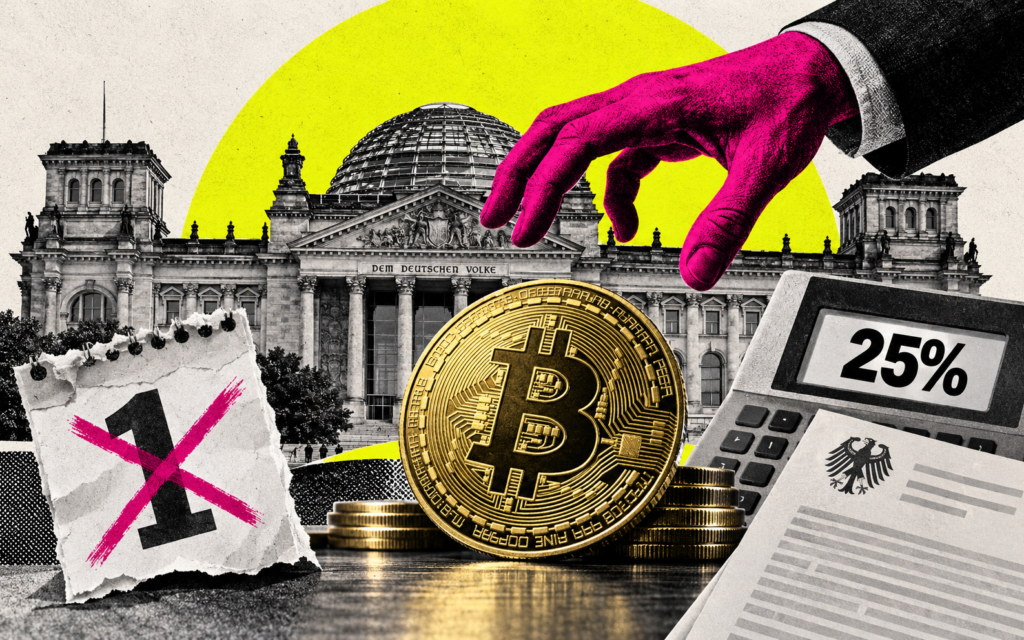
Germany is moving to eliminate one of Europe’s most attractive tax benefits for long-term crypto investors, potentially replacing tax-free gains on Bitcoin with a flat 25% levy.
Under existing German rules, private investors generally pay no tax when they sell crypto assets, including Bitcoin.
Gains realized within one year are taxed at the investor’s individual income tax rate, subject to a €1,000 annual exemption.
But the government is working toward ending that distinction.
A cabinet position adopted in July points toward moving crypto gains into Germany’s investment-income regime, according to analysis of the proposal. That would subject gains to the country’s 25% flat capital gains tax, regardless of how long the cryptocurrency was held.
Once Germany’s 5.5% solidarity surcharge on the tax itself is included, the effective rate would rise to approximately 26.375%, excluding any applicable church tax.
Bitcoin’s One-Year Tax Advantage Could Disappear
The change would be significant for German Bitcoin holders.
An investor who buys €100,000 worth of Bitcoin and later realizes a €100,000 profit after holding the asset for more than one year may owe no income tax on that gain.
Under the 25% investment-income model, the same €100,000 gain could generate approximately €26,375 in tax and solidarity surcharge.
Government’s Plan Can Still Change
However, investors should not treat the change as finalized.
As of the latest available legislative analysis, the government has not yet published final statutory language to implement the 25% crypto tax model.
A separate Green Party proposal would have taken a harsher approach by simply eliminating crypto’s one-year exemption while keeping gains within the private-sale regime.
That could have exposed investors to their individual income tax rates rather than a flat 25%.
The Bundestag’s finance committee rejected that bill in May.
Germany’s current one-year exemption therefore remains in place while the government develops its own approach.
Germany Pushes Crypto Tax Reform as Digital Euro Advances
The debate comes as Germany simultaneously backs Europe’s transition toward a more regulated digital-money infrastructure.
The European Central Bank selected 36 payment service providers in July to participate in its digital euro pilot, which is set to begin in the second half of 2027 and run for 12 months.
European lawmakers have also advanced the digital euro legislation.
The European Parliament adopted its negotiating position this summer, opening the way for talks with EU governments and the European Commission. Germany’s Bundesbank says completing the legislative process by the end of 2026 is realistic.
Germany is also exploring how the digital euro could work alongside Wero, Europe’s homegrown digital payments platform. Bundesbank board member Lutz Lienenkämper recently suggested integrating the digital euro directly into Wero’s wallet as part of efforts to reduce Europe’s dependence on non-European payment providers.
The two developments remain separate: the digital euro did not prompt Germany’s proposed crypto tax change.
But together they point toward a broader shift. Germany is considering removing a major tax advantage enjoyed by decentralized crypto assets, even as European authorities are building a regulated, central-bank-backed digital alternative.
For long-term Bitcoin investors, the immediate issue is much simpler: one of Germany’s most valuable crypto tax benefits may be approaching its end.
Top Trending Crypto Articles
The information provided in this article is for informational purposes only. It is not intended to be, nor should it be construed as, financial advice. We do not make any warranties regarding the completeness, reliability, or accuracy of this information. All investments involve risk, and past performance does not guarantee future results. We recommend consulting a financial advisor before making any investment decisions.

Giuseppe Ciccomascolo began his career as an investigative journalist in Italy, where he contributed to both local and national newspapers, focusing on various financial sectors.
Upon relocating to London, he worked as an analyst for Fitch's CapitalStructure and later as a Senior Reporter for Alliance News. In 2017, Giuseppe transitioned to covering cryptocurrency-related news, producing documentaries and articles on Bitcoin and other emerging digital currencies. He also played a pivotal role in establishing the academy for a cryptocurrency exchange website. Crypto remained his primary area of interest throughout his tenure as a writer for ThirdFloor.