We sometimes use affiliate links in our content, when clicking on those we might receive a commission at no extra cost to you. By using this website you agree to our terms and conditions and privacy policy.
“The idea that ETH is winning in stables is a fantasy. Sorry, Tom Lee,” Krueger wrote, pointing to complex data showing TRON’s growing lead in stablecoin usage, particularly for Tether’s USDT.
As of August 2025, TRON’s USDT supply has reached $80.8 billion, surpassing Ethereum’s $73.8 billion.
That shift has tilted the balance of power in the global stablecoin market, where TRON now commands over 63% of all circulating USDT.
According to on-chain data,TRON processes around $21.5 billion in daily USDT transfers, nearly seven times greater than Ethereum’s stablecoin transfer volumes.
More than 1 million unique wallets transact USDT daily on TRON, accounting for 28% of all active stablecoin wallets worldwide.
The network processes about 9 million transactions per day and handles roughly 60% of global stablecoin payment volume.
Ethereum, by comparison, remains the leading chain for DeFi protocols, NFTs, and broader ecosystem innovation, but it lags significantly in stablecoin settlement activity.
Its higher fees and lower throughput relative to TRON continue to push transactional stablecoin demand elsewhere.
TRON vs. Ethereum
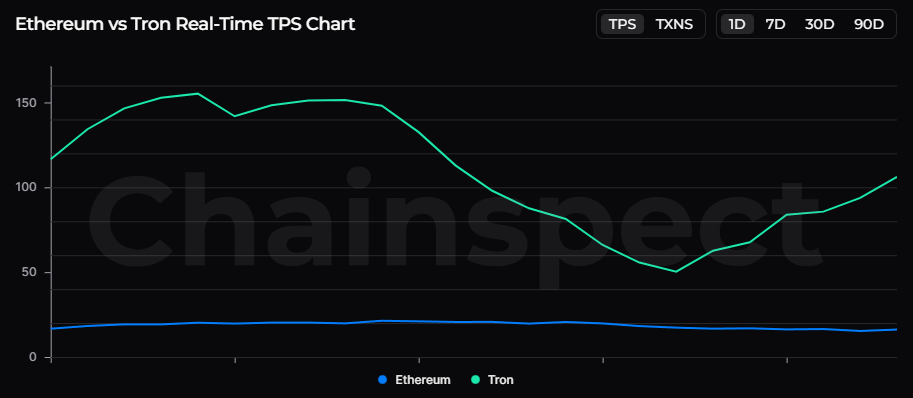
Ethereum vs. TRON TPS chart. | Credit: Chainspect.
Scalability Metrics
Regarding raw performance, TRON significantly outpaces Ethereum across nearly every scalability metric Chainspect tracks.
Real-time throughput: TRON handles 137.9 transactions per second (TPS) compared with Ethereum’s 17.83 TPS, an 87% advantage for TRON.
Max throughput (100 blocks): TRON peaks at 272 TPS, while Ethereum reaches 62.34 TPS, making Ethereum 77% slower.
Theoretical maximum: TRON’s network capacity is estimated at 2,516 TPS, versus Ethereum’s 119.1 TPS, a gap of over 95%.
Transaction volume: TRON processed 496,315 transactions, more than 7.7x Ethereum’s 64,174.
TRON’s average block time is just 3 seconds, compared with Ethereum’s 12.04 seconds.
Finality is also faster: 57 seconds on TRON versus nearly 13 minutes (12m 48s) on Ethereum.
Decentralization and Governance
While TRON leads in performance, Ethereum remains more decentralized regarding validator count and stake.
Validator set: Ethereum has over 1,082,000 validators, compared with just 27 on TRON.
Stake size: Ethereum also leads with $151.8 billion staked, nearly 10x Tron’s $14.96 billion.
Nakamoto coefficient: TRON, however, scores higher at five versus Ethereum’s 2, suggesting greater resistance to collusion among block producers.
Governance models also differ.
Ethereum still relies on off-chain governance, while TRON has a more on-chain governance structure, enabling protocol decisions to be made directly on the blockchain.
Over the past year, Solana’s stablecoin supply doubled from $5 billion to $11.8 billion, showing strong growth even as it remains far behind the two market leaders.
Other networks, such as Binance Smart Chain and newer entrants like Layer 2 solutions on Ethereum, are also vying for relevance in the stablecoin space.
Still, none currently match TRON’s scale, speed, and low-cost transfers, making it the global default settlement layer for USDT.
Giuseppe Ciccomascolo began his career as an investigative journalist in Italy, where he contributed to both local and national newspapers, focusing on various financial sectors.
Upon relocating to London, he worked as an analyst for Fitch's CapitalStructure and later as a Senior Reporter for Alliance News. In 2017, Giuseppe transitioned to covering cryptocurrency-related news, producing documentaries and articles on Bitcoin and other emerging digital currencies. He also played a pivotal role in establishing the academy for a cryptocurrency exchange website. Crypto remained his primary area of interest throughout his tenure as a writer for ThirdFloor.