Discover who really holds power in the BNB ecosystem. | Credit: Pavlo Gonchar/SOPA Images/LightRocket via Getty Images
Share
Key Takeaways
BNB is more than a utility token as it now powers DeFi, NFTs, and governance across the BNB Chain.
The BNB concentration among a small number of wallets means liquidity, governance, and market stability are mainly in the hands of a few.
Over half the BNB supply sits in 10 wallets.
Despite growth in staking and DeFi, Binance remains the ultimate kingmaker, raising long-term questions about decentralization.
BNB has grown from a simple exchange discount token into one of the most widely used assets in the cryptocurrency market. Today, it underpins the BNB Chain, supports decentralized finance applications, and plays a role in staking, payments, and governance across the ecosystem.
It also reached its all-time high of approximately $882.59 on August 21, 2025, a capstone moment driven by surging on-chain activity and bullish market momentum.
But just as important as how BNB is used is who holds it.
In 2025, a few wallets account for most of BNB’s supply, shaping liquidity, market stability, and even regulatory perceptions of the token.
While Binance remains the dominant holder, a mix of private whales, institutional custodians, and DeFi protocols now plays a growing role in its distribution.
Understanding this concentration of ownership offers a clearer view of how power is structured within the BNB ecosystem and why it matters for investors, developers, and policymakers alike.
What Is BNB and Why Does Its Distribution Matter?
BNB, formerly known as Binance Coin, is one of the most influential digital assets in the crypto ecosystem. Launched in 2017 through an ICO, BNB was initially created to provide discounted trading fees on Binance, quickly becoming the world’s largest crypto exchange.
Try Our Recommended Crypto Exchanges
Sponsored
Disclosure
We sometimes use affiliate links in our content, when clicking on those we might receive a commission at no extra cost to you. By using this website you agree to our terms and conditions and privacy policy.
In 2020, Binance Smart Chain (BSC) was launched as a separate compatible blockchain alongside Binance Chain.
In 2022, Binance combined Binance Chain and Binance Smart Chain under a single umbrella called BNB Chain, with BNB serving as the ecosystem’s core token.
Since then, BNB has evolved far beyond its original use case. Today, it is the native token of the BNB Chain, a blockchain that powers thousands of decentralized applications (dApps), DeFi protocols, NFT projects, and Web3 utilities.
BNB’s tokenomics is unique from those of other major cryptocurrencies. It is deflationary, thanks to a quarterly burn program that permanently removes tokens from circulation. This mechanism makes BNB scarcer over time, theoretically increasing its long-term value. At the same time, its utility spans transaction fees, governance, staking, and DeFi collateral.
But its distribution is one of BNB’s most important aspects and one that often gets less attention outside of crypto analyst circles. Token distribution matters because it determines who actually holds power over the ecosystem.
Suppose too few wallets control most of the supply. In that case, a few entities effectively centralized price stability, governance decisions, and even the direction of BNB’s ecosystem.
This is not merely theoretical. In 2025, the concentration of BNB ownership has direct implications for liquidity, exchange operations, regulatory oversight, and investor confidence. Whales, wallets holding massive sums of tokens, can move markets with a single transaction. For BNB, understanding who has it and how it’s distributed provides a clearer picture of where real power lies.
Top 11 BNB Holders in 2025
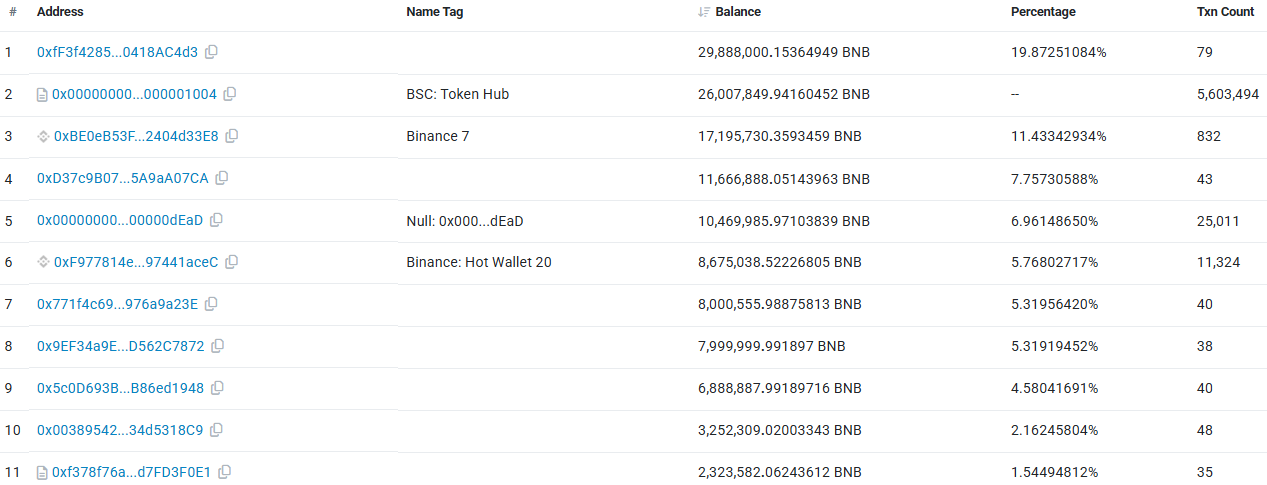
On-chain data confirms that BNB ownership remains highly concentrated, with the top 11 wallets controlling over 55% of the supply. A mix of Binance-controlled wallets and large private addresses dominates the leaderboard.
According to BSCscan, these top 11 holders control well over half of the total BNB supply. This level of concentration highlights both the strength and vulnerability of BNB’s ecosystem.
One whale address dominates with 29.9M BNB (19.9% of supply). With only 79 transactions, this is a massive, relatively inactive vault.
The BSC Token Hub (bridge contract) holds 26.0M BNB, reflecting liquidity locked for cross-chain transfers rather than a single investor.
Binance’s own wallets rank high:
Binance 7 with 17.2M BNB (11.4%)
Binance Hot Wallet 20 with 8.7M BNB (5.8%)
Binance 70 with 2.1M BNB (1.4%)
Several private whale addresses control between 8M–11.7M BNB each, underscoring heavy concentration outside of Binance’s tagged wallets.
Two near-identical wallets each hold just over 8M BNB (5.3% each), suggesting possible institutional or custodial holdings.
A large whale sits at 6.9M BNB (4.6%), further cementing the top 10’s grip.
Even the “smallest” wallet in this top group, with 3.25M BNB (2.2%), represents a staggering sum compared to retail investors.
Together, the top 10 wallets alone control well over 60% of all BNB in existence, highlighting both systemic influence and vulnerability to whale movements.
Top 11 BNB holders. | Source: BSC Scan
This concentration level reinforces Binance’s central role in BNB’s ecosystem and underscores why regulatory bodies and analysts continue to scrutinize its tokenomics. While DeFi protocols and smaller investors play essential roles, the balance of power clearly rests with a small group of entities.
This paints a clear picture: BNB’s supply is highly concentrated among a handful of whales and Binance-controlled wallets, giving them immense influence over liquidity, governance, and market stability.
Key Trends Shaping BNB in 2025
The rich list alone doesn’t tell the whole story. To understand BNB’s dynamics, looking at broader trends shaping ownership and usage is essential.
1. Deflation Through Token Burns
Binance’s quarterly token burns continue to be a defining feature. In 2025, the exchange is still committed to reducing supply until only 100 million BNB remain in circulation. This steady reduction benefits long-term holders but concentrates ownership, as large wallets become an even greater proportion of the remaining supply.
2. Institutional Adoption
Institutional interest in BNB has grown, particularly among funds seeking exposure to Binance’s ecosystem. Unlike Bitcoin and Ethereum, which institutions often buy directly, BNB’s institutional adoption has leaned toward custody solutions and structured investment products. This reduces on-chain activity but increases off-chain financial integration.
Among institutions adopting BNB, there are:
Windtree Therapeutics allocated $60M (and is targeting up to $200M) in BNB for its corporate treasury.
BNB Chain continues to be one of the busiest blockchains in terms of transaction volume. With DeFi protocols, liquid staking platforms, and new dApps absorbing BNB liquidity, more tokens are locked in smart contracts. While this diversifies ownership in practice, it doesn’t change the fact that whales can withdraw liquidity quickly if incentives shift.
4. Regulatory Oversight
After Binance’s regulatory challenges in 2023–24, regulators closely monitor BNB distribution. Authorities in the U.S. and EU have raised concerns about centralized token control, especially when the issuer (Binance) holds such a dominant position. This has raised debates about whether BNB should be classified as a security in some jurisdictions.
5. Whale Consolidation
Despite the growing ecosystem, whales remain firmly in control. Few large wallets have shown significant sell-offs, suggesting either strong confidence in BNB’s future or a reluctance to move funds due to scrutiny. For everyday investors, volatility risk remains high if even one whale decides to move.
Who Holds the Power in BNB’s 2025 Ecosystem?
When it comes to answering the central question—who holds the power in the BNB ecosystem?—the reality is clear: Binance itself is the ultimate kingmaker.
With vast reserves, the ability to burn tokens, and significant influence over BNB Chain development, Binance remains the central authority. Even though DeFi platforms and institutional custodians are reshaping some aspects of token usage, true decentralization remains limited.
That said, power is not absolute.
DeFi lockups create pockets of decentralized liquidity that dilute individual whale influence.
Protocols like PancakeSwap and Venus have effectively taken billions in BNB out of circulation, locking it into yield-bearing ecosystems.
Similarly, liquid staking platforms democratize access by allowing smaller investors to participate in staking rewards.
Still, the risk of liquidity shocks looms large.
If Binance, or one of the major whales, were to sell a large portion of their holdings, the ripple effect could devastate the market. Unlike Bitcoin, where distribution is broader, BNB’s centralized ownership structure makes it vulnerable to whale-driven volatility.
In short, while Binance holds the steering wheel, DeFi and institutions are beginning to tug at the edges of control. However, as of 2025, BNB remains a largely centralized ecosystem.
The decentralization of the BNB Chain has always been controversial. BNB Smart Chain is a decentralized platform for running smart contracts and DeFi applications. Compared to competitors like Ethereum, it offers high throughput and low fees.
As a SimpleSwap analysis pointed out in 2023, BSC’s Proof-of-Staked-Authority (PoSA) consensus mechanism is designed for efficiency, combining elements of Proof-of-Stake and Proof-of-Authority. This model allows BSC to process transactions quickly and cheaply, advantages that have driven its popularity among developers and users.
However, questions remain about how decentralized the network really is. Unlike Ethereum, where anyone can participate in staking and thousands of validators secure the network, BSC operates with a small set of validators (around 21 active at a time).
As of August 22, 2025, BNB Chain maintains 45 active validators, a mix of 21 Cabinet Validators with higher governance weight and 24 Candidate Validators competing for block production. While this structure ensures efficiency and low costs, the relatively small validator set continues to fuel debates about how decentralized the network truly is.
Top 10 validators of BNB Chain. | Source: BSC Trace
However, supporters argue that BSC’s model prioritizes accessibility, performance, and affordability, helping onboard millions of users to Web3 services.
The coordinated behavior of validators and Binance’s direct role in funding and guiding the ecosystem also reinforce these concerns.
Centralized vs. Decentralized Viewpoints on BNB Chain are summarized in the below table:
Perspective
Key Arguments
Centralization critics
Very few validators (mostly seen as Binance-linked)
Network halt coordination indicates central control
BNB’s rich list in 2025 paints a picture of strength and fragility. On one hand, the token continues to thrive, powering one of the most active blockchains in the world and serving as the backbone of the Binance empire.
On the other hand, its concentrated ownership raises critical questions about decentralization, governance, and long-term sustainability.
One truth stands out for investors, builders, and regulators: tracking who holds BNB is just as important as tracking what BNB is used for. Ownership concentration isn’t merely a trivia point, it’s a central factor shaping liquidity, governance, and risk across the entire ecosystem.
As BNB continues its deflationary journey and faces growing institutional and regulatory scrutiny, the balance of power between Binance, whales, and the broader community will determine whether BNB matures into a truly decentralized ecosystem—or remains a centralized empire in the hands of a few.
FAQs
Why does Binance hold so much BNB?
Because it underpins exchange liquidity, backs reserves, and enables token burns central to Binance’s tokenomics strategy.
Is BNB deflationary?
Yes. Binance’s quarterly burn program permanently removes BNB from circulation, reducing total supply over time.
Can whales manipulate BNB’s price?
Yes, to a degree. Large holders have the capacity to trigger volatility through massive transfers, although liquidity management and market makers often absorb some of the impact.
How does BNB compare to ETH in distribution?
Ethereum’s distribution is broader and more community-driven, while BNB remains more concentrated around Binance and early whales. This centralization is both a strength (stability, coordination) and a weakness (risk of manipulation).
Disclaimer:
The information provided in this article is for informational purposes only. It is not intended to be, nor should it be construed as, financial advice. We do not make any warranties regarding the completeness, reliability, or accuracy of this information. All investments involve risk, and past performance does not guarantee future results. We recommend consulting a financial advisor before making any investment decisions.
Giuseppe Ciccomascolo began his career as an investigative journalist in Italy, where he contributed to both local and national newspapers, focusing on various financial sectors.
Upon relocating to London, he worked as an analyst for Fitch's CapitalStructure and later as a Senior Reporter for Alliance News. In 2017, Giuseppe transitioned to covering cryptocurrency-related news, producing documentaries and articles on Bitcoin and other emerging digital currencies. He also played a pivotal role in establishing the academy for a cryptocurrency exchange website. Crypto remained his primary area of interest throughout his tenure as a writer for ThirdFloor.


 Easy
Easy