Key Takeaways
- Ethereum and Solana are reassessing how much token issuance is needed to fund network security without unnecessarily diluting holders.
- Ethereum’s EIP-8361 would progressively burn validator issuance as staking participation rises, potentially cutting current consensus-layer yields from 2.6% to 1.2%.
- Solana’s SIMD-0550 would accelerate disinflation and remove an estimated 18.9 million SOL from future emissions.
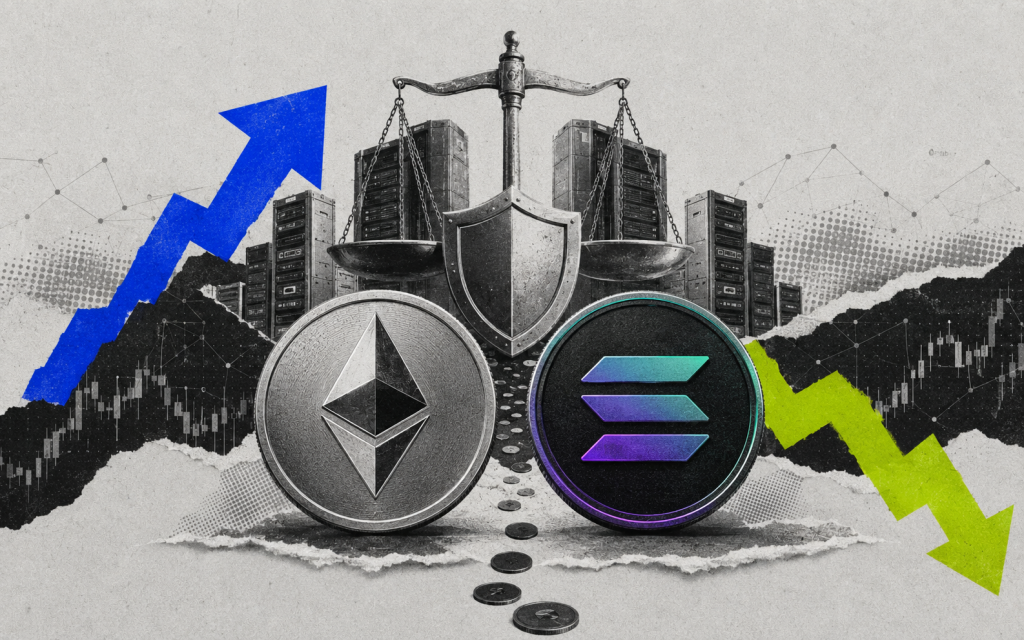
Ethereum and Solana developers are considering changes to their respective inflation schedules as both networks confront a fundamental economic question: how much new token issuance is necessary to maintain robust onchain security?
Galaxy Research Vice President Lucas Tcheyan said stakeholders in both ecosystems are reassessing whether their current security budgets remain appropriate and whether the benefits justify the resulting dilution.
No final decisions have been reached, and the proposals remain subject to technical discussion and governance processes.
The debate could have significant implications for ETH and SOL holders. Reducing issuance may improve long-term supply dynamics, while maintaining current schedules would preserve validator incentives but continue adding tokens to circulation.
The outcome could reshape market expectations around the future supply and value accrual of both assets.
Ethereum Proposal Targets Validator Issuance
Six Ethereum researchers, including Ethereum Foundation researcher Justin Drake, have introduced EIP-8361, known as Tapered Issuance Burn.
The proposal would progressively burn a larger share of validator rewards as more ETH staking occurs. Once 50% of Ethereum’s supply relates to staking, all consensus-layer issuance would be burned, eliminating the incentive for the staking ratio to rise further.
At the current staking rate of roughly one-third of ETH supply, the change would reduce consensus-layer yields from approximately 2.6% to 1.2%.
Priority fees and maximal extractable value revenue would remain unaffected.
Supporters argue that Ethereum’s existing model could push staking participation toward excessive levels, increasing concentration among large operators and liquid staking protocols. Limiting issuance could reduce dilution and strengthen ETH’s monetary properties.
Critics warn that lower yields could make solo staking less viable, weaken Ethereum’s decentralized finance economy and reduce the asset’s appeal to institutional investors. EIP-8361 remains a draft and there’s no schedule for implementation.
If selected for Ethereum’s proposed Hegotá upgrade, it would be unlikely to take effect before 2027.
Solana Considers Faster Disinflation and Fee Burns
Solana is evaluating two proposals through its new onchain governance system.
The first, SIMD-0550, would double Solana’s annual disinflation rate to 30%. This would bring forward the network’s 1.5% terminal inflation rate from 2032 to 2029 and eliminate an estimated 18.9 million SOL from future emissions.
A second proposal, SIMD-0553, would replace Solana’s flat signature fee with a resource-based fee determined by the computing capacity requested by each transaction.
Estimates suggest the change could increase daily SOL burns from around 650 tokens to between 7,500 and 9,000.
Both proposals have secured enough initial stake support to enter the formal discussion process. This although passage will require approval from two-thirds of participating decisive stake.
Token Scarcity Cannot Replace Network Demand
Ethereum and Solana used inflation to reward validators while their ecosystems were still developing. As the networks mature, stakeholders are questioning whether security should increasingly receive funds through transaction activity rather than token emissions.
Lower inflation could support scarcity narratives and reduce dilution for long-term holders. However, it would also compress validator and staker returns, potentially affecting decentralization and network security.
Galaxy Research argued that supply reforms alone are unlikely to determine the long-term value of either asset. Sustainable demand for blockspace, institutional adoption and real-world network activity remain more important.
The debates nevertheless demonstrate that investors are increasingly connecting blockchain security costs with token value.
Any changes could therefore prompt markets to reassess long-term supply expectations for both ETH and SOL.
The information provided in this article is for informational purposes only. It is not intended to be, nor should it be construed as, financial advice. We do not make any warranties regarding the completeness, reliability, or accuracy of this information. All investments involve risk, and past performance does not guarantee future results. We recommend consulting a financial advisor before making any investment decisions.

Giuseppe Ciccomascolo began his career as an investigative journalist in Italy, where he contributed to both local and national newspapers, focusing on various financial sectors.
Upon relocating to London, he worked as an analyst for Fitch's CapitalStructure and later as a Senior Reporter for Alliance News. In 2017, Giuseppe transitioned to covering cryptocurrency-related news, producing documentaries and articles on Bitcoin and other emerging digital currencies. He also played a pivotal role in establishing the academy for a cryptocurrency exchange website. Crypto remained his primary area of interest throughout his tenure as a writer for ThirdFloor.