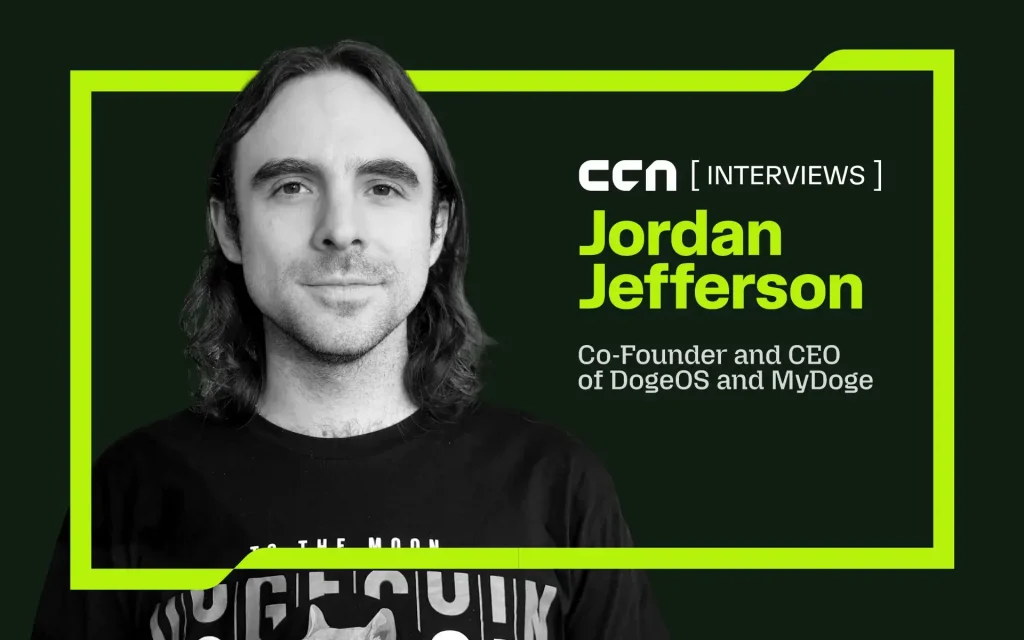
DogeOS is banking on crypto's "lost fun" to capture the market | Source: CCN.
Share
Key Takeaways
DogeOS CEO Jordan Jefferson argued that crypto has become overly focused on speculation and institutional money.
The company is developing Ethereum-compatible infrastructure to enable decentralized applications and on-chain trading for Dogecoin.
Jefferson sees Dogecoin as uniquely positioned for mainstream adoption.
Jordan Jefferson, co-founder and CEO of DogeOS, said the crypto industry has “lost fun” as it became dominated by institutional money, arguing that Dogecoin’s meme-driven culture could help revive consumer adoption.
Speaking to CCN on the sidelines of Consensus 2026, Jefferson said Dogecoin’s appeal lies not only in its brand recognition but also in its community ethos, which he described as closer to the “early crypto ideals” of payments, decentralization, and grassroots participation.
“I think crypto is lacking a bit of fun right now because it sort of became all about the money,” Jefferson said.
“Making money is fun, but losing money is not.”
New Trending Crypto Wallet Offers
Sponsored
Disclosure
We sometimes use affiliate links in our content, when clicking on those we might receive a commission at no extra cost to you. By using this website you agree to our terms and conditions and privacy policy.
Jefferson’s DogeOS project is attempting to build decentralized finance infrastructure around Dogecoin, the world’s largest meme cryptocurrency, by creating an Ethereum Virtual Machine-compatible layer designed to support applications and on-chain trading.
Dogecoin, originally launched in 2013 as a joke based on the Shiba Inu “doge” meme, has long lacked the smart-contract functionality available on networks such as Ethereum and Solana.
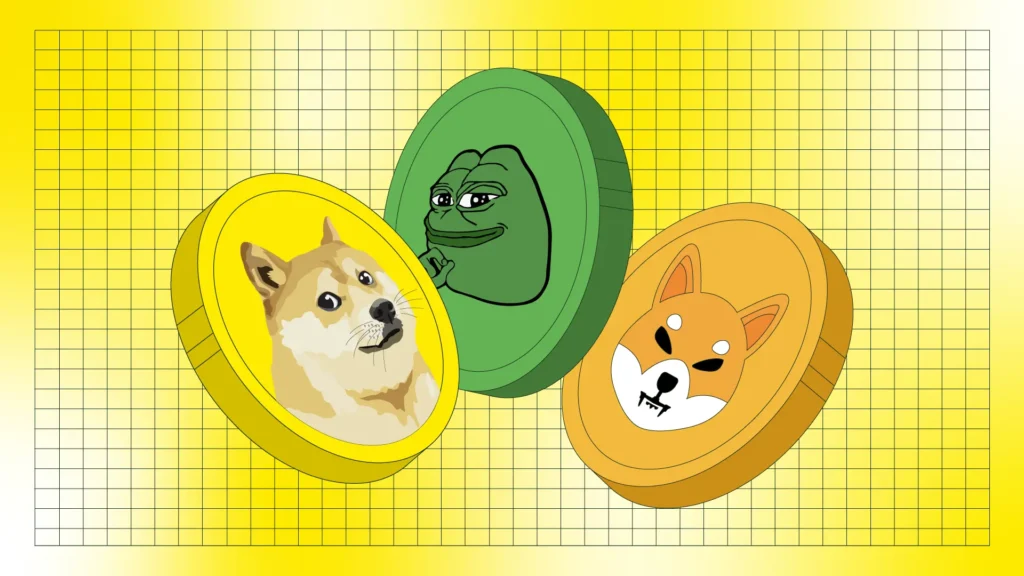
Dogecoin has always been rooted in memes. | Source: GetDoge.
Jefferson told CCN that the gap created an opportunity.
“We realized that Dogecoin was like the biggest community that no one was building anything for,” he said. “There’s got to be something here.”
Jefferson previously launched MyDoge in 2014, which he described as the top Dogecoin wallet app on Apple’s App Store — helping validate the strong demand within the ecosystem.
Challenging Centralized Exchanges
Jefferson said centralized exchanges currently dominate Dogecoin trading and capture most of the economic value through fees, despite Dogecoin being “the people’s currency.”
“There is no on-chain economy for Dogecoin,” he said. “There is no decentralized trading of Dogecoin.”
He said DogeOS aims to redirect some of that activity onto decentralized infrastructure where users and developers can participate directly.
“Billions and billions and billions of dollars are not flowing to the people at all,” Jefferson said.
He added that the firm has an opportunity to “fundamentally change the game” just by enabling DeFi on Doge.
Jefferson said DogeOS intentionally chose Ethereum-compatible infrastructure to make development easier for outside builders.
“Let’s not reinvent the wheel,” he said. “It’s the people’s currency. Let’s make it as easy as many people as possible to come build on it.”
Betting on Community Over Institutions
Jefferson repeatedly emphasized Dogecoin’s grassroots culture as a differentiator in an industry increasingly shaped by institutional capital.
“Dogecoin is really carrying the torch of the early crypto ideals,” he said. “People are still buying coffee with Dogecoin.”
Unlike some competing blockchain ecosystems backed by large foundations or venture capital treasuries, Jefferson said Dogecoin had grown largely organically.
“There is no entity behind it,” he said. “And Dogecoin is still kind of already competing in the top 10.”
Jefferson argued that enabling developers to build on Dogecoin could unlock broader investment and startup activity around the ecosystem.
“There are very few, virtually no, Dogecoin startups,” he said. “We make it possible to build … now all of a sudden you make it possible for all these people to participate.”
Institutional Validation
Jefferson said support from crypto investment firm Polychain Capital and other investors helped shift perceptions around Dogecoin-focused businesses.
“A few years ago, if I told someone I was building in Doge, they would laugh,” he said. “That doesn’t really happen as much anymore.”
He said investors were attracted partly because DogeOS had already spent years building products within the ecosystem rather than pursuing short-term hype cycles.
“This is not a cash grab,” Jefferson said. “We already proved it. We already built the most popular Dogecoin app.”
Jefferson said Dogecoin’s playful identity could ultimately become an advantage in attracting mainstream users unfamiliar with blockchain technology.
“If everyone’s having fun, everyone’s gonna make money,” he said.
He said Dogecoin culture forces builders to think beyond crypto-native users and focus on experiences accessible to ordinary consumers.
“The new users we need, they don’t know what any of this is,” Jefferson said. “Building through the Dogecoin lens … is going to help shape the next wave of successful consumer crypto apps.”
Kurt Robson is a London-based reporter at CCN, specialising in the fast-moving worlds of crypto and emerging technology. He began his career covering local news in Cornwall after graduating from Falmouth University with First Class Honours in Journalism. There, he cut his teeth on everything from council meetings to missing swans.
He quickly rose through the ranks to become a frontline journalist at several of the UK’s leading national newspapers. Over the years, he has interviewed musicians and celebrities, reported from courtrooms and crime scenes, and secured multiple front-page exclusives.
Following the upheaval of the COVID-19 pandemic, Kurt shifted his focus to technology journalism—just ahead of the AI boom. With a natural curiosity and a trained eye for emerging trends, he has found a new rhythm in reporting on innovation.
At CCN, Kurt's work focuses on the cutting edge of crypto, blockchain, AI, and the evolving digital world. Drawing on his background in people-first reporting and his deep interest in disruptive tech, Kurt delivers stories that are insightful, entertaining, and human-centric.
Max Moeller is a Chicago‑based writer and video editor passionate about games, tech, and crypto. Whether it’s crafting clear, insightful articles or piecing together engaging video retrospectives, he’s driven by curiosity and takes pride in keeping things human. Since 2017, Max has been published in a variety of notable crypto magazines.