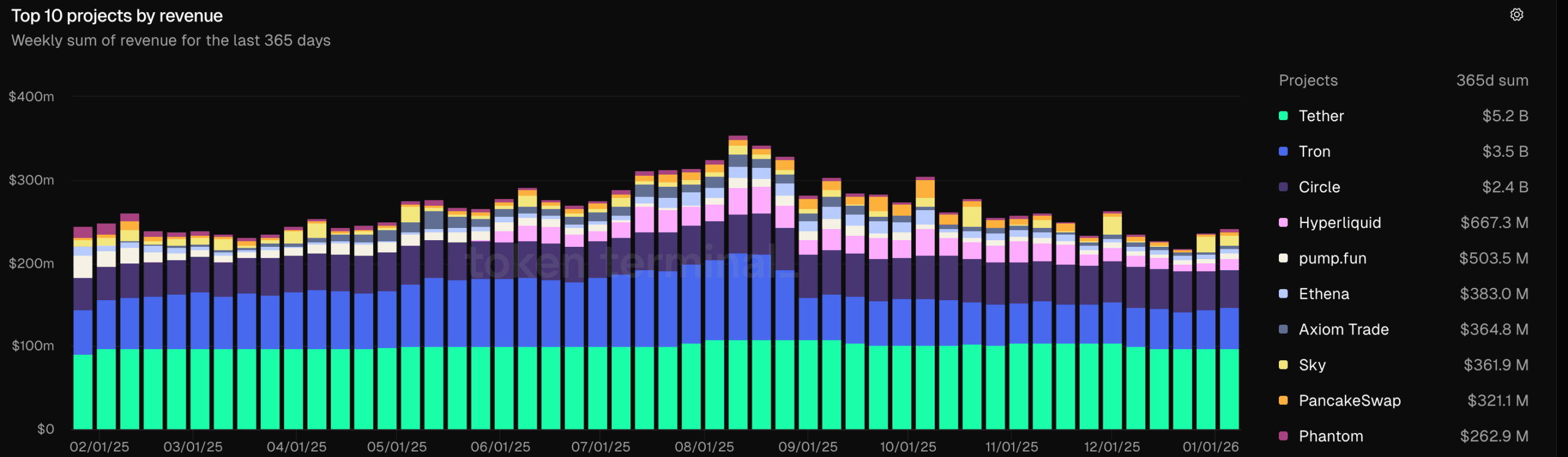
Crypto protocols revenue paints a stark picture between the top and bottom. Credit: CCN
Share
Key Takeaways
Centralized and semi-centralized protocols capture over 64% of top-10 revenue, outpacing their decentralized counterparts.
Tether leads with $5.2 billion in revenue in one year, far ahead of others due to centralized reserve interest earnings.
A $5 billion gap between #1 and #10 highlights extreme concentration, challenging crypto’s decentralization narrative.
Crypto was built on the promise of decentralization. In practice, however, much of the industry’s power and profits remain tightly concentrated.
That contradiction is clearest in the revenue rankings, where the top spots are dominated not by decentralized protocols but by centralized stablecoin issuers such as Tether and Circle.
Try Our Recommended Crypto Exchanges
Sponsored
Disclosure
We sometimes use affiliate links in our content, when clicking on those we might receive a commission at no extra cost to you. By using this website you agree to our terms and conditions and privacy policy.
Based on the latest data from Token Terminal, the annualized revenue of the top crypto protocol reveals a stark disparity: about $5.2 billion for Tether versus $262 million for Phantom.
The top three revenue earners in crypto dwarf the remaining six. Credit: Token Terminal.
Revenue data from the top 10 crypto protocols over the past 30 days shows that a small group captures the vast majority of market earnings.
Tether leads by a wide margin, generating $418.3 million in revenue during the period, while the 10th-ranked protocol, Phantom, recorded just $9.3 million—a gap of roughly $409 million.
Combined, the top 10 protocols produced approximately $995.9 million in revenue, with the top three alone accounting for more than 82%, or about $824.4 million.
This imbalance highlights how a small number of dominant players capture the majority of economic value, often through business models that rely on centralized or semi-centralized structures.
Mechanisms such as reserve interest, transaction fees, and controlled infrastructure enable these protocols to scale revenue more efficiently than fully decentralized alternatives.
Among the top 10, four protocols—Tether, Tron, Circle, and Phantom—operate with centralized or semi-centralized control.
Together, they generated about $633.7 million, representing roughly 64% of total top-10 revenue.
By contrast, the remaining six protocols—Hyperliquid, Sky, Ethena, pump.fun, PancakeSwap, and Axiom Trade—are largely decentralized.
Collectively, they generated $162.2 million, or just 16% of the total, underscoring the revenue gap between centralized scale and decentralized design.
Why Centralization Triumphs Over Decentralized Protocols?
Centralized stablecoin issuers like Tether and Circle earn passive income from interest on vast reserves, which scale effortlessly with adoption.
In contrast, decentralized protocols rely on variable fees from user activity, such as trading or borrowing, which are more competitive.
For instance, Tether’s $418.3 million in monthly revenue dwarfs Hyperliquid’s $50.8 million, despite the latter’s innovative DeFi mechanics and high trading volume.
Semi-centralized chains like Tron benefit from founder-driven ecosystems, enabling fee capture at scale.
Decentralized protocols often face fragmentation across chains, limiting their reach.
Tron’s $204.4 million highlights how controlled governance can optimize for revenue, even if it compromises complete decentralization.
Centralized entities can more easily integrate with traditional finance, thereby attracting institutional capital.
Circle’s compliance focus has helped it secure partnerships, boosting reserves and yields.
Decentralized protocols like Sky and Ethena, while resilient, often face governance delays and community consensus, which slow adoption.
This centralization of revenue raises questions about crypto’s core promise of decentralization.
While the gap underscores the efficiency of centralized models, it also highlights risks such as single points of failure.
As of 2026, crypto’s revenue landscape still reflects Web2-like centralization, where established players with off-chain operations generate outsized returns.
However, growth in DeFi, such as Hyperliquid’s rise, suggests decentralization is gaining ground, though not yet at parity.
Prashant Jha is a seasoned crypto journalist based in Delhi, India, with a Bachelor’s Degree in Computer Science Engineering. Passionate about the evolving world of blockchain and cryptocurrencies, he has been a dedicated voice in the industry since 2018. Prashant’s expertise lies in regulatory reporting, where he unravels complex legal and financial developments with clarity and precision. Before joining CCN in 2024, he honed his craft at Cointelegraph, establishing himself as a trusted name in crypto journalism.
His coverage spans major industry events, including the high-profile collapses of FTX, Three Arrows Capital (3AC), and LUNA, offering readers insightful analyses of their regulatory and market implications. Prashant’s technical background enables him to bridge the gap between intricate blockchain technology and its real-world applications, making his work accessible to novices and experts.
Beyond his professional pursuits, Prashant is an avid music enthusiast, often exploring diverse genres to unwind. A sports lover, he has a particular passion for cricket and frequently engages in discussions about the game. His multifaceted interests and sharp journalistic instincts make him a valuable contributor to CCN, where he continues shaping the crypto landscape's narrative.