An AWS data center overheating incident triggered Coinbase’s latest outage, disrupting trading for hours and exposing infrastructure risks. | Credit: CCN.
Share
Key Takeaways
An overheating AWS data center in Virginia triggered the Coinbase outage on May 7, disrupting trading and transfers for hours.
Coinbase said customer funds remained safe throughout the incident as services gradually returned online.
The outage highlighted crypto’s growing dependence on centralized cloud infrastructure and the physical risks behind digital finance.
Crypto markets are supposed to run 24/7. That constant availability is part of the industry’s identity.
So when Coinbase users suddenly found themselves unable to trade, transfer funds, or access parts of the platform on May 7, frustration spread quickly across social media and trading communities.
At first, many assumed the issue was another exchange-side technical failure or a traffic surge tied to market volatility.
Instead, the root cause turned out to be something much more old-fashioned: an overheating data center.
Try Our Recommended Crypto Exchanges
Sponsored
Disclosure
We sometimes use affiliate links in our content, when clicking on those we might receive a commission at no extra cost to you. By using this website you agree to our terms and conditions and privacy policy.
Unusually high temperatures reportedly caused power interruptions and hardware failures, creating cascading issues that eventually affected Coinbase’s systems.
AWS later confirmed the incident impacted parts of its US-EAST-1 region, including EC2 instances and EBS storage volumes.
The company said it was working to restore cooling systems and replace damaged hardware, though recovery took longer than expected.
As the disruption spread, Coinbase users reported failed transactions, delayed withdrawals, and difficulty accessing trading services.
Some blockchain integrations, including Solana and ALEO transfers, also experienced delays.
Throughout the outage, Coinbase maintained that customer funds remained safe and secure.
To prevent disorderly trading conditions during recovery, the exchange said it would initially reopen in “Cancel Only” mode, allowing users to reduce or close positions before full trading functionality returned.
The incident ultimately served as a reminder that even the largest crypto platforms still depend heavily on physical cloud infrastructure — and that real-world failures can ripple quickly through digital markets.
How Long Was Coinbase Out?
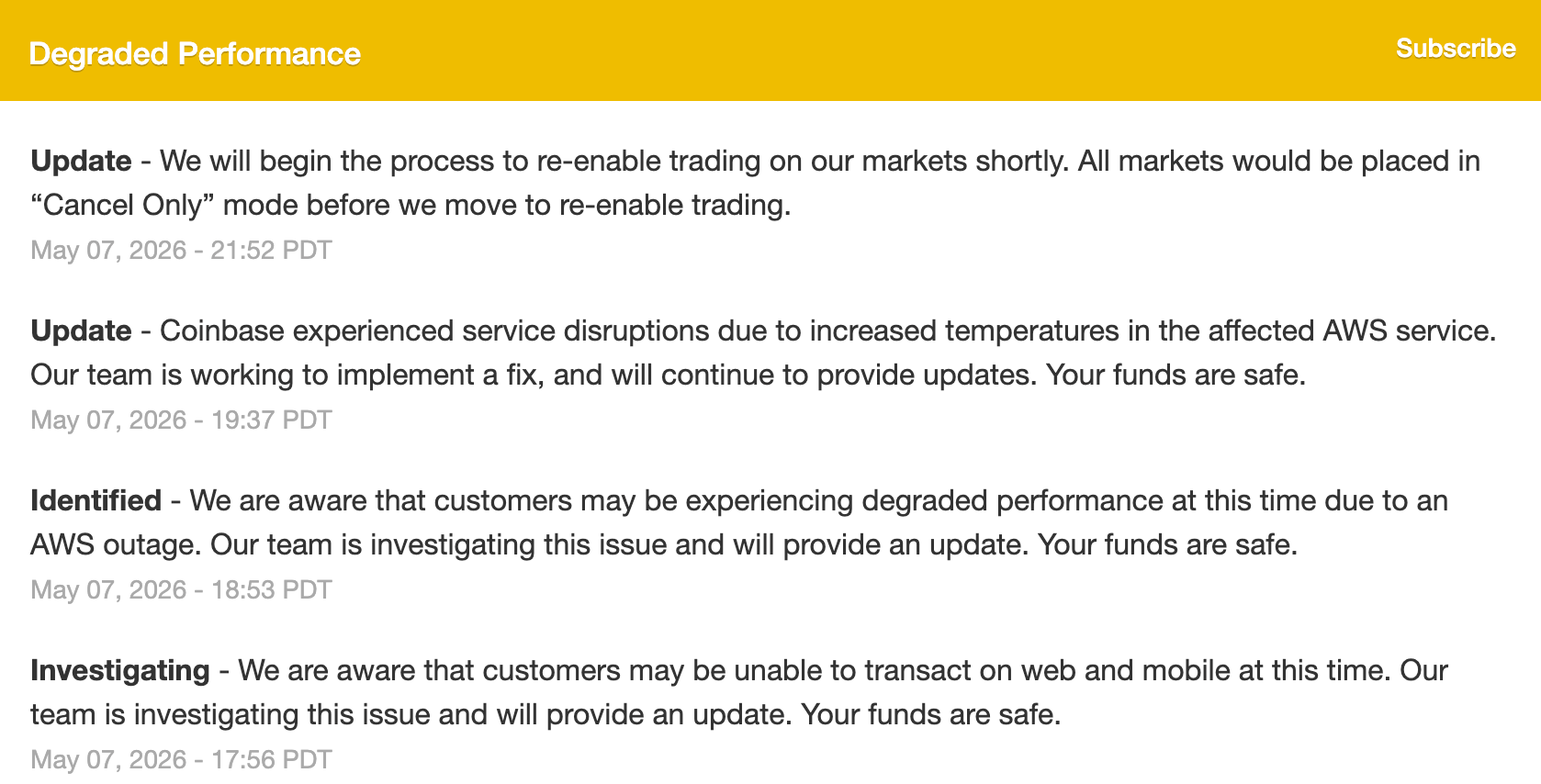
The disruption began around 6:53 p.m. PDT on May 7, when Coinbase first acknowledged degraded performance across parts of the platform.
Additional updates throughout the evening confirmed that elevated temperatures inside the AWS facility were continuing to affect services.
Coinbase outage notification. Credit: Coinbase.
Although some functionality gradually returned overnight, users continued experiencing intermittent issues into the early hours of May 8.
AWS itself reported that cooling recovery and hardware restoration would take several more hours.
By Friday morning, most Coinbase services appeared operational again, though some customers still reported residual delays depending on the region and network they were using.
For traders, the outage was another reminder of how disruptive exchange downtime can become during active market conditions.
In crypto, where markets never close, even a short interruption can lock users out during periods of volatility.
The Bigger Issue: Centralized Cloud Infrastructure
What makes this outage particularly notable is that the problem did not originate from blockchain infrastructure itself.
Despite crypto’s emphasis on decentralization, many of the industry’s largest exchanges, trading platforms, custodians, and applications still rely heavily on centralized providers such as AWS, Google Cloud, and Microsoft Azure.
That creates a contradiction at the heart of the industry.
A single physical issue inside one centralized facility was enough to disrupt services for one of the world’s largest crypto exchanges.
The event exposed how even highly digital financial systems remain vulnerable to real-world operational failures.
It also reignited discussions around redundancy, geographic diversification, and whether major crypto platforms should rely less heavily on concentrated cloud infrastructure.
Data Centers Are Becoming an Environmental Pressure Point
The outage also drew attention to another growing issue: the environmental strain tied to large-scale computing infrastructure.
As AI workloads, cloud computing, and crypto infrastructure continue expanding, those demands are rising rapidly.
When cooling systems fail or temperatures spike, operators often rely on emergency backup systems and hardware replacements that can further increase energy usage and operational stress.
Large data center clusters can also create localized “heat island” effects, placing additional pressure on power grids and water resources, especially during periods of extreme heat.
The Coinbase incident did not create those challenges on its own, but it highlighted how digital finance increasingly depends on infrastructure with very physical environmental costs.
As crypto markets mature, conversations around scalability may no longer focus only on transaction throughput and fees.
Energy efficiency, cooling resilience, and infrastructure sustainability are becoming part of the equation, too.
What Coinbase Users Can Learn From the Incident
Coinbase ultimately restored services and maintained that customer funds were never at risk.
Still, the outage reinforced several lessons for users navigating increasingly interconnected crypto markets.
Relying on a single exchange can create operational risk during outages or infrastructure failures.
Some traders maintain accounts across multiple platforms to preserve flexibility when disruptions occur.
Others increasingly move long-term holdings into self-custody wallets rather than leaving all assets on centralized exchanges.
The incident also showed why real-time status alerts and infrastructure transparency matter.
In fast-moving markets, users often need immediate clarity about whether a problem involves market volatility, blockchain congestion, or exchange infrastructure itself.
For Coinbase, the AWS outage was ultimately an external failure.
But for the broader crypto industry, it exposed something deeper: decentralized finance still runs on very centralized infrastructure behind the scenes.
Prashant Jha is a seasoned crypto journalist based in Delhi, India, with a Bachelor’s Degree in Computer Science Engineering. Passionate about the evolving world of blockchain and cryptocurrencies, he has been a dedicated voice in the industry since 2018. Prashant’s expertise lies in regulatory reporting, where he unravels complex legal and financial developments with clarity and precision. Before joining CCN in 2024, he honed his craft at Cointelegraph, establishing himself as a trusted name in crypto journalism.
His coverage spans major industry events, including the high-profile collapses of FTX, Three Arrows Capital (3AC), and LUNA, offering readers insightful analyses of their regulatory and market implications. Prashant’s technical background enables him to bridge the gap between intricate blockchain technology and its real-world applications, making his work accessible to novices and experts.
Beyond his professional pursuits, Prashant is an avid music enthusiast, often exploring diverse genres to unwind. A sports lover, he has a particular passion for cricket and frequently engages in discussions about the game. His multifaceted interests and sharp journalistic instincts make him a valuable contributor to CCN, where he continues shaping the crypto landscape's narrative.