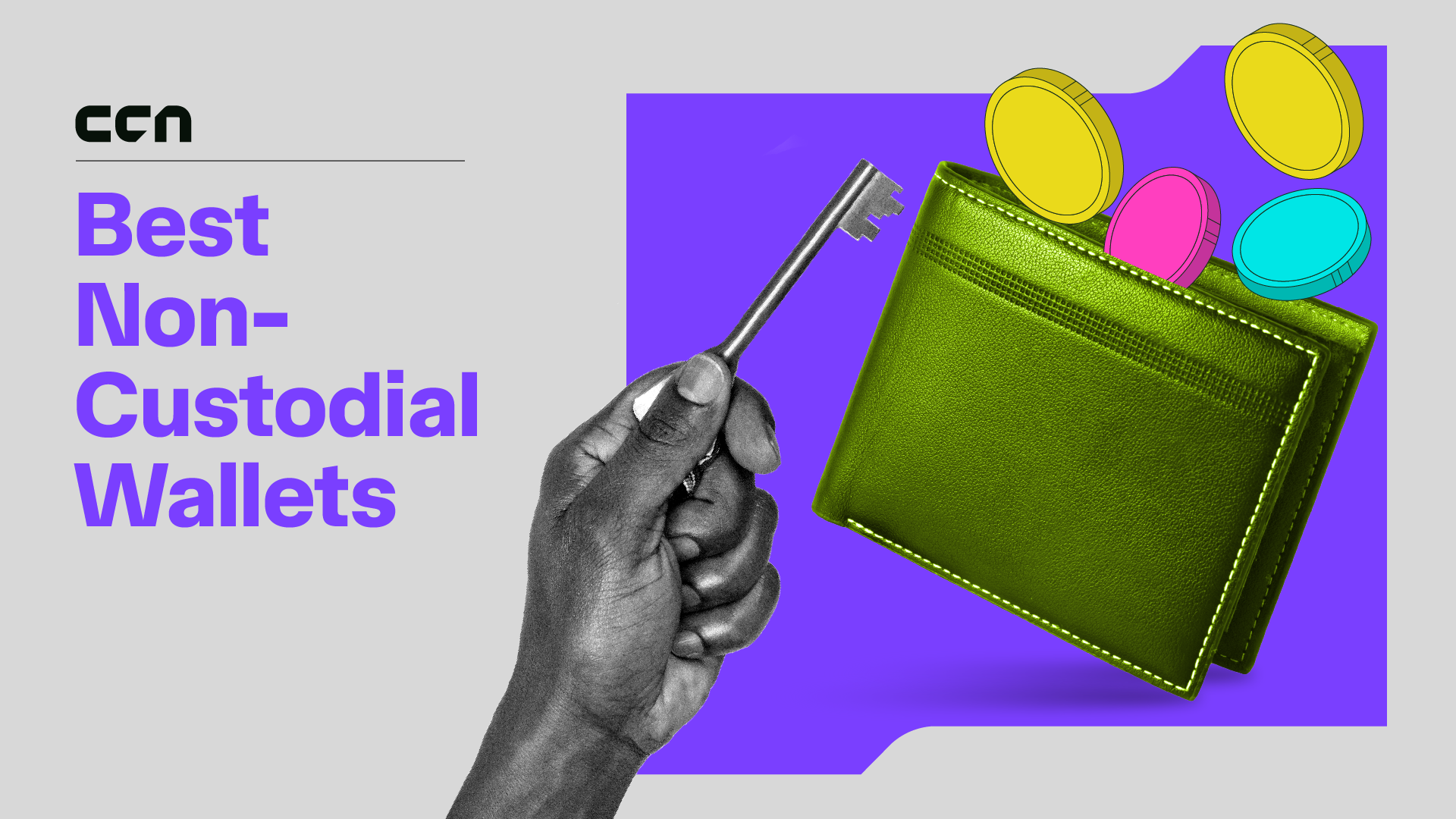
Are you looking to take full control of your crypto assets and explore opportunities in decentralized finance? With the best non-custodial wallet, you will be able to interact with all kinds of Web3 platforms while keeping your crypto holdings safe and secure.
If you’re ready to make the switch, you’ve landed on the right page. After countless hours of research, comparisons, and hands-on testing, we’ve curated the ultimate toplist of non-custodial wallets and presented it in the article below.
Key Takeaways
- Non-custodial wallets are crypto wallets that allow their owners to manage their private keys independently, instead of having them managed by a centralized platform.
- These wallets offer several advantages, such as avoiding the limits and restrictions imposed by exchanges and accessing the wider Web3 and DeFi ecosystems.
- At the same time, self-custody wallets also place greater responsibility on the user, including protecting private keys, performing backups, and handling recovery.
- When looking for the best non-custodial wallet for your needs, choose one that is highly secure and developed by a reputable, trustworthy provider.
- It is also important that the wallet has high cross-platform compatibility, supports a wide range of networks, and offers broad interoperability across the Web3 ecosystem.
Top Non-Custodial Wallets – Best Wallet Picks
Below you’ll find a short rundown of our standout picks for the best non-custodial wallets on the market.
Detailed Reviews of the Best Non-Custodial Wallets
Now, let’s take a closer look at what makes each of these wallets unique and who they are best suited for.
Overview of the Best Non-Custodial Crypto Wallets 2026
| Casino |
Welcome Bonus |
Our Rating |
|
Safepal
|
Trusted, Secure & Crypto Friendly |
4.0 |
|
Tangem
|
Receive Up to $10 in BTC when you buy and activate a Tangem Wallet. |
4.0 |
|
BitBox
|
Trusted, Secure & Crypto Friendly |
4.0 |
|
Blockstream
|
Trusted, Secure & Crypto Friendly |
4.0 |
|
Bitkey
|
Get 20% off the purchase of a new Bitkey hardware wallet. |
4.0 |
|
RockWallet
|
|
4.0 |
|
Kraken
|
Get $10 in Bitcoin when you register through a referral link from an existing member. |
4.5 |
|
Zengo
|
Earn $10 in Bitcoin by referring your friends. |
4.0 |
|
Uphold
|
Trusted, Secure & Crypto Friendly |
4.0 |
|
Coinbase
|
Earn $10 in Ethereum (ETH) when you stake $100 in ETH for the first time, up to $30 in rewards |
4.5 |
Disclaimer: Investing in cryptocurrencies carries significant risk. Values are highly volatile. Never invest more than you can afford to lose. This site does not provide financial advice. Act based on your own research and consult with a financial professional before making decisions. Don’t invest unless you’re prepared to lose all the money you invest.
Affiliate disclosure: This website may contain affiliate links, which means we may earn a commission if you click on a product link and make a purchase/register.
Why Trust CCN Reviews
CCN is a free platform dedicated to delivering high-quality, insightful content on the crypto market. We keep you updated with the latest trends and analysis, empowering you to make smarter trading decisions.
Every review, guide, or comparison we publish is crafted by a team of experts with years of experience in crypto trading, blockchain, and financial markets. We don’t just compile data—we test platforms, tools, and strategies ourselves to provide trustworthy, firsthand insights.
Most importantly, our content is rigorously fact-checked and unbiased. Our goal isn’t to sway your decisions but to equip you with reliable knowledge. Whether you’re learning how to buy Bitcoin or comparing best crypto wallets, you can count on CCN for accurate, transparent information.
How We Determine the Best Wallets
While most users turn to non-custodial wallet solutions to escape the limitations of centralized custody, these wallets offer much more than true ownership. With the right self-custody wallet, crypto users can access the broader DeFi ecosystem and participate in on-chain activities such as DAO governance, staking, NFT ownership, liquidity provision, and others.
This means that when we were doing the research for our best self-custody crypto wallet recommendations, we had to be interested in a wide range of factors and qualities that can affect multiple different areas of the wallets’ performance, including the following:
- Security Architecture
- Open-Source Transparency
- Usability & User Experience
- Backup, Recovery & Migration
- Supported Coins & Chains
- Transaction Functionality
- Firmware & Longevity
- Reputation
By evaluating how the wallets perform in practice and comparing them against each of these criteria, we identified several non-custodial wallets that stand out from the crowd and deliver high-quality performance across the board. For more information on wallets, please visit our Best Crypto Wallets guide and Best Ripple Wallets guide to choose a secure way to protect your assets.
Security Architecture
A wallet can excel in many areas, but if it compromises security and puts users’ funds at risk, none of its other strengths can make up for it. For this reason, the first thing we looked for when identifying top-quality non-custodial wallets was a well-designed, robust security architecture.
And while most software wallets typically offer similar security features and are similarly exposed to online threats, our focus in this evaluation category was on hardware wallets, which are the gold standard for non-custodial private key protection.
We looked for truly cold, air-gapped hardware wallets that rely on offline communication methods, such as QR codes and microSD cards, to sign transactions. In addition, we also rated wallets that integrate a Secure Element, particularly those that feature a certified chip with an EAL5 or higher CC security standard.
Furthermore, we awarded bonus points to wallets that featured anti-coercion security mechanisms, such as duress and decoy PINs and 25th-word passphrases.
On top of these foundational security measures, we also looked for non-custodial wallets with physical anti-tampering protections, such as tamper-evident seals and factory integrity checks, that allow users to verify the device’s authenticity and confirm it hasn’t been tampered with.
Finally, we also gave additional credit to wallets that provide proof of specialized hardware security testing to assess their resilience against physical extraction techniques, side-channel attacks, and fault-injection methods.
Open-Source Transparency
Another factor we consider important when finding top-quality wallets is the trustworthiness and transparency of the development team behind them.
When a manufacturer decides to release a wallet as an open-source product, this illustrates the development team’s confidence in their software, as it allows the community experts to examine the codebase and verify its integrity.
This is why, in our search for the best non-custodial wallet, we prioritized wallets whose firmware, hardware schematics, and companion apps are open source. What’s more, we favored wallets that implement signed firmware, which can be independently verified through reproducible builds and hash matching.
In addition to open development practices, the wallets that had undergone independent security audits and publicly disclosed the findings of those assessments received extra points for transparency in our review.
Usability & User Experience
After assessing the wallets’ capabilities in some of the more technical and under-the-hood areas, we decided to turn our attention to something much more practical: the day-to-day experience they deliver to their users.
We started from their physical design and evaluated the hardware wallets’ build quality, durability, button layout, and screen size and resolution, before moving on to their software.
And what better way to evaluate a wallet’s usability than to actually use it and see how it feels for yourself? To get a sense of their user experience, we set up the wallets from scratch and noted the clarity of their onboarding process, as well as the first-time configuration steps, such as generating a recovery seed phrase and pairing the device with a companion app.
Furthermore, we tested the wallets’ overall performance in everyday use cases, such as navigating the settings, signing a transaction, and installing a firmware update.
It is worth pointing out that our user experience evaluation was not only focused on ease of use but also on how easy these non-custodial wallets make it to make a mistake.
The wallets that used clever user interface practices, visual warnings, and confirmation screens to prevent user errors received the highest scores in our user experience assessment.
Backup, Recovery & Migration
Having a reliable means to restore access in the event of a lost or compromised device is an important consideration for all crypto wallets, especially self-custody wallets that place the responsibility for backup and recovery entirely on the user.
With that in mind, in our evaluation, we expected the best non-custodial wallets to be flexible and support multiple backup methods, such as microSD cards and encrypted cloud backups, in addition to the standard paper and metal. Encrypted cloud backups may be offered as an optional convenience feature, but they introduce additional security risks and are not universally recommended by security experts.
Furthermore, cross-wallet compatibility also played a key role in our assessment, and we looked favorably on wallets that supported multiple seed formats, such as BIP39, Shamir/SLIP-39, and SeedQR, and made wallet migration more convenient.
By the end of our review, we identified wallets that offer multiple reliable recovery options and allow users to easily switch to a different wallet if that is what they want.
Supported Coins & Chains
Support for assets and compatibility with multiple blockchains are key to a wallet’s overall usability. Beyond holding private keys, the best non-custodial wallets enable access to DeFi and broader Web3 activities.
To assess interoperability, we examined supported networks and asset standards, noting that while leading wallets often cover major blockchains like Bitcoin and Ethereum, many remain chain-specific or rely on integrations. We also rewarded wallets that consistently expand support for new assets.
In addition, we evaluated DeFi functionality, favoring wallets with features like NFT management, staking, and token swapping. For hardware wallets, we reviewed compatibility with third-party tools such as MetaMask to ensure broader ecosystem integration.
Transaction Functionality
While non-custodial wallets offer more than basic transfers, we focused closely on their transaction capabilities. Beyond sending and receiving funds, we looked for features that improve security, efficiency, and control.
Key criteria included support for multisig and PSBT workflows, which enable secure multi-party approvals and transaction construction. We also evaluated compatibility with advanced Bitcoin features, such as Taproot and SegWit, as well as with Ethereum standards, including EIP-1559, NFT signing, and WalletConnect.
For hardware wallets, we prioritized those that support offline transaction signing and clearly display accurate transaction details. Overall, we selected wallets that deliver safe, reliable, and user-friendly transaction experiences.
Firmware & Longevity
A strong non-custodial wallet should deliver reliable performance over time, supported by regular updates from its developers. Ongoing firmware updates are essential to address security vulnerabilities, fix bugs, and introduce new features as the ecosystem evolves.
To assess long-term reliability, we reviewed each wallet’s update history and analyzed changelogs to identify products that are actively maintained. We also gave extra weight to wallets that support offline firmware updates, allowing users to stay secure without exposing their devices to unnecessary online risks.
Reputation
A wallet’s quality is closely tied to the team behind it, so we evaluated the developers and companies involved in our review. We examined their track records, looking for reliability and any red flags such as security incidents, recalls, or controversies—and how transparently they handled them.
We also assessed how teams respond to user feedback and manage bug reports. To validate our findings, we reviewed discussions on online forums and official communications. Based on this research, the wallets we selected are supported by reputable, transparent teams with strong standing in the crypto community.
Price Value
Price and overall value were key factors in our evaluation, particularly for hardware wallets, since software wallets are typically free. We didn’t assume that higher cost means better quality or that cheaper options offer better value. Instead, we focused on comparing wallets based on features, security, and usability.
We excluded wallets that compromised essential security just to reduce cost, while recognizing that some affordable options still provide strong protection. For the remaining wallets, we assessed overall value by considering what each device offers at its price point.
This included factoring in bundled accessories, such as cables or seed cards, that users might otherwise need to purchase separately. We also evaluated build quality and premium features such as metal casings or touchscreens. While these don’t directly impact security, they enhance durability and user experience, contributing to the wallet’s overall value.
Why Should You Use Non-Custodial and Not Custodial Wallets?
- True Ownership of Your Cryptocurrency: The biggest motivator to switch to a non-custodial wallet is the ability to retain complete control over your assets. When you use a self-custody wallet, you are the only party who knows its private keys, and you don’t depend on a custodial platform to manage them on your behalf.
- Eliminating Counterparty Risk: Holding your assets in a custodial wallet exposes them to all the risks the underlying platform faces, including hacking, bankruptcy, or even sudden shutdown due to changing regulations. By moving your funds to a non-custodial wallet, you effectively reduce all these risks.
- Freedom From Account Restrictions: While the top crypto exchanges provide users with reliable access to their funds, they still impose certain limits and restrictions when moving funds from their custodial wallets. Using a non-custodial wallet will allow you to move your funds freely, without needing anyone’s approval.
- Greater Privacy and Anonymity: To obtain a custodial wallet, users must join a centralized platform, create a user account, and share a lot of personal information. The process of getting a non-custodial wallet, on the other hand, doesn’t require sharing any personal details or passing KYC verification.
- Access to Decentralized Finance and Web3: Because your private keys are not under your control and regulatory constraints prevent it, custodial wallets can’t be used to interact with the broader decentralized Web3 space outside the exchange’s native ecosystem. This means that if you want to participate in DeFi activities such as DAO governance, on-chain staking, yield farming, decentralized token swaps, NFT trading, and similar on-chain services, you will need a non-custodial wallet.
Custodial vs Non-Custodial Wallets
|
Custodial Wallet |
Non-Custodial Wallet |
| Private Key Control |
Private keys managed by the custodial platform |
Private keys completely controlled by the user |
| User Responsibility |
Private key management and security are handled by the platform |
The user is solely responsible for private key management and security |
| Security Level |
As secure as the underlying custodial platform |
Very secure when handled properly |
| Ease of Use |
Very easy, beginner-friendly, and familiar |
Moderate, may require some technical knowledge |
| Recovery Options |
Restoring lost access is handled by customer support |
The user can restore lost access using a seed phrase |
| Transaction Control |
Certain rules, limits, and restrictions are imposed by the custodial platform |
The user has complete control over signing transactions |
| Transaction Speed |
May be affected by platform internal controls, particularly true for withdrawals |
As fast as the transaction speed of the blockchain network being used |
| KYC |
Typically mandatory |
Typically not required |
| Risk of Freezing |
Access to funds can be frozen by the custodial platform or even regulators |
Non-existent, no third party can freeze or seize your funds |
| Ideal For |
Beginners, active traders, and users who prioritize convenience |
Advanced users, long-term holders, and users who need access to the DeFi space |
How to Set Up a Non-Custodial Wallet
Now that you know what the best non-custodial wallets available on the market are, and understand which qualities to look for when making your choice, all that is left is to pull the trigger, get the wallet you want, and take control over your crypto.
If you need help configuring your wallet and properly securing your seed phrase, we’ve got you covered. The step-by-step guide below will walk you through the entire process.
-
Step 1 – Acquire the Wallet From an Official Source
Assuming you’ve chosen a self-custody wallet, the setup process is similar for both hardware and software options, though there are minor differences. Always download software wallets from official websites or trusted app stores, such as the Apple App Store, Google Play, or the Chrome Web Store. For hardware wallets, buy only from the manufacturer or authorized resellers, and verify authenticity and packaging before use to avoid tampering risks.
-
Step 2 – Install the Wallet Software on Your Device
Once you have your wallet, begin the setup by installing and initializing it. Software wallets are quick to set up. Simply create a new wallet and follow the on-screen steps. For hardware wallets, first install the official companion app, then connect the device and proceed with initialization. From there, the process is similar. In all cases, take your time, follow instructions carefully, and set a strong password or PIN for security.
-
Step 3 – Generate a Seed Phrase and Back It up Securely
Securing your recovery seed phrase is the most important step when setting up a self-custody wallet. It’s the main way to restore access, so losing or exposing it can mean permanent loss of funds. The wallet generates this phrase during setup. Write it down and confirm it as instructed. Avoid storing it digitally or in the cloud. Keep it offline in a safe place, and consider using a metal backup for better long-term protection.
-
Step 4 – Maximize Your Wallet’s Security
At this stage, your wallet is ready, but it’s worth taking a few extra steps before adding funds. Check for any software or firmware updates, as these often include important security fixes. Next, review the settings and enable all available protections, such as passphrases or PIN features. Finally, use your wallet cautiously. Avoid public Wi-Fi and connect only to trusted platforms to reduce potential risks.
-
Step 5 – Make a Small Transaction to Test the Wallet
After setting up and securing your wallet, it’s wise to run a test transaction. Send a small amount of crypto to confirm everything works correctly. Copy your wallet’s receiving address, choose the correct network, and complete the transfer from another platform. Once confirmed, check your balance. For extra assurance, you can reset the wallet and restore it using your seed phrase to verify your backup before transferring larger amounts.
Conclusion – Finding the Right Non-Custodial Wallet
In the end, it is impossible to single out one specific wallet as the objectively best self-custody crypto wallet. Different users have different preferences and needs, and it is unrealistic to expect a single wallet to cater to them equally.
Now that you have seen our recommendations and understand the key factors to consider when choosing a non-custodial wallet, you can assess your options more accurately and make the right choice.
As a final tip, we suggest you consider using a combination of software and hardware self-custody wallet to strike the perfect balance between security and convenience.
Frequently Asked Questions
A non-custodial, or self-custody, wallet gives users direct control over their crypto by allowing them to manage their own private keys, unlike custodial wallets, which hold them. This enables greater flexibility, including the ability to transfer funds freely, hold a wider range of assets, and access DeFi and Web3 services. However, it also means users are fully responsible for securing their keys and recovering access if needed.
While the best choice depends on individual needs, several non-custodial wallets stand out for their security features, usability, and overall reliability. Popular options include Exodus, MetaMask, Trust Wallet, Electrum, Phantom, and Coinbase Wallet. For stronger offline key storage, popular hardware wallet options include Tangem, Ledger Nano X, Trezor Model T, and Safepal S1.
Yes. You can lose access to your crypto with a non-custodial wallet, which is an important risk to understand. In most cases, recovery depends on your seed phrase. If it’s lost and you can’t access your device, your funds may be permanently unrecoverable. That’s why securely backing up your recovery phrase and protecting access to your wallet are absolutely essential.
Yes. Non-custodial wallets can be suitable for beginners if they’re willing to learn and follow best practices for managing their private keys. While many start with custodial wallets for convenience, some non-custodial options are designed to be intuitive and user-friendly. Ultimately, with the right mindset and discipline, experience level shouldn’t be a barrier to using a self-custody wallet.
Non-custodial wallets give you complete control over your funds and private keys, removing the need to trust a third party. They also offer greater censorship resistance and enable direct access to DeFi platforms, NFTs, and broader Web3 applications.
Rundown of the Best Non-Custodial Crypto Wallets 2026
-
Safepal
-
Tangem
-
BitBox
-
Blockstream
-
Bitkey
-
RockWallet
-
Kraken
-
Zengo
-
Uphold
-
Coinbase

Ilija is a CCN writer with 7 years of experience covering all things crypto. Ever since a fateful run-in with Litecoin in 2013, he's been an avid investor and writer in the space. When he's not maniacally hacking away at his keyboard, Ilija spends his time either hiking in nature or holed up in his apartment gaming.