Key Takeaways
- CLARITY lacks both a scheduled vote and a demonstrated 60-vote coalition.
- Today is the last ordinary cloture-filing route to Friday action.
- Delay is substantially more likely than Senate passage before recess.
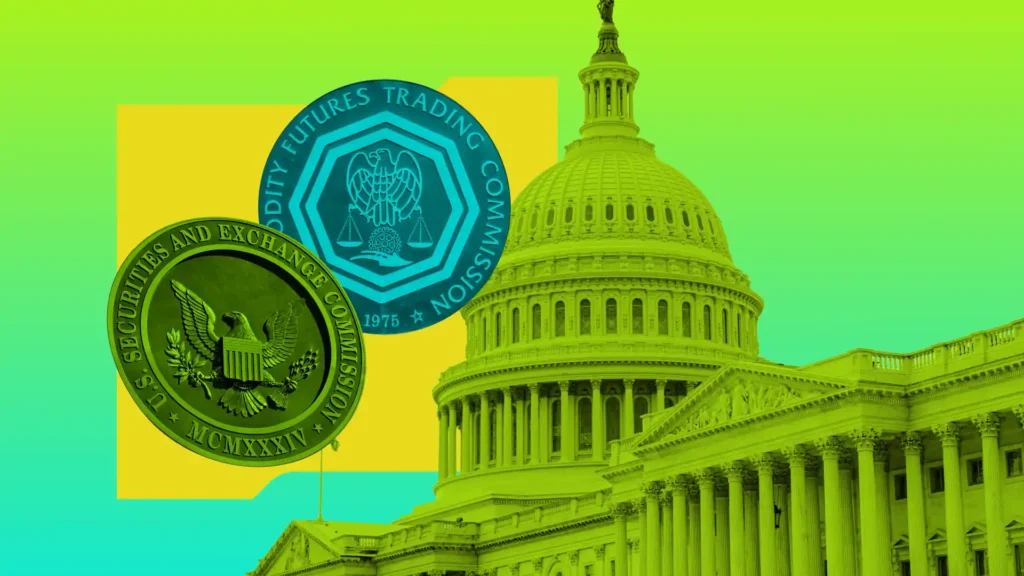
The Digital Asset Market Clarity Act, H.R. 3633, is unlikely to clear the Senate before lawmakers leave Washington. The House passed it 294–134 in July 2025; Senate Agriculture advanced its Commodity Futures Trading Commission-focused framework in January, and Senate Banking approved its portion 15–9 in May.
| Date |
Development |
| July 17, 2025 |
House passes H.R. 3633, 294–134. |
| Jan. 29, 2026 |
Senate Agriculture advances its digital-commodities framework. |
| May 14 |
Senate Banking advances H.R. 3633, 15–9. |
| July 22 |
The merged text has been released; seven Democrats object to the current version. |
| July 28 |
Majority Leader John Thune says the Senate will “probably have a vote.” |
| As of Aug 4 |
CLARITY remains absent from published floor business. |
A merged draft appeared July 22, but seven Democratic negotiators said it remained inadequate on ethics, consumer protection, illicit finance, conflicts, and market integrity.
As of Aug. 4, the CLARITY vote was absent from the Senate’s published floor schedule. With the August state work period set to begin on Aug. 10, lawmakers have just two remaining legislative days, Aug. 6 and Aug. 7, to decide the fate of one of the crypto industry’s most consequential bills before recess.
Crypto Bill Status, Procedure, and Vote Math
Committee action makes the measure eligible for floor consideration, but leadership has not publicly completed the next procedural step. Rule XXII requires 16 signatures for cloture; the vote normally occurs one hour after the Senate meets on the following calendar day but one. A Wednesday filing could therefore produce Friday action.
Cloture on the motion to proceed requires three-fifths of senators duly chosen and sworn — normally 60. With Republicans holding 53 seats, at least 7 non-Republicans are needed for the Republican conference to remain united.
The two Democrats who helped advance the Banking bill, Ruben Gallego and Angela Alsobrooks, later joined Mark Warner, Cory Booker, Catherine Cortez Masto, John Hickenlooper, and Raphael Warnock in saying the merged text “falls short.”
Chairman Tim Scott says CLARITY brings digital assets “into the sunlight,” while Cynthia Lummis calls the current period the “last real chance” for years. Elizabeth Warren labels it a “pro-industry crypto bill,” and Cortez Masto warns that the text could weaken investigators’ ability to trace illicit finance and recover victims’ assets. Law-enforcement organizations separately said the developer provisions “could create gaps in oversight and accountability.”
Political Dynamics and Probable Outcomes
Republicans frame CLARITY as innovation, consumer protection, and national security legislation. Democrats emphasize presidential conflicts, anti-money laundering gaps, and market integrity.
Coinbase CEO Brian Armstrong argued that the CLARITY Act is the result of extensive bipartisan negotiations aimed at creating long-awaited regulatory certainty for the US crypto industry. He said the legislation would strengthen consumer protections, equip law enforcement with clearer oversight tools, and keep digital asset activity within the US regulatory framework instead of pushing innovation overseas.
Armstrong also highlighted provisions that would allow banks to expand their use of stablecoins and other crypto services, describing the bill as an opportunity to reinforce America’s position as a global financial and technology leader. He urged senators to back the legislation, saying the upcoming vote would demonstrate whether lawmakers support a clear regulatory framework for the industry.
Crypto-sector groups have spent nearly $200 million in the 2026 election cycle, increasing pressure for action while reinforcing Democratic messaging about industry influence.
An EY Washington analysis, citing Punchbowl News, concluded that Republicans can force a vote on cloture to put Democrats on record, although the political benefit of doing so has diminished.
What Happens if the Clarity Act Fails?
If the CLARITY Act does not pass before the August recess, the crypto industry would not be left without a regulatory path. However, the SEC Chair Paul Atkins has repeatedly said the agency is prepared to move forward under its existing authority, including through the SEC’s Project Crypto initiative, to provide greater regulatory clarity for digital assets.
Atkins has argued that legislation remains the preferred outcome because it would establish a durable statutory framework, but said the SEC can still advance rulemaking and guidance if Congress fails to act.
That approach would provide more certainty than regulation by enforcement, although agency rules would lack the permanence of legislation and could be revised by future administrations.
Top Trending Crypto Articles
The information provided in this article is for informational purposes only. It is not intended to be, nor should it be construed as, financial advice. We do not make any warranties regarding the completeness, reliability, or accuracy of this information. All investments involve risk, and past performance does not guarantee future results. We recommend consulting a financial advisor before making any investment decisions.

Dr. Guneet Kaur is a senior editor at CCN.com and a Science Fellow at Exponential Science. She is a fintech and blockchain expert with extensive experience in digital finance education, blockchain ecosystems, and cryptocurrency markets. She has worked with global media such as Cointelegraph, as well as education and blockchain platforms, to design and lead strategic content and learning initiatives. As an educator and assessor for top-tier executive programs, she bridges real-world fintech trends with academic insight.
Dr. Kaur is also a published researcher and peer reviewer across fintech and data science journals, including Financial Innovation Journal and International Journal of Big Data Intelligence and Applications. Her work spans data-driven analysis, Web3 innovation, and technical content development. With a strong foundation in both industry and academia, she translates complex financial technologies into practical applications, empowering learners, professionals, and institutions across the rapidly evolving digital finance landscape.