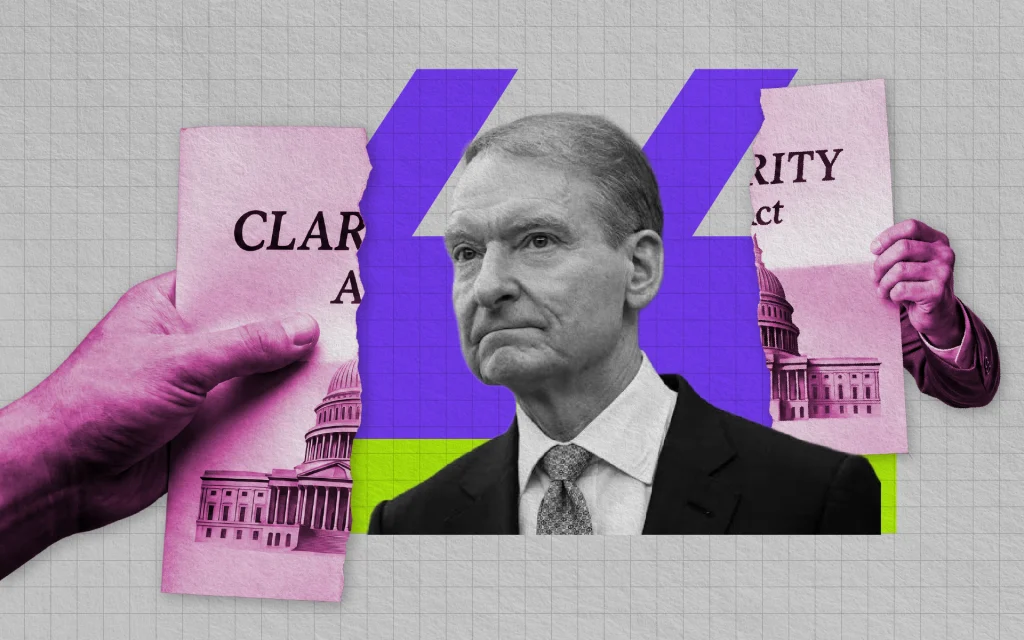
Could Sept. 15 Open the Institutional DeFi Floodgates? Former Lawmakers Say CLARITY Act Is the First Step
Share
Key Takeaways
Blockchain Association defends CLARITY Act’s DeFi protections.
DeFi liability remains the bill’s biggest sticking point.
The Senate faces a deadline before the August recess.
The Blockchain Association is pushing back against criticism from the National Sheriffs’ Association (NSA), arguing that the law enforcement group has fundamentally misunderstood how the CLARITY Act would regulate decentralized finance (DeFi).
In a letter sent to Senate Majority Leader John Thune and Senate Minority Leader Chuck Schumer, the crypto advocacy group responded point by point to the sheriffs’ objections, focusing on Section 604 of the bill, also known as the Blockchain Regulatory Certainty Act (BRCA).
The Blockchain Association has sent a letter to Senate leaders John Thune and Chuck Schumer. | Source: @BullTheoryio
According to the association, the provision does not exempt criminals from oversight. Instead, it clarifies that developers who create non-custodial blockchain software, but never take possession of customer assets, should not automatically be treated as money transmitters.
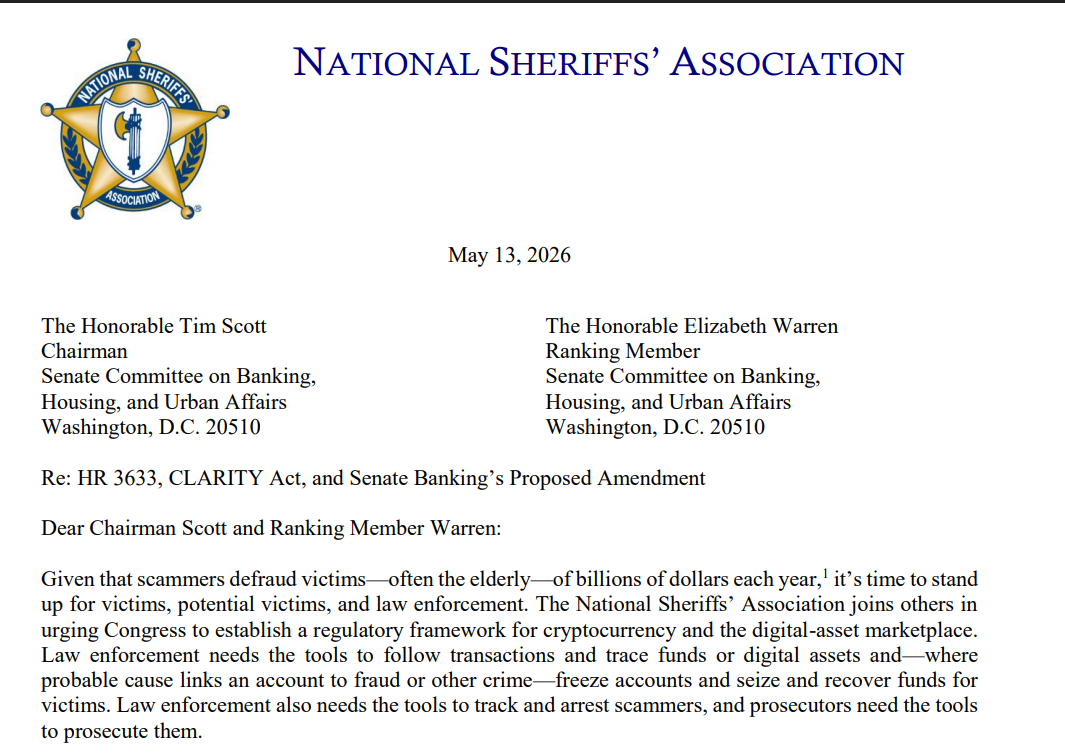
The National Sheriffs’ Association disagrees. In its own letter to the Senate Banking Committee, the group warned that the current language could create broad exemptions for mixers, tumblers, and certain DeFi participants, making it harder for investigators to trace illicit transactions, freeze criminal funds, and prosecute financial crimes involving digital assets. The organization has urged lawmakers to amend Section 604 rather than pass it in its current form.
The National Sheriffs’ Association is renewing its opposition to the CLARITY Act’s DeFi provisions. | Source: banking.senate.gov
Try Our Recommended Crypto Exchanges
Sponsored
Disclosure
We sometimes use affiliate links in our content, when clicking on those we might receive a commission at no extra cost to you. By using this website you agree to our terms and conditions and privacy policy.
The Blockchain Association argues that developers who simply publish open source, non-custodial software should not face the same regulatory obligations as exchanges or companies that actually control customer funds. It maintains that existing criminal laws, anti-money laundering requirements and sanctions enforcement would continue to apply to bad actors, even if the legislation becomes law.
The sheriffs’ group, however, argues that the proposed language could weaken law enforcement by allowing certain DeFi services to avoid registration and compliance requirements. The letter also supports amendments proposed by Senator Catherine Cortez Masto, which would narrow the exemption and focus regulation on whether a participant has custody of assets or actively facilitates digital asset transfers.
CLARITY Act Faces Pressure Ahead of Senate Recess
The exchange comes as lawmakers face increasing pressure to advance the CLARITY Act before the Senate’s August recess. The legislation is widely viewed as the most significant attempt to establish a comprehensive US regulatory framework for digital asset markets.
While the Blockchain Association insists the bill strikes the right balance between innovation and public safety, opposition from law enforcement organizations highlights how DeFi liability remains one of the most contentious sections of the legislation. The outcome of those negotiations could determine whether the bill secures enough bipartisan support to advance in the Senate.
Disclaimer:
The information provided in this article is for informational purposes only. It is not intended to be, nor should it be construed as, financial advice. We do not make any warranties regarding the completeness, reliability, or accuracy of this information. All investments involve risk, and past performance does not guarantee future results. We recommend consulting a financial advisor before making any investment decisions.
Dr. Guneet Kaur is a senior editor at CCN.com and a Science Fellow at Exponential Science. She is a fintech and blockchain expert with extensive experience in digital finance education, blockchain ecosystems, and cryptocurrency markets. She has worked with global media such as Cointelegraph, as well as education and blockchain platforms, to design and lead strategic content and learning initiatives. As an educator and assessor for top-tier executive programs, she bridges real-world fintech trends with academic insight.
Dr. Kaur is also a published researcher and peer reviewer across fintech and data science journals, including Financial Innovation Journal and International Journal of Big Data Intelligence and Applications. Her work spans data-driven analysis, Web3 innovation, and technical content development. With a strong foundation in both industry and academia, she translates complex financial technologies into practical applications, empowering learners, professionals, and institutions across the rapidly evolving digital finance landscape.