Key Takeaways
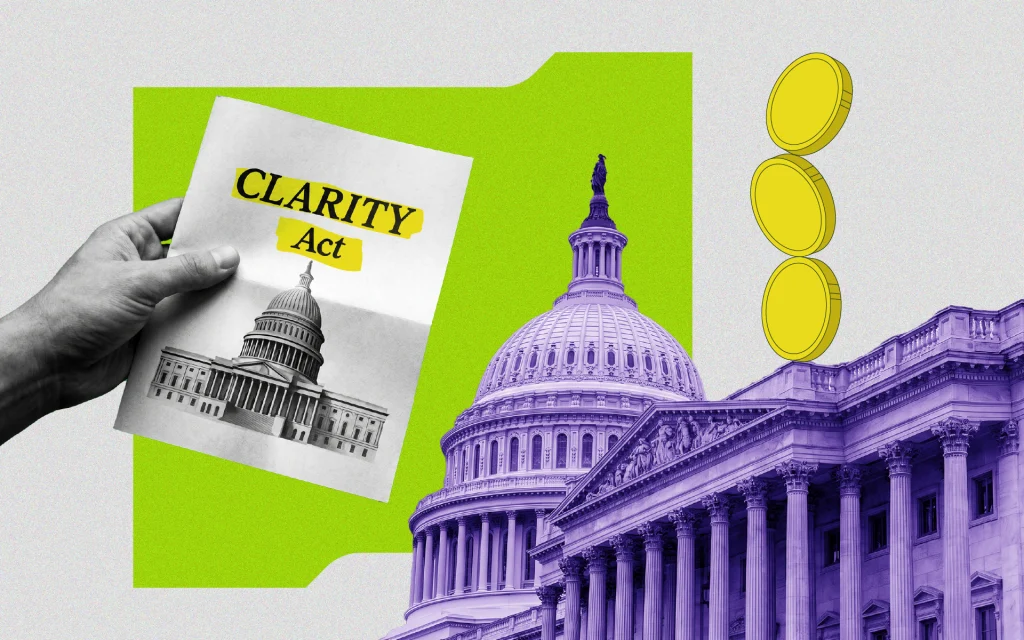
- The CLARITY Act enters its final seven-day push before the Senate’s August recess as lawmakers work to finalize a bipartisan ethics compromise that could unlock enough Democratic votes.
- More than 1 million calls and emails have been sent to US senators backing the CLARITY Act, reflecting growing grassroots pressure ahead of a potential Senate vote.
- Passage remains uncertain because the bill still needs White House approval on the ethics language and at least 60 Senate votes to overcome the filibuster.
Seven days remain before the Senate leaves for August recess, and the crypto industry’s most consequential bill is suddenly showing signs of life.
Coinbase Chief Policy Officer Faryar Shirzad said more than 1 million calls and emails have flooded senators’ offices in support of the CLARITY Act, a grassroots push that arrives just as two of the bill’s toughest negotiators claim they finally cracked the deadlock.
Crypto Bill Compromise Nobody Has Seen Yet
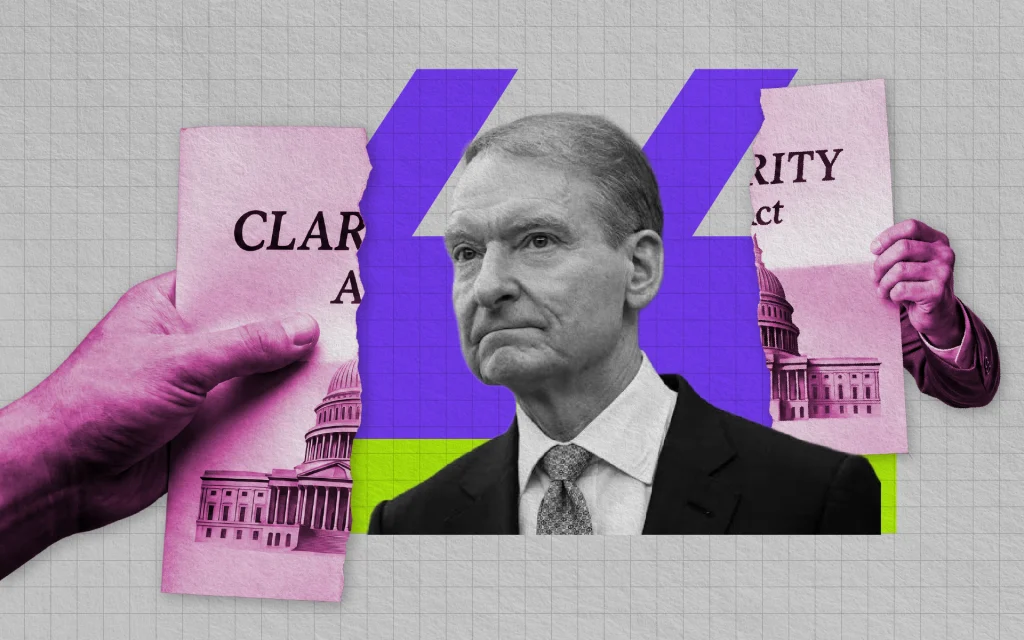
Senators Thom Tillis and Ruben Gallego have finalized a new bipartisan ethics compromise for the bill, according to people familiar with the talks, though the text has not been released publicly and still needs White House sign-off before it can move.
Ethics language, covering how officials with crypto holdings, including the president’s, are policed, has been the single provision blocking Democratic votes for months.
Eleanor Terrett reported on July 30 that sources off the Hill describe the Tillis-Gallego proposal as including a role for state attorneys general, though the full scope of the package, and what additional language may have been added to address White House concerns, remains unclear.
The latest draft was sent to the White House on Wednesday morning and is currently under review. Terrett also noted that industry representatives spent Tuesday making calls directly to the White House, arguing that locking in an ethics compromise is essential to getting the bill across the finish line. How the White House responds, she noted, could determine whether the Senate moves to a vote on the bill next week.
Galaxy Digital co-founder Mike Novogratz told Milk Road he expects the compromise to land, and to land in August.
“I think it’s going to be a last-minute small little compromise,” he said, describing a structure modeled on the Laken Riley Act, where state attorneys general can sue the Department of Justice over enforcement but cannot sue the president directly, a framework designed to give Democrats an enforcement mechanism without triggering a fight over executive immunity.
Novogratz said the exhaustion in the room is real. He recounted Senator Mark Warner telling him directly, “No matter if I never have to hear the word crypto again after this act is passed, I’ll be happy,” a line Novogratz read as evidence that senators who have spent years on the bill simply want it finished, regardless of which side claims the win.
Lummis Pushes Back on Holdouts
Senator Cynthia Lummis used a post on X to argue Democrats have already gotten far more than critics admit.
She said the bill now includes 33 Democrat-driven edits in Title I alone, 23 new illicit finance sections, 30 additional wins for the CFTC, and three entirely new titles Democrats requested, adding up to more than 100 compromises.
“‘Perfect’ stopped being principled months ago. Now it’s just an excuse not to legislate,” she wrote, calling on the Senate to pass the act now.
Why the Math Still Isn’t Settled
None of this confirms the passage of the crypto bill before August recess. Republicans hold 53 Senate seats, meaning roughly seven Democratic votes are needed to clear the 60-vote filibuster threshold, and prediction markets have priced 2026 passage in the 30% to 33% range in recent weeks, odds set before this week’s compromise reports became public.
Senators Chris Murphy, Chris Van Hollen, and Jeff Merkley have formally opposed earlier drafts over the ethics language, and Warner and Catherine Cortez Masto have tied their votes to law enforcement organizations signing off on the final text.
If the Senate leaves Washington without a floor vote, the bill does not die, but its odds worsen considerably, with the next viable window likely falling in 2027, a midterm-shadowed year less friendly to complex legislation.
That is the pressure now sitting behind every call, email, and closed-door negotiation this week: not whether the CLARITY Act eventually passes, but whether it passes before the Senate goes home.
Top Trending Crypto Articles
The information provided in this article is for informational purposes only. It is not intended to be, nor should it be construed as, financial advice. We do not make any warranties regarding the completeness, reliability, or accuracy of this information. All investments involve risk, and past performance does not guarantee future results. We recommend consulting a financial advisor before making any investment decisions.

Dr. Guneet Kaur is a senior editor at CCN.com and a Science Fellow at Exponential Science. She is a fintech and blockchain expert with extensive experience in digital finance education, blockchain ecosystems, and cryptocurrency markets. She has worked with global media such as Cointelegraph, as well as education and blockchain platforms, to design and lead strategic content and learning initiatives. As an educator and assessor for top-tier executive programs, she bridges real-world fintech trends with academic insight.
Dr. Kaur is also a published researcher and peer reviewer across fintech and data science journals, including Financial Innovation Journal and International Journal of Big Data Intelligence and Applications. Her work spans data-driven analysis, Web3 innovation, and technical content development. With a strong foundation in both industry and academia, she translates complex financial technologies into practical applications, empowering learners, professionals, and institutions across the rapidly evolving digital finance landscape.