Congress to Reject the CLARITY Act? Banks and 18 State AGs Turn Up Pressure Ahead of Today's Senate Vote
Share
Key Takeaways
The Senate is set for a crucial procedural vote on the CLARITY Act at 2:15 p.m. ET Tuesday, with supporters needing 60 votes to advance the crypto market structure bill.
A bipartisan coalition of 18 state attorneys general is urging Congress not to pass the bill as written, arguing it could weaken states’ ability to pursue crypto fraud and protect investors.
Banking groups are applying separate pressure over stablecoin rewards, arguing that the latest compromise still fails to adequately protect community bank deposits.
The CLARITY Act faces its biggest political test yet on Tuesday as the US Senate prepares for a procedural vote that could either revive Washington’s long-running effort to establish crypto market rules or send lawmakers back to negotiations.
The Senate is scheduled to vote at 2:15 p.m. ET on whether to advance the Digital Asset Market Clarity Act. The measure needs 60 votes, meaning Republicans require Democratic support to overcome the threshold.
Reuters reported that the outcome remained uncertain despite Senate Republicans releasing another revised version of the legislation on Sunday.
The timing is particularly difficult for supporters. Banks are escalating their campaign against stablecoin provisions, 18 state attorneys general are challenging the bill’s treatment of state enforcement powers, and some Democrats remain dissatisfied with its ethics protections.
Try Our Recommended Crypto Exchanges
Sponsored
Disclosure
We sometimes use affiliate links in our content, when clicking on those we might receive a commission at no extra cost to you. By using this website you agree to our terms and conditions and privacy policy.
In a letter to Senate Banking Committee Chair Tim Scott and Ranking Member Elizabeth Warren, the group argued that the legislation could restrict states from using securities and commodities laws to pursue misconduct involving digital assets.
James warned that the bill could “embolden scammers” and potentially strip state attorneys general of authority they have used to protect investors. Her office pointed to previous New York enforcement actions involving Tether, Gemini, Genesis, Coin Café and KuCoin as examples of the role states already play in crypto oversight.
That argument directly challenges one of the concessions Republicans say they made to Democrats.
The disagreement therefore is not over whether states have any role, but whether the revised language preserves enough of their existing authority.
Banks Say Stablecoin Compromise Still Falls Short
Banks are attacking the legislation from another direction.
The American Bankers Association and other banking groups argue that stablecoin issuers and intermediaries could effectively offer interest-like incentives that compete with traditional deposits.
Their concern is that attractive stablecoin rewards could pull money out of community banks, reducing funding available for mortgages, agricultural loans and small-business credit.
Nearly 80 state banking associations previously joined the ABA and Independent Community Bankers of America in pushing for stronger language.
Many of us have mentioned how the stablecoin yield debate playing out in Clarity, and the arguments made against yield by the bank trades, mirror the battle over money market funds in the 1970s. Well here's some proof.
The latest draft gives the Treasury secretary authority to intervene if stablecoins cause a “substantial detrimental impact” on community banks with less than $10 billion in assets. Regulators could then move against stablecoin reward structures after assessing the impact.
Treasury Secretary Scott Bessent has presented the additional authority as protection for community banks.
Banking groups are unconvinced.
“A circuit breaker that activates only after substantial deposit flight has already occurred is not a safeguard at all,” the groups said, arguing Congress should prevent interest-like stablecoin payments before damage occurs.
🚨NEW: Eight banking trade groups say the deposit flight “circuit breaker” added to the new Clarity Act text is “not a safeguard at all,” arguing it would only kick in after substantial deposit flight had already occurred.
Crypto companies take the opposite view. The industry has argued that overly broad restrictions on stablecoin rewards could protect incumbent banks from competition rather than address genuine financial stability risks.
The disagreement has become one of the central fault lines in negotiations.
Sen. Elizabeth Warren remains among the bill’s strongest critics. On Monday, she argued that the latest CLARITY Act would not adequately prevent Trump from profiting from crypto ventures and separately pushed legislation targeting banking interests owned by senior government officials.
Republicans say they have moved substantially toward Democratic demands. The final draft incorporates much of an ethics proposal associated with Senators Thom Tillis and Ruben Gallego, alongside the more than 100 other negotiated changes.
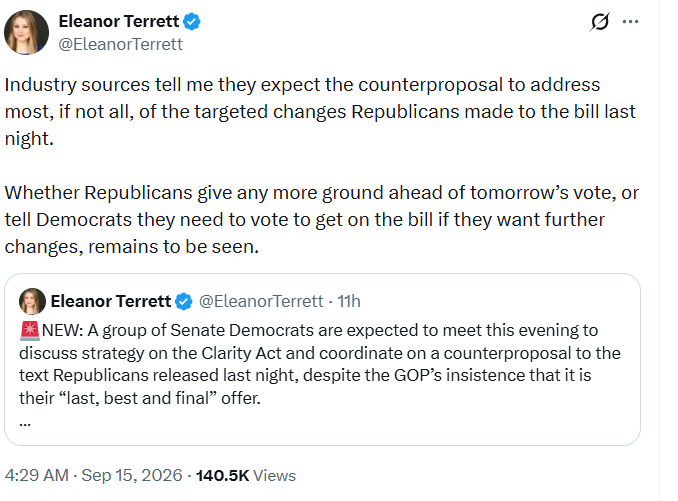
Senate Democrats prepare a CLARITY Act counterproposal ahead of the key vote. |Source: @EleanorTerrett
Lummis argues that passing legislation is preferable to leaving digital-asset policy dependent on shifting SEC and CFTC interpretations between administrations. She says the bill would create durable rules while protecting developers and clarifying oversight of decentralized finance.
The bill also has heavyweight institutional supporters. Lummis’ office lists BlackRock, Fidelity, Franklin Templeton, Goldman Sachs, Charles Schwab and SoFi among organizations backing the legislation. Several law-enforcement groups have also supported it or withdrawn previous opposition.
That leaves Tuesday’s vote finely balanced.
Failure to reach 60 votes would not necessarily kill US crypto market structure legislation permanently. But with Congress moving closer to the midterm election period, another delay could sharply narrow the window for passing a comprehensive framework in 2026.
For now, the fight has moved beyond the familiar crypto-versus-regulators debate. Banks, state prosecutors, crypto companies, Republicans and Democrats are all pushing competing versions of what “clarity” should actually mean — and Today’s vote will reveal whether enough senators believe the latest compromise has found it.
Disclaimer:
The information provided in this article is for informational purposes only. It is not intended to be, nor should it be construed as, financial advice. We do not make any warranties regarding the completeness, reliability, or accuracy of this information. All investments involve risk, and past performance does not guarantee future results. We recommend consulting a financial advisor before making any investment decisions.
Dr. Guneet Kaur is a senior editor at CCN.com and a Science Fellow at Exponential Science. She is a fintech and blockchain expert with extensive experience in digital finance education, blockchain ecosystems, and cryptocurrency markets. She has worked with global media such as Cointelegraph, as well as education and blockchain platforms, to design and lead strategic content and learning initiatives. As an educator and assessor for top-tier executive programs, she bridges real-world fintech trends with academic insight.
Dr. Kaur is also a published researcher and peer reviewer across fintech and data science journals, including Financial Innovation Journal and International Journal of Big Data Intelligence and Applications. Her work spans data-driven analysis, Web3 innovation, and technical content development. With a strong foundation in both industry and academia, she translates complex financial technologies into practical applications, empowering learners, professionals, and institutions across the rapidly evolving digital finance landscape.