Key Takeaways
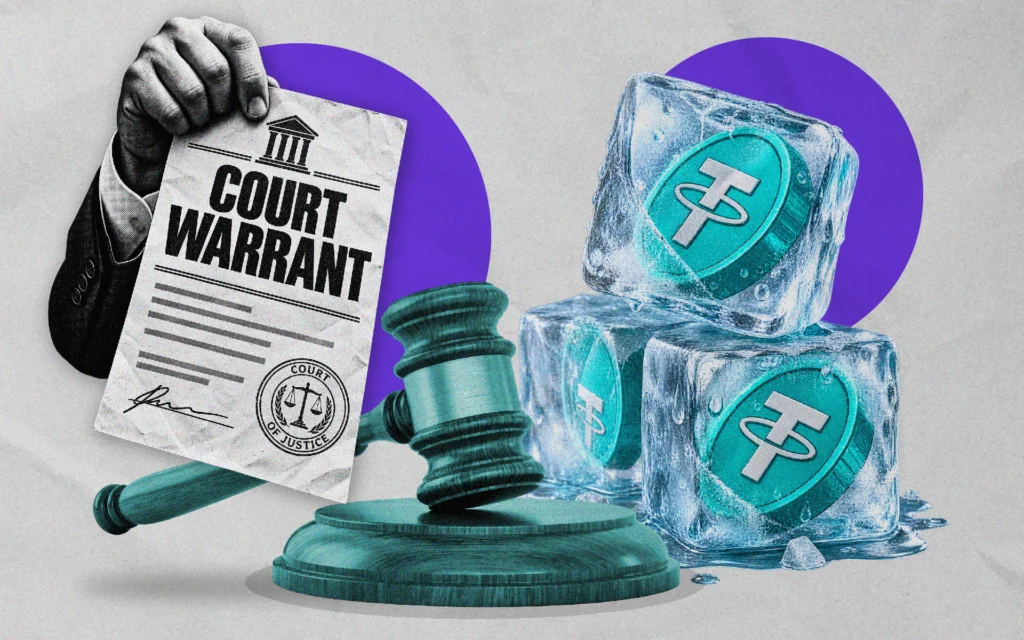
- Two Thai businessmen are suing Tether after 42.4 million USDT across 10 Ethereum wallets was blacklisted in October 2025, months before a federal seizure warrant was issued.
- The lawsuit does not establish that Tether acted unlawfully. Tether calls the case “baseless” and says its cooperation with law enforcement helps prevent criminal use of USDT.
- Tether says it has frozen more than $4.4 billion in assets while working with over 340 law enforcement agencies across 65 countries.
Holding USDT in a self-custody wallet gives users control over their private keys, but it does not necessarily mean the tokens themselves cannot be frozen.
A new $42.4 million lawsuit against Tether is putting that distinction under scrutiny.
Thai businessmen Nutthawat Rukthammachalern and Natthawat Kasamvilas filed a complaint in the Southern District of New York on Aug. 31. They allege Tether blacklisted 42,417,785.62 USDT across 10 Ethereum addresses on Oct. 30, 2025, following an informal request from a Homeland Security Investigations agent. According to the complaint, no warrant or other legal process had been issued at that point.
A federal magistrate judge in North Carolina issued a seizure warrant on Feb. 19, 2026, more than three months later.
Can Tether Freeze USDT in a Self-Custody Wallet?
Technically, Tether can blacklist addresses holding USDT. The tokens remain visible onchain, but a blacklisted address cannot transfer them. Tether also has administrative functions allowing it to burn frozen USDT and issue replacement tokens.
The legal question is different.
The plaintiffs argue that Tether lacked authority to impose the original freeze before the warrant existed. They say they acquired the tokens through secondary-market transactions and had no direct contractual relationship with Tether. They are asking the court to remove the blacklist, prevent destruction of the disputed tokens before a final forfeiture ruling, and award damages.
Tether rejects that argument, calling the lawsuit a “baseless attempt” to interfere with its work alongside global law enforcement.
No court has yet decided whether the plaintiffs own the disputed USDT or whether Tether’s actions were unlawful.
$42.4M Is Part of a Bigger $61M Case
The disputed funds appear connected to a wider federal investigation.
On Feb. 24, the Justice Department announced the seizure of more than $61 million in USDT allegedly traced to wallets involved in laundering proceeds from crypto investment scams. The DOJ specifically thanked Tether for helping transfer the assets.
It is far from Tether’s first major freeze.
In April, Tether said it helped US authorities freeze another $344 million in USDT across two addresses. The company says cooperation with more than 340 agencies across 65 countries has resulted in over $4.4 billion being frozen, including more than $2.1 billion connected to US authorities.
Federal filings from an unrelated North Korean money-laundering case also show that Tether voluntarily froze USDT addresses in March and April 2023, years before the government’s June 2025 civil forfeiture complaint.
The latest lawsuit, therefore, raises a broader question for stablecoin users: self-custody protects control of wallet keys, but does it also protect control of an issuer-managed asset within that wallet?
For USDT, the answer is not absolute. The blockchain may be decentralized, but the token still has an issuer who can prevent it from moving.
Top Trending Crypto Articles
The information provided in this article is for informational purposes only. It is not intended to be, nor should it be construed as, financial advice. We do not make any warranties regarding the completeness, reliability, or accuracy of this information. All investments involve risk, and past performance does not guarantee future results. We recommend consulting a financial advisor before making any investment decisions.

Dr. Guneet Kaur is a senior editor at CCN.com and a Science Fellow at Exponential Science. She is a fintech and blockchain expert with extensive experience in digital finance education, blockchain ecosystems, and cryptocurrency markets. She has worked with global media such as Cointelegraph, as well as education and blockchain platforms, to design and lead strategic content and learning initiatives. As an educator and assessor for top-tier executive programs, she bridges real-world fintech trends with academic insight.
Dr. Kaur is also a published researcher and peer reviewer across fintech and data science journals, including Financial Innovation Journal and International Journal of Big Data Intelligence and Applications. Her work spans data-driven analysis, Web3 innovation, and technical content development. With a strong foundation in both industry and academia, she translates complex financial technologies into practical applications, empowering learners, professionals, and institutions across the rapidly evolving digital finance landscape.