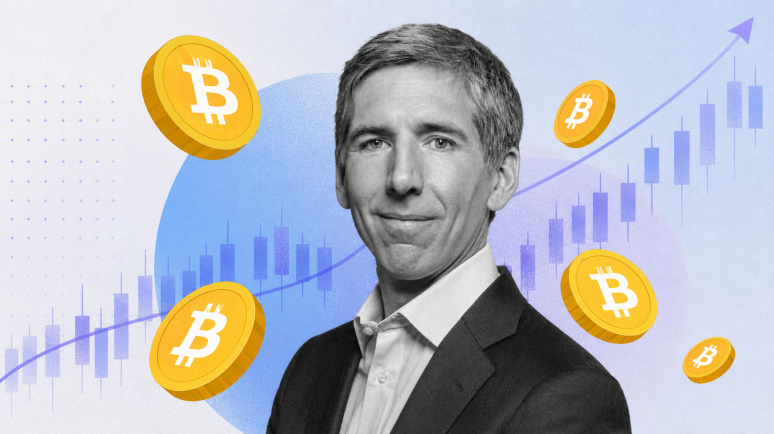
The bounce comes as Cubic Analytics founder Caleb Franzen outlined a bullish scenario extending toward $205,000.
Try Our Recommended Crypto Exchanges
Sponsored
Disclosure
We sometimes use affiliate links in our content, when clicking on those we might receive a commission at no extra cost to you. By using this website you agree to our terms and conditions and privacy policy.
Trump Sets November Deadline for Iran Strike Pause
Trump said on Oct. 8 that Washington would refrain from attacking Iran before the Nov. 3 congressional elections, highlighting ongoing diplomatic discussions.
“We are having productive discussions with the Islamic Republic of Iran,” he wrote on Truth Social.
Trump also said the US blockade would continue, maintaining economic pressure while negotiations proceed.
Oil prices eased on Friday following the announcement, with Brent trading around $103 a barrel during the morning.
The decline offers some relief from the energy-price pressures surrounding the conflict, although the timing alone does not establish that Trump’s statement caused Bitcoin’s recovery.
CCN previously reported that Bitcoin traded near $82,600 during early Asian trading, still short of the levels reached during its recent move above $87,000.
Franzen Sees a New Bitcoin Bull Market
Speaking with host John Gillen on Milk Road Crypto’s Oct. 7 episode, Franzen said Bitcoin’s technical behavior had persuaded him to reverse the bearish stance he adopted in November 2025.
Two developments drove that change, including an August breakout above Bitcoin’s 200-day moving-average cloud and a weekly price gain exceeding 20%.
Franzen argued that Bitcoin’s August move differed from earlier failed recovery attempts because it sustained the breakout.
“I think Bitcoin has re-entered a new bull market environment,” he said.
His research also highlighted Bitcoin’s 21-day exponential moving average crossing above its 200-day equivalent.
According to Franzen’s historical analysis, that signal was followed by average gains of approximately 33% over three months, 43.4% over six months, and 153% over one year.
What Would It Take For BTC to Reach $205K?
Franzen outlined several potential upside levels, including approximately $142,000, $159,000, and $205,000.
Starting from its current $82,600 price, reaching $205,000 would require a gain of roughly 148%.
BTC would first need to recover its previous record near $126,000.
Despite being asked about the end of 2026, Franzen did not commit to reaching his highest target by then.
During the interview, he placed the BTC 200-day exponential moving average near $75,135.
“If we break down below that 200 day moving average cloud, we fall below 71,000, then those targets temporarily are going to be invalidated,” he said.
From $82,600, a decline to $71,000 would represent approximately 14% downside.
$729M ETF Exodus Tests Bitcoin Recovery
Bitcoin’s rebound also faces a measurable demand challenge.
Farside Investors’ data shows US spot BTC ETFs recorded net outflows of $484.9 million on Oct. 7 and $244.1 million on Oct. 8 — a combined $729 million.
BlackRock’s IBIT accounted for $207.7 million of Wednesday’s withdrawals, while Fidelity’s FBTC recorded $197.1 million in outflows on Thursday.
The withdrawals highlight that the price recovery has coincided with selling through a major investment channel.
Disclaimer:
The information provided in this article is for informational purposes only. It is not intended to be, nor should it be construed as, financial advice. We do not make any warranties regarding the completeness, reliability, or accuracy of this information. All investments involve risk, and past performance does not guarantee future results. We recommend consulting a financial advisor before making any investment decisions.
Kurt Robson is a London-based reporter at CCN, specialising in the fast-moving worlds of crypto and emerging technology. He began his career covering local news in Cornwall after graduating from Falmouth University with First Class Honours in Journalism. There, he cut his teeth on everything from council meetings to missing swans.
He quickly rose through the ranks to become a frontline journalist at several of the UK’s leading national newspapers. Over the years, he has interviewed musicians and celebrities, reported from courtrooms and crime scenes, and secured multiple front-page exclusives.
Following the upheaval of the COVID-19 pandemic, Kurt shifted his focus to technology journalism—just ahead of the AI boom. With a natural curiosity and a trained eye for emerging trends, he has found a new rhythm in reporting on innovation.
At CCN, Kurt's work focuses on the cutting edge of crypto, blockchain, AI, and the evolving digital world. Drawing on his background in people-first reporting and his deep interest in disruptive tech, Kurt delivers stories that are insightful, entertaining, and human-centric.













 Nearly 1 in 3 Bitcoin Is Sitting With Its Public Key Exposed, and the Number Keeps Growing