Glassnode says 6.3M BTC has public keys exposed on-chain, highlighting the scale of Bitcoin’s potential future quantum-security migration. | Credit: CCN.com
Share
Key Takeaways
Glassnode says 6.26 million BTC, or 31.2% of issued supply, sits behind public keys already visible on-chain.
Address reuse accounts for 4.33 million BTC, making it the largest source of exposure.
Exposed supply grew by 222,000 BTC since May, with exchanges contributing 123,000 BTC.
Nearly a third of Bitcoin’s issued supply is held by public keys already visible on the blockchain, according to figures shared by Glassnode co-founder Rafael Schultze-Kraft, putting the scale of a potential future migration into sharper focus.
Schultze-Kraft said 6.26 million BTC, or 31.2% of supply, falls into this category.
The share has climbed from 24.8% in early 2021, returning to levels last seen in 2016.
The figures measure public-key exposure, rather than stolen funds or compromised wallets. They nevertheless highlight how address practices could shape Bitcoin’s preparedness for future cryptographic threats.
New Trending Crypto Wallet Offers
Sponsored
Disclosure
We sometimes use affiliate links in our content, when clicking on those we might receive a commission at no extra cost to you. By using this website you agree to our terms and conditions and privacy policy.
The largest source of exposure is address reuse, accounting for approximately 4.33 million BTC, according to Schultze-Kraft.
Some Bitcoin output types initially conceal public keys behind hashes. Spending reveals the relevant key, leaving any remaining or subsequently received coins associated with that same key exposed under Glassnode’s methodology.
Another approximately 1.94 million BTC is exposed through script types that make public keys visible by design. Schultze-Kraft’s breakdown includes 1.71 million BTC in early pay-to-public-key (P2PK) outputs and 222,000 BTC in Taproot outputs.
6.26M #BTC, or 31.2% of supply, sits behind a public key that is already visible on-chain.
At least that much would have to move in a migration to addresses whose keys are still hidden behind a hash.
The share is up from 24.8% in early 2021 and back at 2016 levels.
Around 1.10 million BTC within the P2PK category is attributed to Satoshi Nakamoto, Bitcoin’s pseudonymous creator. That attribution remains an estimate, rather than confirmed ownership.
Taproot presents a different case: its output key is visible from the outset. Consequently, moving funds to a fresh address does not necessarily conceal their public key; the destination’s script type also matters.
Since Glassnode’s May report, exposed supply has increased by 222,000 BTC, while total issued supply grew by 64,000 BTC, Schultze-Kraft said.
That gap indicates that changing wallet usage and output composition are expanding the exposed balance beyond Bitcoin’s newly mined supply.
Exchanges Hold 1.79 Million BTC Behind Visible Keys
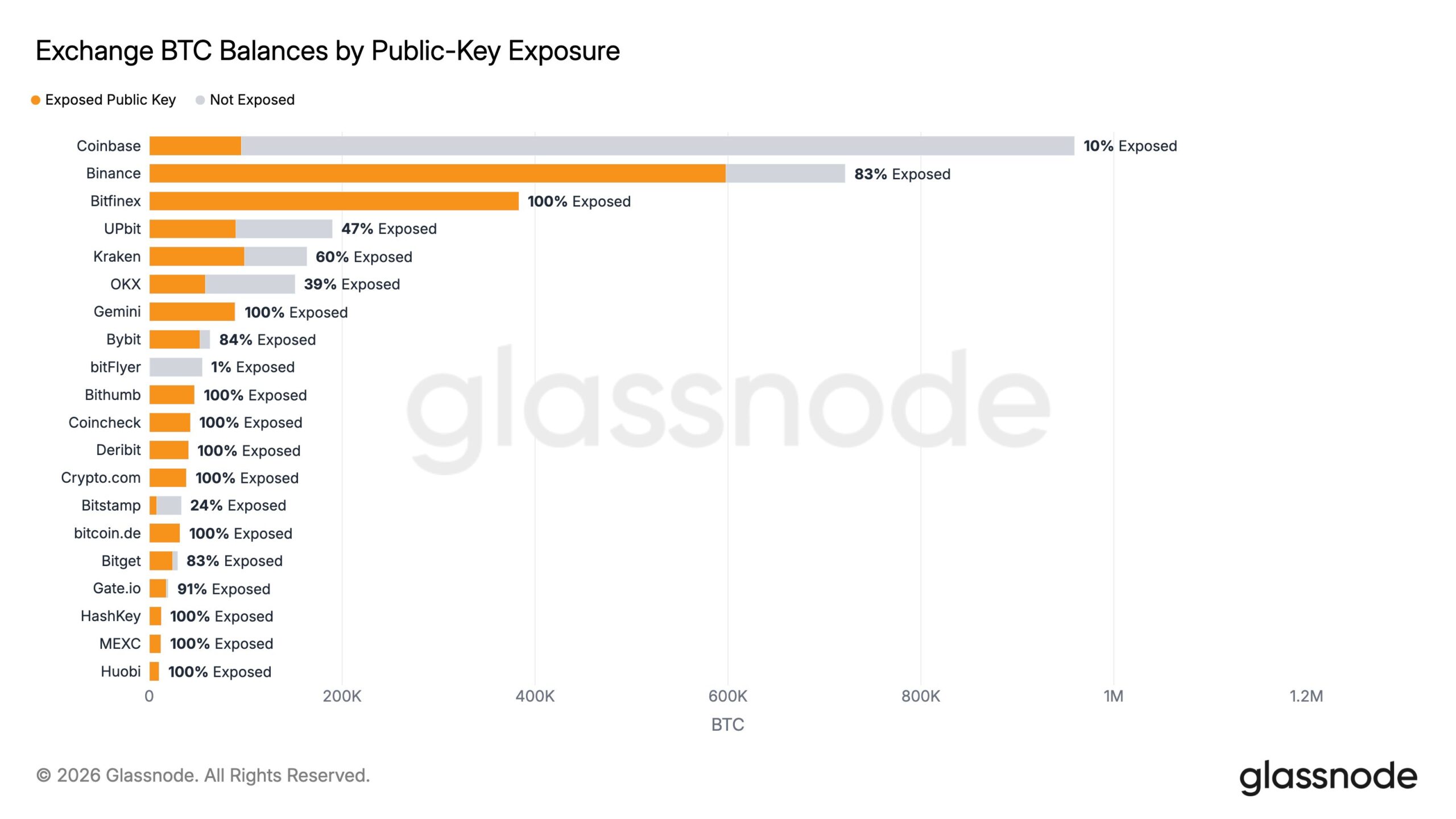
Exchanges account for 1.79 million BTC held behind visible public keys, representing 57% of their identified balances.
That proportion has increased from 55% in May to 39% at the beginning of 2021. Exchanges contributed 123,000 BTC to the increase in exposed supply since May.
The figures vary substantially across platforms. Schultze-Kraft reported exposure of 10% for Coinbase, 83% for Binance, and 100% for Bitfinex. Seven of the 15 largest exchange balances exceeded 99%.
Exchanges hold 1.79 million BTC behind visible public keys. | Credit: Glassnode
Among other tracked entities, Fidelity held approximately 375,000 BTC with 2% exposed. Grayscale’s share stood at 49%, Revolut’s at 99%, and Robinhood’s at 100%.
Identified holdings of the US, UK, and El Salvador governments showed 0% exposure.
Schultze-Kraft emphasized that these percentages describe address usage, not a security ranking or solvency assessment. The entity figures cover only labeled addresses, limiting conclusions about an institution’s complete holdings.
Hidden Public Keys Offer Limited Protection
The update followed Ethereum researcher Justin Drake’s call for the industry to plan for “bunker mode,” including a controlled migration toward fresh addresses whose public keys remain concealed behind hashes.
The quantum concern is that a sufficiently capable computer running Shor’s algorithm could recover private keys from exposed public keys. That remains a conditional threat, with the timing and feasibility uncertain.
Keeping keys hidden reduces exposure while funds remain unspent. It does not provide complete post-quantum protection: spending can reveal the key before a transaction confirms, creating a separate attack window.
Migration also depends on access. Coins whose private keys are lost cannot be voluntarily moved, while inactive holders may never participate.
Glassnode’s growing tally therefore measures both an address-management issue active custodians can address and a legacy problem that could require broader protocol decisions. It establishes the scale of preparation without establishing a deadline for action.
Disclaimer:
The information provided in this article is for informational purposes only. It is not intended to be, nor should it be construed as, financial advice. We do not make any warranties regarding the completeness, reliability, or accuracy of this information. All investments involve risk, and past performance does not guarantee future results. We recommend consulting a financial advisor before making any investment decisions.
Giuseppe Ciccomascolo began his career as an investigative journalist in Italy, where he contributed to both local and national newspapers, focusing on various financial sectors.
Upon relocating to London, he worked as an analyst for Fitch's CapitalStructure and later as a Senior Reporter for Alliance News. In 2017, Giuseppe transitioned to covering cryptocurrency-related news, producing documentaries and articles on Bitcoin and other emerging digital currencies. He also played a pivotal role in establishing the academy for a cryptocurrency exchange website. Crypto remained his primary area of interest throughout his tenure as a writer for ThirdFloor.