Bitcoin held $62,000 support, but Glassnode says a daily close below that level could trigger liquidations and send BTC toward $53,700. | Credit: CCN.com
Share
Key Takeaways
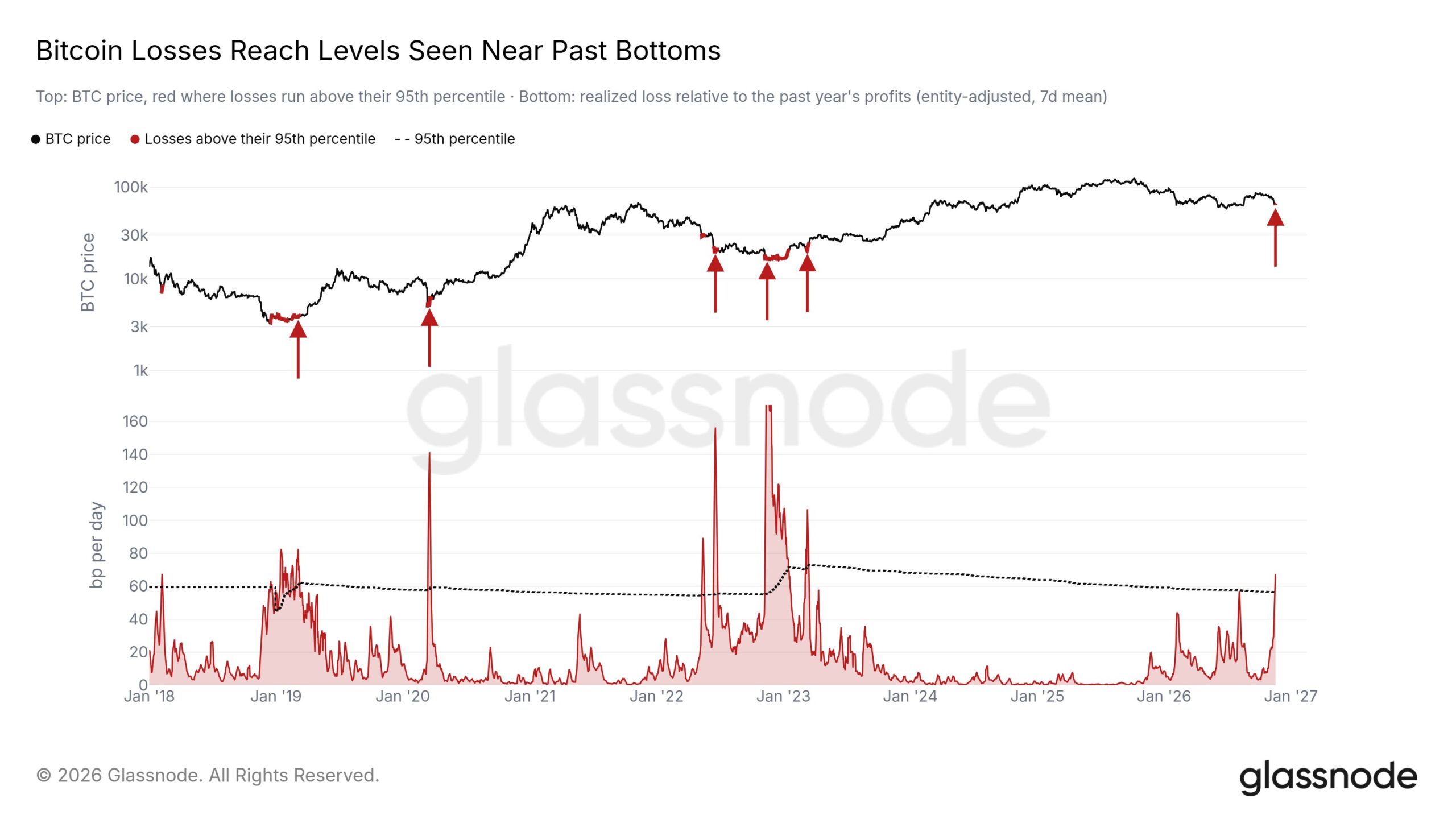
Bitcoin held the $62,000–$66,000 support zone after realized losses reached levels last seen near previous market bottoms.
Glassnode warned that a daily close below $62,000 could trigger further liquidations of long positions.
A recovery above $74,100, the average break-even level for short-term holders, would strengthen the case that Bitcoin is forming a bottom.
Bitcoin held the lower edge of a key support zone after falling to $62,000 on Nov. 15, but Glassnode warned that a daily close below that level could accelerate selling and expose the crypto to a deeper decline toward $53,700.
The blockchain analytics firm said the selloff pushed realized losses to levels last seen near previous market lows and wiped out much of the leveraged buying above $62,000.
Try Our Recommended Crypto Exchanges
Sponsored
Disclosure
We sometimes use affiliate links in our content, when clicking on those we might receive a commission at no extra cost to you. By using this website you agree to our terms and conditions and privacy policy.
Glassnode found that realized losses, which investors lock in when they sell coins below their purchase price, surged relative to profits taken over the previous year.
The ratio reached levels seen near market lows in 2018, 2020, 2022 and early 2023.
Recent buyers drove much of the selling. Holders of coins acquired within the past six months had taken profits during the September and October rally, but began selling at a loss again as prices fell.
Investors who had held their coins for one to three years were comparatively quiet after their last wave of major profit-taking in late 2025.
Bitcoin losses reached levels seen near past bottoms. | Credit: Glassnode
The selloff also forced leveraged traders out of the market. Relative to outstanding futures positions, Nov. 13 and 14 saw some of the largest liquidations of long positions since 2023.
Glassnode’s estimates show that most leveraged long positions vulnerable to liquidation above $62,000 had already been closed, with a sizable cluster remaining below that level.
Why $62,000 Is the Level to Watch
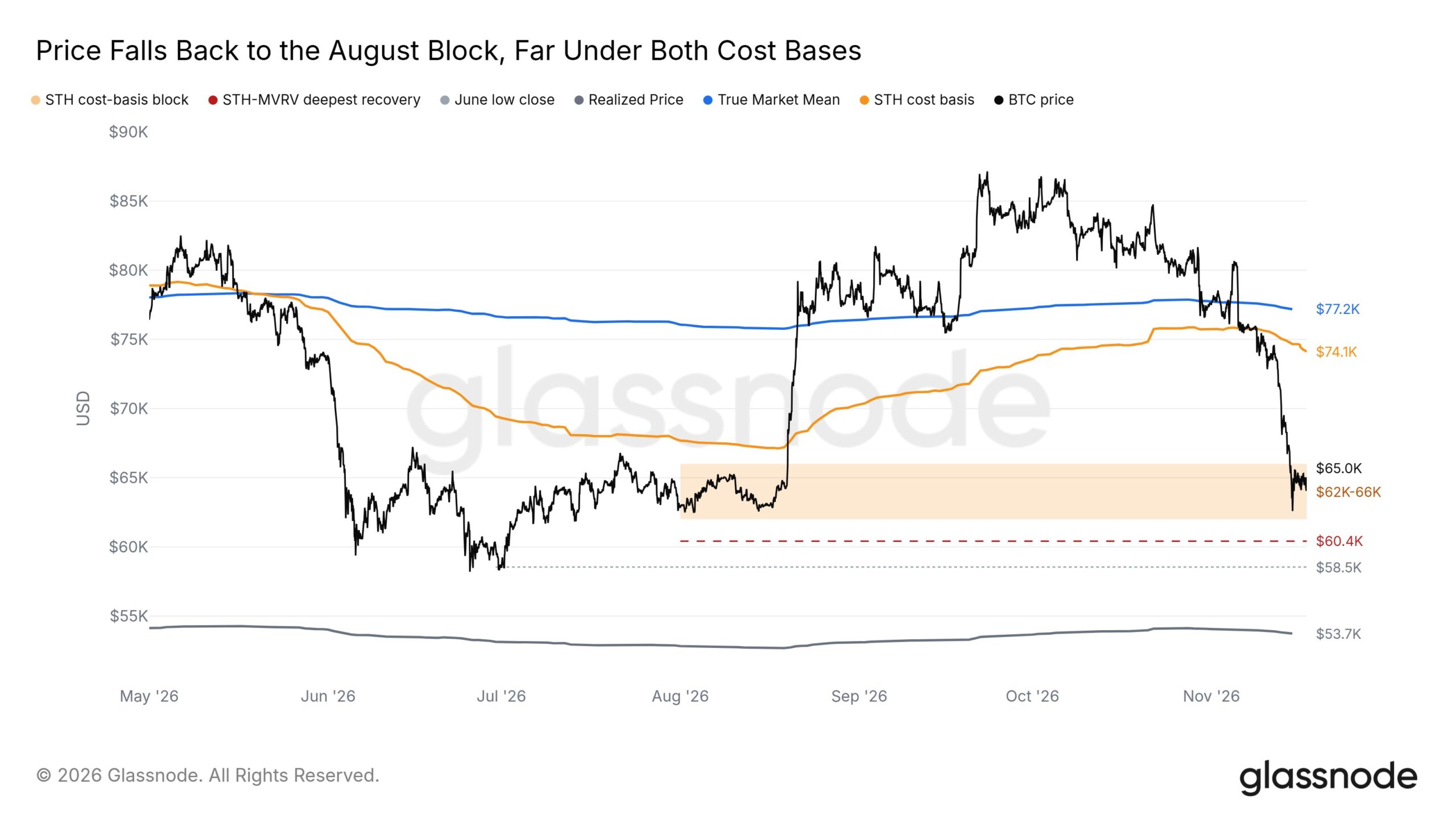
The $62,000 to $66,000 range formed around Bitcoin’s August low and accounts for roughly one-fifth of the coins held by short-term investors.
The amount of Bitcoin in that cost-basis band increased by about 66,000 BTC over the two days of heaviest selling, indicating that buyers absorbed some of the supply.
Glassnode said a daily close below $62,000 would leave buyers across that range underwater. Few recent buyers acquired coins below the zone, while a cluster of potential long liquidations is concentrated around $60,000.
Price falls back to the August block. | Credit: Glassnode
Forced selling could speed up a move toward June’s $58,500 low and then $53,700, Bitcoin’s realized price, an on-chain measure of the average price at which coins last moved.
Buy orders within 5% of the market price on Binance and Coinbase outweighed sell orders by about 2.3 to one. Binance’s largest concentration of buy orders since August sat near $60,000, although traders can cancel those orders before they are filled.
On the upside, Glassnode identified $74,100 as the average break-even level for short-term holders. A move back above it would strengthen the case that Bitcoin is forming a bottom.
ETF Outflows and Shrinking Stablecoin Supply Weigh on Demand
US spot Bitcoin ETFs recorded $2.6 billion in net outflows over the 10 trading days through Nov. 13. Bitcoin briefly traded at a premium on Coinbase as US buyers stepped in around the Nov. 15 low, reversing a discount that had persisted for most of the period since late October.
That premium faded back into a small discount, leaving Glassnode looking for a sustained recovery as evidence of a return in US demand.
Bitcoin spot ETFs have seen approximately 25,600 BTC leave the funds across the last 9 reported trading sessions.
Yesterday alone, another 3,700 BTC in net outflows was recorded.
That's a pretty significant shift in institutional demand.
Stablecoin supply also fell 4.2% over 90 days as three-month US Treasury bill yields rose about 45 basis points. Glassnode said higher yields can draw traders out of stablecoins and into Treasury bills or money market funds, reducing the cash available to deploy in crypto markets.
Deribit options implied a roughly one-in-three chance that Bitcoin would settle below $53,700 at the September 2027 expiry. In the near term, Glassnode’s downside scenario hinges on whether Bitcoin closes below $62,000.
Disclaimer:
The information provided in this article is for informational purposes only. It is not intended to be, nor should it be construed as, financial advice. We do not make any warranties regarding the completeness, reliability, or accuracy of this information. All investments involve risk, and past performance does not guarantee future results. We recommend consulting a financial advisor before making any investment decisions.
Giuseppe Ciccomascolo began his career as an investigative journalist in Italy, where he contributed to both local and national newspapers, focusing on various financial sectors.
Upon relocating to London, he worked as an analyst for Fitch's CapitalStructure and later as a Senior Reporter for Alliance News. In 2017, Giuseppe transitioned to covering cryptocurrency-related news, producing documentaries and articles on Bitcoin and other emerging digital currencies. He also played a pivotal role in establishing the academy for a cryptocurrency exchange website. Crypto remained his primary area of interest throughout his tenure as a writer for ThirdFloor.











 ‘AI Is Built Around the User’: Fraser Edwards on How To Repair the Broken Data Economy