Bitcoin whales face nearly $8 billion in unrealized losses as sentiment plunges, with $60,000 emerging as a crucial support level. | Credit: CCN.com
Share
Key Takeaways
Bitcoin’s short-term holder whales face a record nearly $8 billion in unrealized losses following a roughly 30% decline since October.
Whale inflows to Binance have increased but remain below February and June peaks, suggesting no widespread panic selling.
Sentix identifies $60,000 as crucial support: holding it could support a rebound, while a breakdown risks further selling.
Bitcoin’s newest large investors are facing nearly $8 billion in unrealized losses, their highest total on record, as the cryptocurrency’s decline tests confidence across the market.
However, exchange transfers suggest these holders have yet to respond with widespread panic, according to CryptoQuant analyst Darkfost.
The divergence comes as Sentix reports a sharp deterioration in Bitcoin sentiment, raising the possibility of a contrarian rebound while highlighting $60,000 as a critical support level.
Together, the findings describe a market under considerable financial and psychological pressure, but without clear evidence that recent whale buyers have collectively abandoned their positions.
Try Our Recommended Crypto Exchanges
Sponsored
Disclosure
We sometimes use affiliate links in our content, when clicking on those we might receive a commission at no extra cost to you. By using this website you agree to our terms and conditions and privacy policy.
Darkfost’s analysis focuses on short-term holder whales: large investors who accumulated Bitcoin during the past 155 days. Following a correction of approximately 30% since October, the group’s estimated unrealized losses have climbed to almost $8 billion.
These are paper losses, reflecting the gap between acquisition costs and current market valuations rather than losses necessarily locked in through sales.
Bitcoin short-term holder whales face nearly $8B in unrealized losses, a record high
CryptoQuant analyst Darkfost data shows short-term holder whales that heavily accumulated BTC over the past 155 days are now sitting on almost $8 billion in unrealized losses. Despite BTC’s ~30%… pic.twitter.com/SWb55kyF3T
Their scale illustrates how sharply conditions have changed for investors who built substantial positions during Bitcoin’s recent recovery. It also creates a potential source of selling pressure if those holders become unwilling to tolerate further declines.
Nevertheless, the record dollar figure requires context. It measures the aggregate financial exposure of this cohort and does not, by itself, establish that every investor faces the same degree of stress.
Darkfost also cautioned that transfers associated with the Binance hack or wallet consolidations could affect the calculation. Consolidating unspent transaction outputs, or UTXOs, reorganizes Bitcoin holdings and does not necessarily represent a fresh purchase or sale.
Binance Inflows Rise Without Clear Panic
Transfers to Binance have increased, although Darkfost said their magnitude remains below levels associated with previous periods of heavier whale activity.
The monthly average inflow measure rose from approximately 1,200 BTC to 2,100 BTC. Individual daily spikes exceeded 4,000-5,000 BTC, while transfers topped 9,000 BTC on Nov. 3.
Despite those increases, inflows remained below the peaks recorded in June and February, even as the cohort’s unrealized losses reached a record. Darkfost interpreted that combination as evidence of resilience among recent large buyers.
📉 Ethereum reserves on Binance drop to their lowest level since 2021
Ethereum reserves held on Binance have just fallen to levels not seen since 2021.
Today, approximately 2.9 million ethereum:native are estimated to be held on Binance, marking their lowest level in nearly… pic.twitter.com/1IAnXwhYxX
Exchange deposits can indicate an intention to sell because they move assets onto trading platforms. However, a transfer alone does not confirm that a sale occurred, making the distinction between potential supply and executed selling important.
The current pattern therefore suggests mounting pressure without a comparable surge in exchange-bound Bitcoin. That could change if prices continue falling, particularly if holders who have absorbed losses begin prioritizing capital preservation.
For now, the available figures support a narrower conclusion: losses have escalated faster than the measured exchange response.
Sentiment Collapse Puts $60,000 in Focus
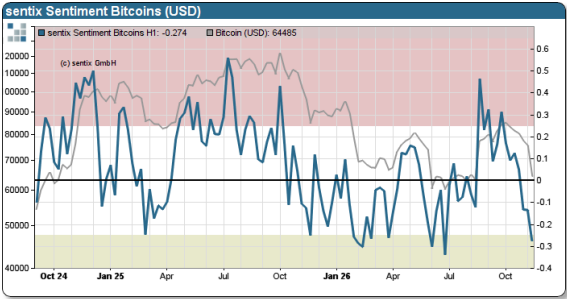
Meanwhile, the Sentix analysis shows bearish sentiment exceeding bullish sentiment by 27 percentage points. The reading is approaching levels seen around Bitcoin’s summer 2026 bottom.
Sentiment has deteriorated by 40 percentage points in four weeks, reflecting the speed with which falling prices have damaged investors’ near-term expectations.
Sentix argues that such pronounced pessimism could eventually help stabilize prices or support a recovery. Its strategic bias measure, which tracks underlying confidence, has remained comparatively resilient.
Sentix sentiment on Bitcoin vs. BTC price. | Credit: Sentix
That creates a possible divergence between immediate fear and longer-term conviction. However, extreme pessimism alone does not establish that a bottom has formed.
Sentix identifies $60,000 as the decisive technical threshold. Holding that level could preserve strategic confidence and leave room for a rebound. A sustained break below it could instead weaken that confidence and trigger further selling.
Bitcoin’s next test is whether subdued whale transfers and resilient underlying conviction can withstand another decline.
Disclaimer:
The information provided in this article is for informational purposes only. It is not intended to be, nor should it be construed as, financial advice. We do not make any warranties regarding the completeness, reliability, or accuracy of this information. All investments involve risk, and past performance does not guarantee future results. We recommend consulting a financial advisor before making any investment decisions.
Giuseppe Ciccomascolo began his career as an investigative journalist in Italy, where he contributed to both local and national newspapers, focusing on various financial sectors.
Upon relocating to London, he worked as an analyst for Fitch's CapitalStructure and later as a Senior Reporter for Alliance News. In 2017, Giuseppe transitioned to covering cryptocurrency-related news, producing documentaries and articles on Bitcoin and other emerging digital currencies. He also played a pivotal role in establishing the academy for a cryptocurrency exchange website. Crypto remained his primary area of interest throughout his tenure as a writer for ThirdFloor.