Key Takeaways
- EU regulators are scrutinizing Binance’s continued operations in the bloc despite the exchange not holding a MiCA license.
- Binance is relying on “reverse solicitation,” an exemption allowing non-EU firms to serve customers who approach them entirely on their own initiative.
- ESMA says the exemption must be interpreted very narrowly and cannot be used to circumvent MiCA licensing requirements.
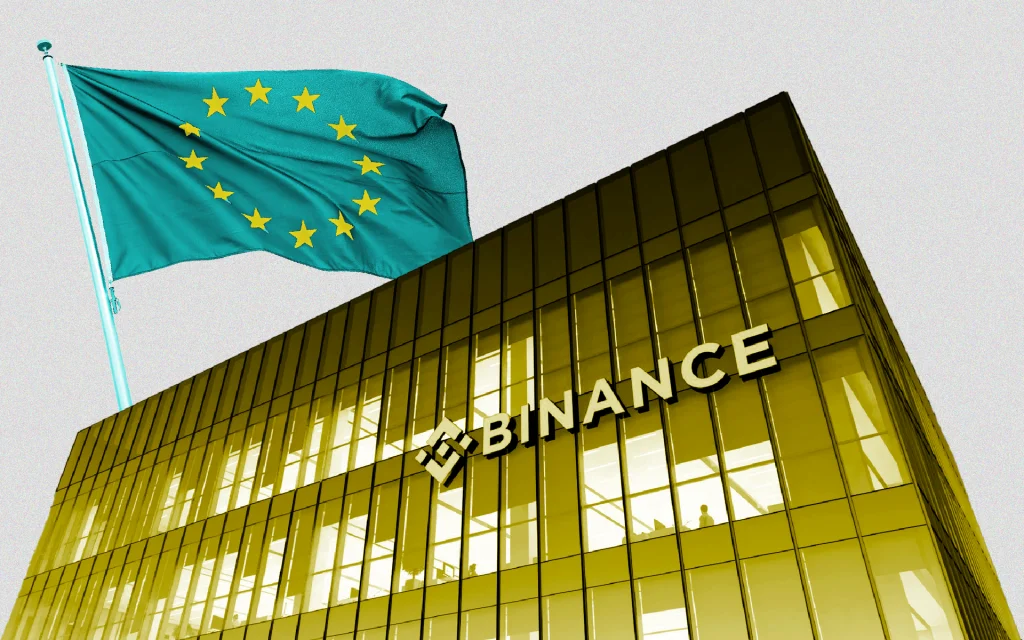
Binance is facing fresh scrutiny in Europe as regulators examine whether the world’s largest crypto exchange is relying too heavily on a narrow legal exemption to continue serving European Union customers without a Markets in Crypto-Assets (MiCA) license.
The European Securities and Markets Authority (ESMA) and national regulators are questioning Binance’s use of “reverse solicitation,” the Financial Times reported Thursday, citing people familiar with the matter.
The provision allows companies outside the EU to provide services to European customers when those customers approach the company entirely on their own initiative.
The scrutiny comes three months after the end of the MiCA transitional period. Crypto-asset service providers without the necessary authorization were expected to wind down their EU operations once the deadline passed.
Binance entered July without a MiCA license after withdrawing its application with Greece’s Hellenic Capital Market Commission on June 24.
Some regulators have now requested information from Binance about its continued activity in Europe. Authorities could pursue enforcement measures, including fines, if they conclude that the exchange’s interpretation of the exemption breaches MiCA.
Binance Is Leaning on MiCA’s Reverse Solicitation Exemption
At the heart of the dispute is Article 61 of MiCA, which provides a limited route for companies based outside the EU to serve customers in the bloc without obtaining authorization.
The exemption applies when an EU customer initiates contact with the foreign company at their “own exclusive initiative.” That distinction matters because ESMA has deliberately adopted a broad interpretation of what constitutes solicitation.
Its guidelines make clear that solicitation is not limited to direct sales pitches. Promotions, advertisements, and even broader brand advertising can potentially prevent a third-country company from relying on Article 61.
ESMA explicitly rejected a narrower interpretation, saying such an approach could create a loophole for foreign companies to circumvent MiCA.
That makes the exemption difficult to apply to large consumer-facing exchanges with established European user bases.
According to the FT, some services involving European customers have also been routed through a Binance entity regulated in Abu Dhabi.
Binance has previously highlighted its regulatory approvals under the Abu Dhabi Global Market framework as part of its broader compliance push.
An Abu Dhabi entity, however, remains a third-country provider from MiCA’s perspective. Its ability to serve EU customers without European authorization therefore depends on whether the activity genuinely meets the requirements for reverse solicitation.
Binance Still Has No MiCA License
The current dispute follows Binance’s unsuccessful attempt to secure authorization before the end of the MiCA transition period.
The exchange had sought approval through Greece, which could have allowed it to operate across the bloc under MiCA’s passporting framework.
On June 24, however, Binance announced that it had withdrawn its application and would instead seek authorization in another EU member state. It has not publicly identified that jurisdiction.
At the time, Binance said the decision followed months of engagement with Greek regulators and reflected uncertainty over whether the process could be completed before the deadline.
The exchange subsequently began communicating changes to affected European users as it adjusted its services.
Binance nevertheless stressed that it was not abandoning Europe. The company said its long-term objective remained to obtain MiCA authorization and operate under the EU’s harmonized regulatory framework.
MiCA is designed to replace the fragmented national regimes that previously governed much of Europe’s crypto industry with common rules covering authorization, supervision, disclosures and consumer protection.
ESMA maintains a central register of authorized crypto-asset service providers as part of the framework.
Regulators Could Set a Major Precedent for Offshore Exchanges
The outcome could have implications extending well beyond Binance.
Reverse solicitation has long existed in European financial regulation, but MiCA gives regulators an opportunity to establish how the concept applies to global crypto platforms that can reach European customers through websites, apps and other digital channels.
ESMA’s existing guidance points toward a restrictive interpretation. The regulator has specifically warned against allowing third-country companies to use the provision as a loophole for effectively conducting business in Europe without authorization.
The Binance case could therefore provide an important early test of where regulators draw the line between a European customer independently seeking access to an offshore exchange and an exchange effectively continuing to operate in the EU without a license.
The stakes are particularly high given Binance’s scale. A permissive interpretation could allow other offshore exchanges to retain European customers without immediately securing MiCA authorization.
A restrictive interpretation would reinforce the requirement that major platforms obtain an EU license to actively serve the bloc.
For now, regulators appear to be gathering information rather than announcing formal action.
But with the MiCA transition period over and Binance still pursuing authorization, the exchange’s reliance on reverse solicitation is becoming a significant test of how aggressively Europe’s new crypto rulebook will be enforced.
Top Trending Crypto Articles
The information provided in this article is for informational purposes only. It is not intended to be, nor should it be construed as, financial advice. We do not make any warranties regarding the completeness, reliability, or accuracy of this information. All investments involve risk, and past performance does not guarantee future results. We recommend consulting a financial advisor before making any investment decisions.

Giuseppe Ciccomascolo began his career as an investigative journalist in Italy, where he contributed to both local and national newspapers, focusing on various financial sectors.
Upon relocating to London, he worked as an analyst for Fitch's CapitalStructure and later as a Senior Reporter for Alliance News. In 2017, Giuseppe transitioned to covering cryptocurrency-related news, producing documentaries and articles on Bitcoin and other emerging digital currencies. He also played a pivotal role in establishing the academy for a cryptocurrency exchange website. Crypto remained his primary area of interest throughout his tenure as a writer for ThirdFloor.