How is AI posing a risk to Bitcoin? | Source: CC N
Share
Key Takeaways
Ran Neuner argues AI data centers are outbidding Bitcoin miners for electricity.
Neuner warns that if miners shift heavily to AI, Bitcoin’s hash rate could fall.
Critics say Bitcoin can adapt.
Crypto commentator Ran Neuner has ignited debate across the digital asset industry after declaring that artificial intelligence has effectively “killed Bitcoin,” arguing that the AI boom is diverting both investment capital and energy resources away from Bitcoin.
In a recent YouTube video and accompanying post on X, the founder of Crypto Banter argued that AI has become Bitcoin mining’s biggest competitor, contending that the two industries now compete directly for electricity and infrastructure.
But analysts and traders have pushed back on the claims, saying it misunderstands how Bitcoin’s mining economics work and how the network adjusts to changing incentives.
Try Our Recommended Crypto Exchanges
Sponsored
Disclosure
We sometimes use affiliate links in our content, when clicking on those we might receive a commission at no extra cost to you. By using this website you agree to our terms and conditions and privacy policy.
Neuner: AI has replaced Bitcoin as the top tech investment
Neuner said the rapid rise of AI has shifted investor attention and capital away from cryptocurrencies.
For years, he argued, Bitcoin had been “the ultimate risk asset,” attracting investors betting on a transformative technology and delivering outsized returns.
The crypto historically followed a predictable four-year cycle around its halving events, often rallying in the year following the reduction in mining rewards.
But Neuner said the expected post-halving surge failed to materialize in 2025.
“Instead of the traditional pump, we got a brutal bear market,” he said, adding that media coverage and venture capital funding had increasingly focused on AI instead of crypto.
He pointed to venture capital figures showing roughly $202 billion raised by AI startups in 2025 compared with about $30 billion for crypto, while AI accounted for roughly half of global venture funding, compared with about 7% for crypto.
At the same time, technology stocks tied to AI surged, with companies such as Nvidia and Google posting strong gains and the Nasdaq rising sharply over the past two years.
Why Neuner Says Bitcoin Miners are Switching To AI
According to Neuner, the deeper issue with Bitcoin and AI lies in the economics of electricity.
Bitcoin mining converts electricity into crypto through specialized hardware, while AI companies increasingly deploy massive data centers that also require vast amounts of power.
As global demand for AI compute accelerates, Neuner said the industry is willing to pay significantly more for electricity than Bitcoin miners.
He cited estimates suggesting that:
Bitcoin mining generates roughly $60–$130 of revenue per megawatt of electricity.
AI data centers generate about $200–$500 per megawatt.
“That’s up to eight times more profitable,” Neuner wrote on X.
He argued that this financial incentive is already pushing mining companies to pivot toward AI infrastructure.
AI has killed Bitcoin forever.
It became Bitcoin mining’s biggest competitor.
Not another crypto.
AI.
Because both industries compete for the same thing: electricity.
And right now, AI is willing to pay much more for it.
Core Scientific, a major Bitcoin miner, signed a large AI hosting agreement and is being acquired by AI cloud firm CoreWeave in a deal valued around $9 billion.
He also pointed to Jihan Wu, co-founder of mining hardware giant Bitmain, saying his firm Bitdeer is moving significant infrastructure toward AI.
“Miners are doing the same math,” Neuner said, arguing that existing mining facilities can relatively easily be converted into AI compute centers.
Bitcoin’s AI Hash Rate Concerns
Neuner warned that if miners continue shifting to AI, the Bitcoin network could lose computing power which secures the blockchain.
Bitcoin’s design automatically adjusts mining difficulty as miners enter or leave the network. But Neuner said a sustained migration to AI could still weaken the system.
Bitcoin’s security relies on its decentralized network of miners competing to validate transactions.
A dramatic drop in hash rate could reduce the cost of a so-called 51% attack, where a coordinated group gains majority control of the network’s computing power.
Two Scenarios For Bitcoin’s Future
Neuner outlined two possible outcomes for Bitcoin.
Scenario one:
Bitcoin’s price rises significantly, restoring profitability for miners and allowing AI and Bitcoin to compete for energy resources.
A strong rally could trigger short squeezes and renewed investor interest, he said, ultimately reinforcing Bitcoin’s role as a store of value.
Scenario two:
If prices remain low while AI demand continues rising, miners may increasingly abandon the network.
In that case, Neuner warned, Bitcoin could enter a negative spiral where declining hash rate undermines investor confidence, reducing its perceived value.
“If the other scenario happens,” he said, “that’s pretty much a Bitcoin doomsday.”
Traders and Analysts Push Back
Several analysts and crypto investors quickly disputed Neuner’s conclusions, arguing that Bitcoin’s economic design already accounts for shifting mining incentives.
Analyst Daniel Batten called the argument “nonsense,” saying the relationship between AI and Bitcoin may be complementary rather than competitive.
Batten said Bitcoin mining can support AI infrastructure by monetizing energy before AI data centers are fully built and by absorbing surplus power that would otherwise go unused.
He also argued that the profitability of mining should be judged on more than just electricity prices, including revenue streams from demand-response programs and renewable energy credits.
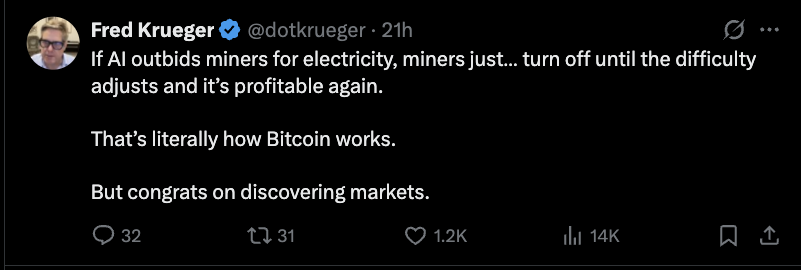
Fred Krueger pushed back on the claims. | Souce: X (@dotkrueger)
“If AI outbids miners for electricity, miners just turn off until the difficulty adjusts and it’s profitable again,” he responded on X.
Adding: “That’s literally how Bitcoin works.”
Some users also noted that smaller or independent miners could step in if large industrial players exit the market, since Bitcoin mining does not require the same specialized infrastructure as AI computing.
Kurt Robson is a London-based reporter at CCN, specialising in the fast-moving worlds of crypto and emerging technology. He began his career covering local news in Cornwall after graduating from Falmouth University with First Class Honours in Journalism. There, he cut his teeth on everything from council meetings to missing swans.
He quickly rose through the ranks to become a frontline journalist at several of the UK’s leading national newspapers. Over the years, he has interviewed musicians and celebrities, reported from courtrooms and crime scenes, and secured multiple front-page exclusives.
Following the upheaval of the COVID-19 pandemic, Kurt shifted his focus to technology journalism—just ahead of the AI boom. With a natural curiosity and a trained eye for emerging trends, he has found a new rhythm in reporting on innovation.
At CCN, Kurt's work focuses on the cutting edge of crypto, blockchain, AI, and the evolving digital world. Drawing on his background in people-first reporting and his deep interest in disruptive tech, Kurt delivers stories that are insightful, entertaining, and human-centric.