TAO climbed 10% and is currently testing the upper boundary of its descending channel.
RENDER and NEAR are at critical inflection points, with both prices poised to rise.
NVIDIA just delivered one of the most jaw-dropping earnings reports in tech history.
The chip giant announced $68 billion in quarterly revenue, shattering analyst expectations and confirming that demand for AI infrastructure is accelerating, not slowing.
As a result, its stock surged to $200 per share. But that’s not all.
Within hours, the crypto market responded to the NVIDIA earnings. Three AI-themed coins — Bittensor (TAO), NEAR Protocol (NEAR), and RENDER- surged into double digits.
The connection is not a coincidence. NVIDIA’s chips power the data centers and model-training pipelines that enable artificial intelligence.
When the company reports record demand, it sends a clear message to the market: AI is scaling fast, and anything connected to that ecosystem stands to benefit.
Here is a rundown of how the AI coins broke out. In this analysis, CCN also examines what could be next for them.
Bittensor (TAO)
TAO, native to the Bittensor project. led the charge. TAO powers a decentralized machine learning network where AI models compete and are rewarded with tokens.
Essentially, it is an open marketplace for artificial intelligence.
Because NVIDIA’s report validated the explosive demand for AI, TAO’s core use case suddenly looked more valuable.
Furthermore, its limited token supply amplified the price move. Buyers moved fast, and the cryptocurrency climbed, registering an approximately 10% rally over the last 24 hours.
Get These Top Crypto Casino Offers Now!
Sponsored
Disclosure
We sometimes use affiliate links in our content, when clicking on those we might receive a commission at no extra cost to you. By using this website you agree to our terms and conditions and privacy policy.
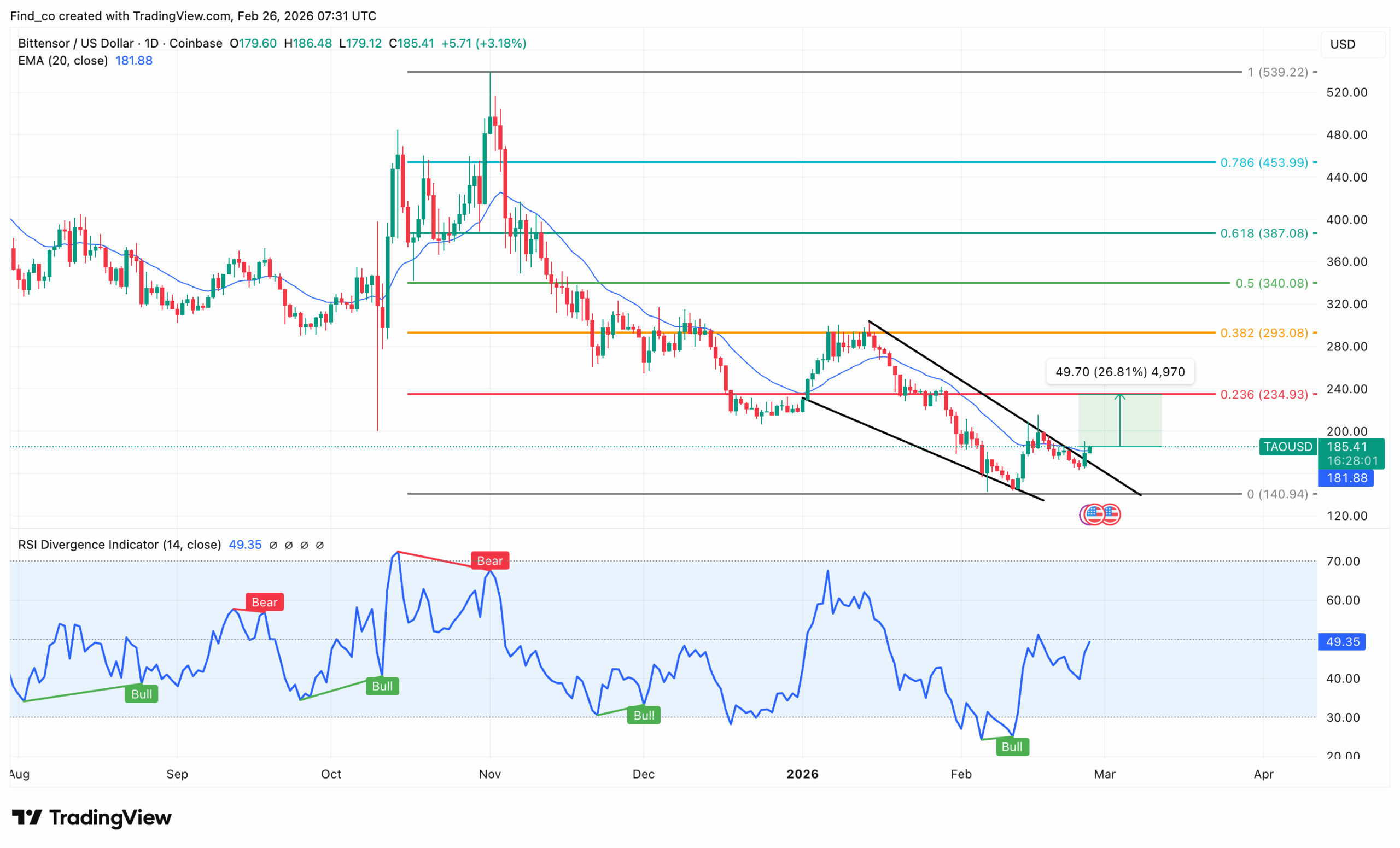
At the time of writing, TAO trades at $185.41. Interestingly, it has just broken above the 20-EMA ($181.88).
The setup is familiar but compelling. As shown below, a descending channel has compressed TAO’s price since early February, driving TAO from $293 down to a low near the zero Fib floor at $140.94.
As it stands, the 0.236 Fib at $234.93 is the first real target. Beyond that, $293.08 (0.382) is the mid-term objective.
So, bulls need to break the descending channel — a daily close above $200 would be the first meaningful confirmation.
But if demand for the altcoin drops, this prediction might not come to pass. Instead, TAO might decline to $140.94.
NEAR Protocol (NEAR)
NEAR followed closely. For those unfamiliar, the project has been positioning itself as a key blockchain for AI-native applications.
Its high-speed, low-cost architecture makes it attractive for developers building AI agents and decentralized apps.
Moreover, NEAR recently announced new AI tool integrations, putting it directly in the spotlight.
When NVIDIA’s numbers confirmed the AI boom, NEAR’s developer narrative gained immediate credibility with traders.
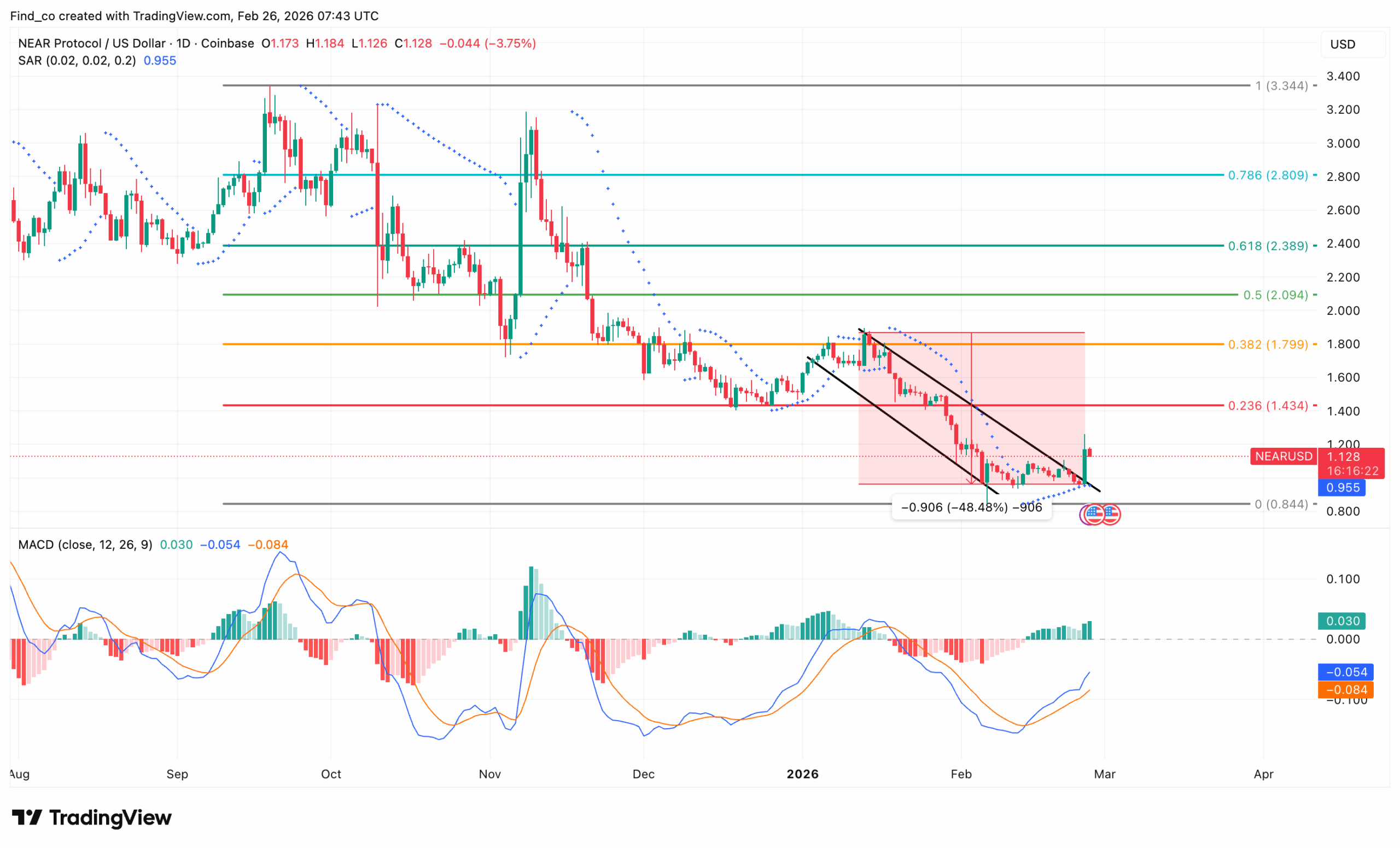
NEAR Protocol is at a pivotal inflection point. Price trades at $1.128, down 3.75% on the day, but the broader picture is quietly turning.
Previously, the damage to the NEAR price action has been severe. A 48.48% decline happened as the altcoin was trapped inside a descending channel from January’s high near $1.90.
This drove NEAR toward the zero Fib floor at $0.844. However, bulls defended that support.
At the time of writing, the price has since bounced and is now charging against the channel’s upper boundary.
Two indicators are turning constructive. The Parabolic SAR sits at $0.955, below NEAR’s price, confirming the short-term trend has shifted upward.
Meanwhile, the MACD is crossing above its signal line, with the histogram flipping green for the first time since October.
The dotted blue cycle indicator curves upward from the lows, suggesting the model sees a potential trend shift building into March.
Today’s pullback is testing resolve. The SAR at $0.955 is the key support to defend.
A break and hold above $1.43 (0.236 Fib) would mark the first real structural recovery signal. Beyond that, $1.799 (0.382 Fib) could be the mid-term target.
Still, traders need to watch out. If the hype around the NVIDIA earnings fades, this might not happen. In that scenario, NEAR’s price might slide to $0.84.
RENDER
RENDER rounds out the trio with a compelling story. It connects creators and developers with idle GPU computing power distributed across a global network.
The link to NVIDIA is especially direct here. For context, NVIDIA GPUs are the backbone of Render’s supply side.
Therefore, when NVIDIA reports surging GPU demand, it validates the exact infrastructure on which Render is built.
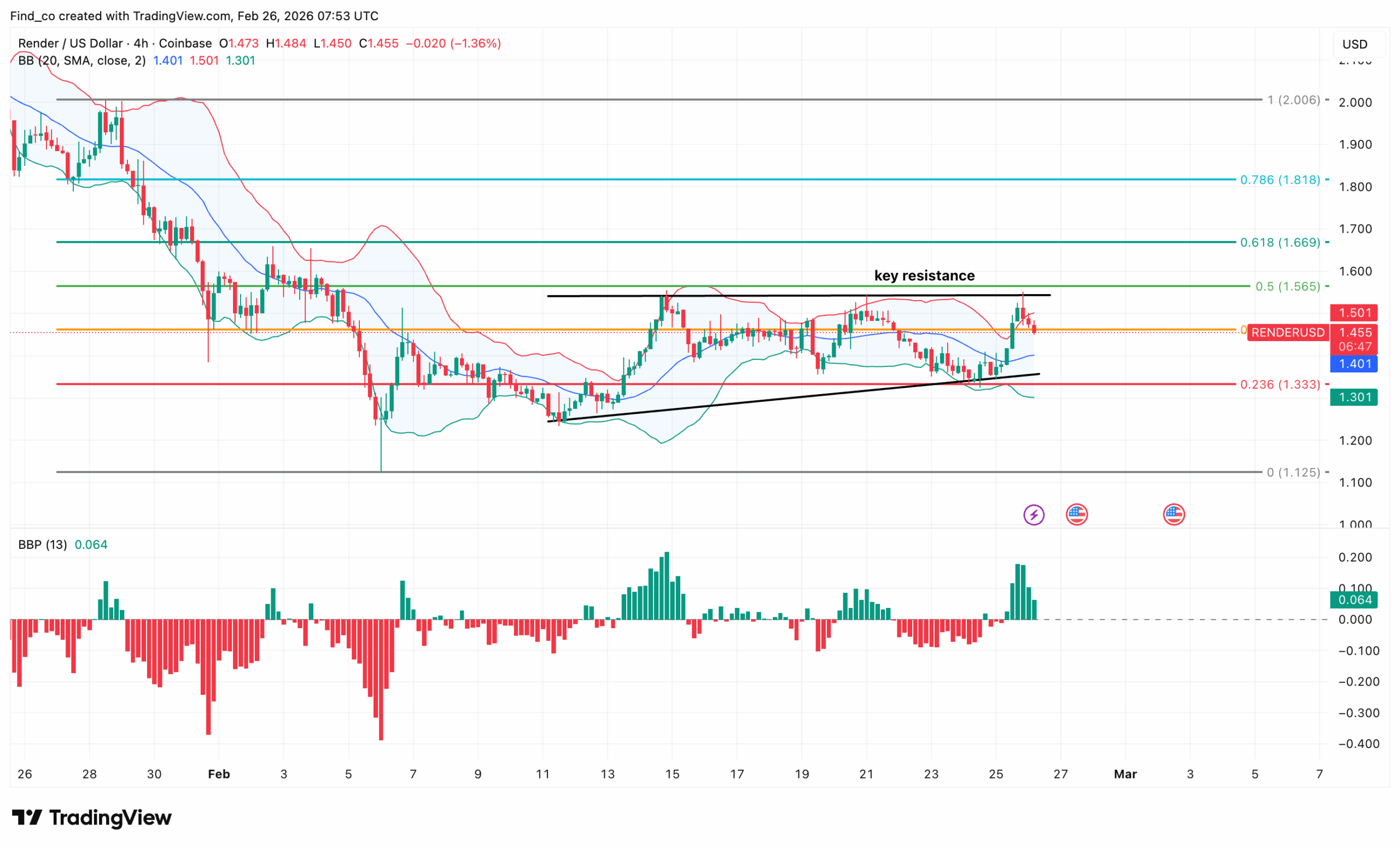
At the time of writing, RENDER is coiling at a decision point. RENDER trades at $1.46, caught in a tightening structure between rising support and stubborn horizontal resistance.
The pattern is an ascending triangle. A rising trendline has supported the price since the Feb. 6 low near $1.25, with the price printing higher lows consistently.
Above it, a flat key resistance line at approximately $1.57 has rejected every rally attempt since Feb. 11.
Furthermore, the Bollinger Bands (BB) reinforce the tension. The upper band ($1.50), middle band ($1.40), and lower band ($1.30) are contracting, which is a squeeze setup.
Besides that, the Bull Bear Power (BBP) indicator at 0.064 is marginally positive and just posted its strongest green bar since mid-February
This suggests that bulls have a slight edge heading into March.
A confirmed break above $1.501 opens the door to $1.57 (0.5 Fib), then to $1.67 (0.618 Fib).
Alternatively, failure to above below the rising trendline near $1.380 breaks the pattern entirely and likely retests $1.333 (0.236 Fib). This could also be the case if bullish sentiment around NVIDIA’s earnings drops.
Disclaimer:
The information provided in this article is for informational purposes only. It is not intended to be, nor should it be construed as, financial advice. We do not make any warranties regarding the completeness, reliability, or accuracy of this information. All investments involve risk, and past performance does not guarantee future results. We recommend consulting a financial advisor before making any investment decisions.
Victor Olanrewaju is a crypto analyst and reporter at CCN with deep roots in on-chain research and technical analysis. His crypto journey began in 2017, but it was the 2020 Uniswap airdrop that sparked a full-time pivot into the space.
With a foundation in copywriting, Victor honed his craft creating high-converting content for leading crypto brokers — most notably an XRP price prediction that ranked #1 on Google during the 2021 bull run.
He later joined AMBCrypto in 2022, where he combined storytelling with technical and on-chain analysis to cover key market narratives.
In 2024, he expanded his expertise at BeInCrypto, collaborating with analysts and using tools like Glassnode, Santiment, and IntoTheBlock to break down Bitcoin and altcoin trends.
At CCN, Victor covers the top cryptocurrencies, memecoins, macro shifts, blending real-time insights with deep-dive metrics.
He holds a Bachelor’s degree in Physics from the University of Ibadan, equipping him to simplify complex data for a wide audience. Follow his work or connect on LinkedIn or X.