Key Takeaways
- USD₮0 was built to address stablecoin fragmentation, creating a unified liquidity layer that allows USDT to move seamlessly across multiple blockchains.
- Adoption has accelerated rapidly, with daily volume growing from around $500,000 at launch in January 2025 to roughly $300 million within 15 months.
- USD₮0 uses a lock-and-mint model backed by LayerZero messaging, ensuring each USDT0 token is transparently backed 1:1 by USDT reserves.
- Security and interoperability risks remain central concerns, with the team prioritizing audits, bug bounties, and fail-safe mechanisms as cross-chain stablecoin infrastructure expands.
As stablecoins expand across multiple blockchains, liquidity fragmentation has emerged as one of crypto’s biggest infrastructure challenges. While USDT dominates global stablecoin usage, moving liquidity seamlessly between chains remains difficult, particularly for users and developers operating across ecosystems.
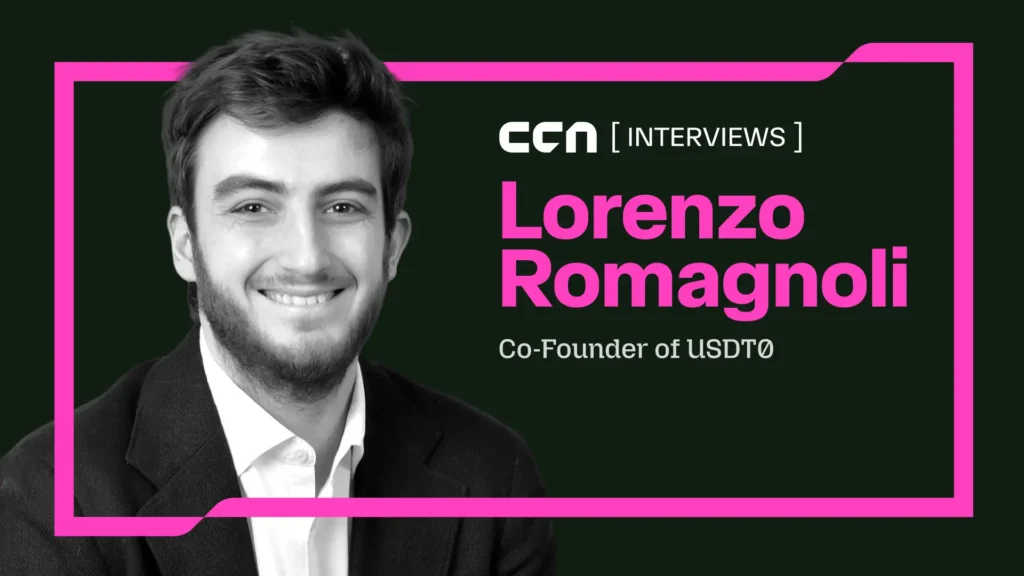
Speaking with CCN’s Giuseppe Fabio Ciccomascolo at EthCC, Lorenzo Romagnoli, Co-founder of USDT0, explained how the project is attempting to solve this problem by creating a unified liquidity layer for Tether across chains, and why adoption has accelerated faster than expected.
“We Saw a Big Gap in Moving USD Between Chains”
Romagnoli said the idea behind USD₮0 emerged from a straightforward infrastructure problem.
“Our problem was pretty simple. We realized that there was a big gap in the way people were moving USD assets between chains.”
Coming from a background working around the Tether ecosystem, the team viewed USDT as foundational infrastructure for crypto markets. However, interoperability across major chains remained fragmented.
“We strongly believe that the entirety of the system that powers Tether… is probably one of the best things that ever happened in crypto. But we realised that there was a major problem… you could not have a single interoperability layer that allowed you to go from the large chains… Ethereum, Solana, Tron… to the rest of the world.”
USD₮0 was built using LayerZero infrastructure to address those inefficiencies. Adoption, Romagnoli said, quickly exceeded expectations.
“When we launched in January 2025… we were moving around $500,000 a day, and it felt like a massive amount.”
Fifteen months later, the scale looks very different.
“Now… we’re moving $300 million every day.”
Romagnoli attributed the growth to ecosystem collaboration rather than aggressive expansion.
“We really got a massive amount of adoption… not because we are geniuses… but because we were able to work with a lot of ecosystems… and by giving them a product that is somewhat good, it just grew organically.”
A Unified Liquidity Layer for USDT
Romagnoli described USD₮0 not as a new stablecoin, but as a unified liquidity layer built around Tether.
“The way we like to think about USD₮0… is a single unified liquidity layer for all kinds of Tether deployments.”
The system works by locking USDT on a reserve chain and minting USD₮0 across supported networks.
“When you interact with our smart contract… you lock USDT… and then you issue USD₮0 on whatever chain we support.”
This process relies on LayerZero messaging infrastructure to connect different blockchains.
“It’s done through a messaging protocol called LayerZero… that allows to put those different blockchains in connection.”
Transparency, Romagnoli stressed, is central to the design.
“You can always audit that for every single USD₮0 in the world, there is one USDT being backed in our contract.”
USDT0’s supply has grown to roughly $4.2 billion, making it one of the largest holders of USDT.
“Our supply today is around $4.2 billion… which makes us the third largest single holder of USDT globally.”
Tackling Stablecoin Fragmentation
Romagnoli highlighted fragmentation as one of crypto’s biggest usability challenges, particularly in emerging markets.
“I spend a lot of time in Latin America and Africa… people don’t even know that there is a blockchain behind… they just know that there is USDT.”
Even experienced users face complexity.
“There are like 20 different chains where USDT is issued… that’s terrible UX.”
USD₮0 aims to abstract that complexity.
“Thanks to USD₮0, you don’t really care on which chain you have the tokens… it’s always the same USDT and you can move it easily between them.”
This approach allows developers to build applications that hide blockchain complexity from users.
“All that matters to the user is that you have USD… if somebody sends it on Polygon… or Arbitrum… you don’t care.”
Security as the Core Focus
Cross-chain infrastructure introduces risk, and Romagnoli acknowledged that interoperability protocols have historically been vulnerable.
“Interoperability protocols… are one of the places where the most amount of money has been lost.”
As a result, security remains the primary focus for USD₮0.
“The vast majority of the focus of our company is actually safety and security.”
The project has introduced one of the largest bug bounty programs in the industry.
“If you manage to find a vulnerability… you can walk away with around $31 million.”
Romagnoli also emphasized extensive auditing.
“When you’re responsible for the security of around $4.3 billion… you have to invest heavily in audits and security.”
Trust and Transparency in Stablecoin Infrastructure
As scrutiny around stablecoin transparency increases, Romagnoli said USD₮0 was designed around verifiable reserves.
“We come from an on-chain DeFi background… so we always say: don’t trust, verify.”
USD₮0 maintains transparent reserve backing.
“For every single USDT0… there is at least one USDT backing them… our whole system is extremely transparent.”
The system also includes fail-safe mechanisms.
“If something goes wrong… we would freeze the protocol… and address the issue.”
Growth Ahead
Romagnoli expects adoption to continue accelerating as stablecoin usage grows.
“Numbers usually go up parabolically… not linearly.”
He suggested daily volume could reach $800 million to $1 billion in the coming year.
“If we have this discussion again in one year… I very much hope… daily volume around $800 million to $1 billion.”
As stablecoins increasingly underpin global crypto activity, USD₮0 is positioning itself as the infrastructure layer connecting liquidity across chains.
“We’re not trying to reinvent the wheel… we’re just trying to make Tether 1% better every day.”
The information provided in this article is for informational purposes only. It is not intended to be, nor should it be construed as, financial advice. We do not make any warranties regarding the completeness, reliability, or accuracy of this information. All investments involve risk, and past performance does not guarantee future results. We recommend consulting a financial advisor before making any investment decisions.

Onkar Singh has three years of experience as a digital finance content creator. Throughout his career, he has collaborated with various DeFi projects and crypto media outlets. In his leisure time, he enjoys fitness activities at the gym and watching movies across different genres. Balancing his professional and personal interests, Onkar continues to contribute to the digital finance landscape while pursuing his hobbies.

Giuseppe Ciccomascolo began his career as an investigative journalist in Italy, where he contributed to both local and national newspapers, focusing on various financial sectors.
Upon relocating to London, he worked as an analyst for Fitch's CapitalStructure and later as a Senior Reporter for Alliance News. In 2017, Giuseppe transitioned to covering cryptocurrency-related news, producing documentaries and articles on Bitcoin and other emerging digital currencies. He also played a pivotal role in establishing the academy for a cryptocurrency exchange website. Crypto remained his primary area of interest throughout his tenure as a writer for ThirdFloor.


 Easy
Easy