How are DATs linked to crypto crashes? | Credit: CCN.com
Share
Key Takeaways
Eye’s investigation linked a massive 100,000 BTC whale to Garrett Jin, former BitForex CEO.
On-chain evidence suggests the whale made over $190 million from precise short trades.
Hyperliquid’s structure enables transparency but magnifies whale-level influence.
The case raises broader concerns about trust and control in decentralized finance (DeFi).
In the world of crypto, surprises are nothing new, though some tend to be more dramatic than others. Discovering a hidden whale is one of those moments that never fails to capture the community’s attention.
On October 11, 2025, on-chain investigator Eye (@eyeonchains) sent ripples through the crypto world with a viral thread on X. The post alleged that the mysterious Hyperliquid whale, holding more than 100,000 BTC valued at roughly $11 billion, was Garrett Jin, the former CEO of the defunct BitForex exchange.
The community has reacted:
tD’s comments | Source: X
This article explores how the investigation unfolded, what it reveals about blockchain transparency, and why it could reshape how users view decentralized finance (DeFi) accountability.
On-chain investigator Eye (@eyeonchains) shared what he described as months of blockchain tracking that allegedly led to identifying the person behind the so-called Hyperliquid whale.
Grok, who is Jin Garrett? | Source: Grok
According to Eye, the investigation connects Garrett Jin, a figure with a long and controversial history in crypto, to wallets holding tens of thousands of Bitcoin.
Jin’s ventures often centered on exchanges, wallets, and staking, reflecting a shift from centralized to DeFi. However, many post-BitForex projects became inactive by 2024, coinciding with regulatory pressures and the exchange’s scandal.
From Bitforex to Bitcoin Billions: Tracing Garrett Jin’s Alleged Trail
Eye outlined Jin’s professional background. “Garrett Jin, who graduated with a degree in economics from Boston University in 2008, began his career as an intern at the China Construction Bank, where he worked until 2011,” he wrote. In 2012, Jin founded Da Yo Trading (HK), a trading firm that operated until 2014.
Eye’s thread connected Jin’s early financial experience to his later ventures in crypto. “From 2017 to 2020, he served as the CEO of @bitforexcom, an exchange that became the subject of a scandal, accused of falsifying trading volumes,” Eye posted.
The exchange was also flagged by Japan’s Financial Services Agency (FSA) on June 26, 2020, for operating without proper registration and was shut down amid controversy.
As BitForex collapsed amid mounting allegations and frozen user withdrawals, Jin reportedly moved on to new projects. “Garrett founded WaveLabs VC in 2020 (operational until 2023), launching projects such as @tanglepaycom (2021), @iotabee (2022), and @groupfi_ai (2023),” Eye explained.
He described TanglePay as a “mobile/Chrome wallet for IOTA supporting tokens, staking,” and noted that Jin’s series of ventures maintained a strong focus on DeFi and wallet infrastructure.
Mapping Jin’s Path Through Crypto
To simplify Garrett Jin’s steps and movements based on Eye’s investigation, the following table outlines the key points chronologically:
Year
Event
Details
2008–2011
Early career
Intern at China Construction Bank
2012–2014
First venture
Founded Da Yo Trading (HK)
2017–2020
Exchange leadership
CEO of BitForex exchange
2020–2023
New ventures
Created WaveLabs VC and projects
2021–2023
DeFi projects
Launched TanglePay, Iotabee, GroupFi
2024
Institutional platform
Founded XHash for ETH staking
2025
Whale allegations
Linked to Hyperliquid wallet activity
According to the Eye’s posts, his association with a massive Hyperliquid whale was clear as of October 2025.
The alleged connection between Jin and the Hyperliquid whale, according to Eye, stems from Ethereum Name Service (ENS) data.
“The ENS name ereignis.eth (‘event’ in German) confirms his link to this wallet, identifying him as the actor behind the large-scale operations on Hyperliquid/Hyperunit” he wrote.
Eye also pointed out that Jin is followed on X by @sershokunin, the founder of @hyperunit, suggesting potential proximity between the two.
Eye continued tracing Jin’s business activities beyond BitForex. “Garrett is also the founder of @XHash_com (since 2024), an institutional platform for non-custodial ETH staking,” he stated.
He suggested that the staked ETH could have been used “to onboard questionable funds into the company,” adding that Jin’s ongoing operations “raise doubts about his continued role in controversial crypto movements.”
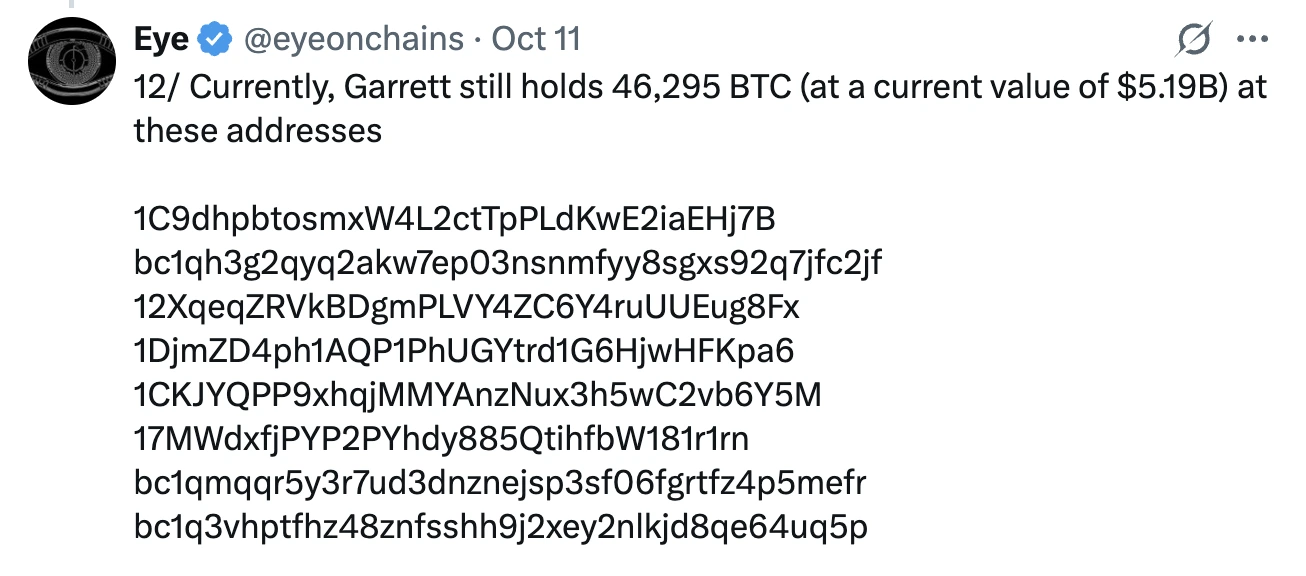
Concluding the thread, Eye claimed that Jin “still holds 46,295 BTC (at a current value of $5.19B)” across several identified wallet addresses.
Eye’s post | Source: X
These addresses, listed in the posts, reportedly correspond to long-term Bitcoin holdings linked to the same cluster of transactions used to trace the whale’s identity.
While these findings remain unverified and subject to public scrutiny, the allegations have reignited questions about the blurred boundaries between past exchange scandals and current DeFi operations.
Posts questioning the allegations | Source: X
How Hyperliquid Became the Whale’s $11B Playground
However, identifying the whale and tracing the flow of funds only reveals part of the story. When platform and timing are involved, the investigation takes on a more profound significance.
What began as a straightforward wallet-tracking case now connects to a key platform: Hyperliquid, one of the year’s most dramatic trading events. It exposes how precise market timing can transform on-chain movements into billion-dollar consequences.
Hyperliquid has become a central force in decentralized derivatives trading. It runs on its own Layer-1 blockchain and specializes in decentralized perpetual futures trading.
But that same openness means large players can exert outsized influence over markets in ways few other platforms allow.
The whale first drew attention in August 2025, when it reportedly began exchanging large amounts of BTC for ETH on Hyperliquid’s spot and perpetual markets.
According to one report, it sold over 35,000 BTC (valued at about $4.23 billion) in that rotation, acquiring 570,000 ETH, which it later staked via Ethereum’s Beacon Deposit Contract, he entry point for users to stake ETH on the Beacon Chain.
By October 7, just before the market’s major decline, that same address is said to have opened a $735 million BTC short at 10× leverage, followed by a $353 million ETH short.
On October 10, following the U.S. announcement of 100% tariffs on Chinese imports, the market imploded. Bitcoin dropped below $105,000.
The fallout was severe. According to leaderboard data cited by several platforms, over 6,300 wallets on Hyperliquid suffered losses of about $1.23 billion, with more than 1,000 wallets fully liquidated.
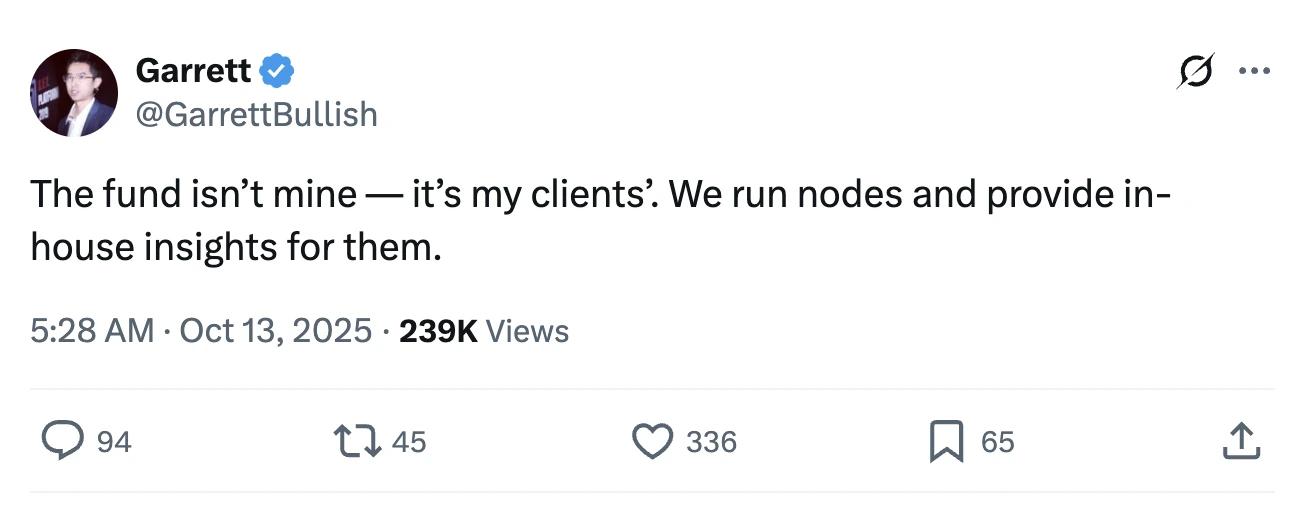
Jin denied the allegations, stating that the crypto used for the short positions belonged to clients, not to him.
Jin Garrett’s comment | Source: X
Conclusion
The Hyperliquid whale case highlights the intersection of technology, timing, and influence within decentralized markets. Eye’s investigation pieced together wallet trails, ENS data, and large transactions that allegedly point to Garrett Jin, reviving old questions about transparency and accountability in DeFi.
The whale’s massive trades, timed with global market shocks, show how individual actors can trigger billion-dollar swings across decentralized systems. While Jin denies ownership of the funds, claiming they belong to clients, the event underscores how market timing and blockchain openness can expose both opportunity and risk.
As regulators and developers reassess DeFi’s future, the Hyperliquid episode stands as a reminder that transparency does not always mean fairness. Decentralization may distribute control, but power still gravitates to those who know how to move markets.
By shorting BTC and ETH before the market downturn, the whale reportedly earned around $200 million in gains.
What triggered the crypto market crash?
The U.S. announced 100% tariffs on Chinese imports on October 10, 2025.
Why is this case important?
It illustrates how whales can influence decentralized markets despite transparency claims.
Did Jin admit involvement?
No. He denies ownership of the funds, saying the crypto belonged to clients.
Disclaimer:
The information provided in this article is for informational purposes only. It is not intended to be, nor should it be construed as, financial advice. We do not make any warranties regarding the completeness, reliability, or accuracy of this information. All investments involve risk, and past performance does not guarantee future results. We recommend consulting a financial advisor before making any investment decisions.
Dr. Lorena Nessi is an award-winning journalist and media technology expert with 15 years of experience in digital culture and communication. Based in Oxfordshire, UK, she combines academic insight with hands-on media practice.
She holds a PhD in Communication, Sociology, and Digital Cultures, and an MA in Globalization, Identity, and Technology.
Lorena has taught at Fairleigh Dickinson University, Nottingham Trent University, and the University of Oxford. She is a former producer for the BBC in London, with additional experience creating television content in Mexico and Japan.
Her research focuses on digital cultures, social media, technology, capitalism, and the societal impact of blockchain innovation.
She has written extensively on digital media and emerging technologies, with her work featured in both academic and media platforms. Her Web3 expertise explores how blockchain technologies shape culture, economics, and decentralized systems.
Outside of work, Lorena enjoys reading science fiction, playing strategic board games, traveling, and chasing adventures that get her heart racing. A perfect day ends with a relaxing spa and a good family meal.


 Easy
Easy