Key Takeaways
- The FTX collapse permanently reshaped attitudes toward custody risk, accelerating the shift toward self-custody as users recognized the dangers of relying on centralized exchanges.
- Non-custodial infrastructure has matured significantly, making direct-to-wallet trading faster, simpler, and more practical for everyday users rather than just crypto enthusiasts.
- Repeated exchange failures, hacks, and security breaches continue to reinforce demand for self-custody solutions, with hardware wallets and non-custodial services seeing sustained adoption growth.
- While institutions are expanding regulated custody offerings through ETFs and custodial platforms, many long-term crypto users increasingly view self-custody as the safest and most authentic way to own digital assets.
Three years after FTX took $8 billion of customer funds to zero, the crypto industry is still processing what happened. Sam Bankman-Fried is in prison. Creditors have received partial repayments in dollars, not the Bitcoin they deposited.
Around 10% of crypto holders in 2025 identified difficulty trusting exchanges as their biggest ongoing concern, while 16% reported access problems with custodial platforms. By 2025, 59% of crypto wallet users globally had shifted toward non-custodial solutions, with hardware wallet sales growing at a nearly 30% compound annual growth rate.
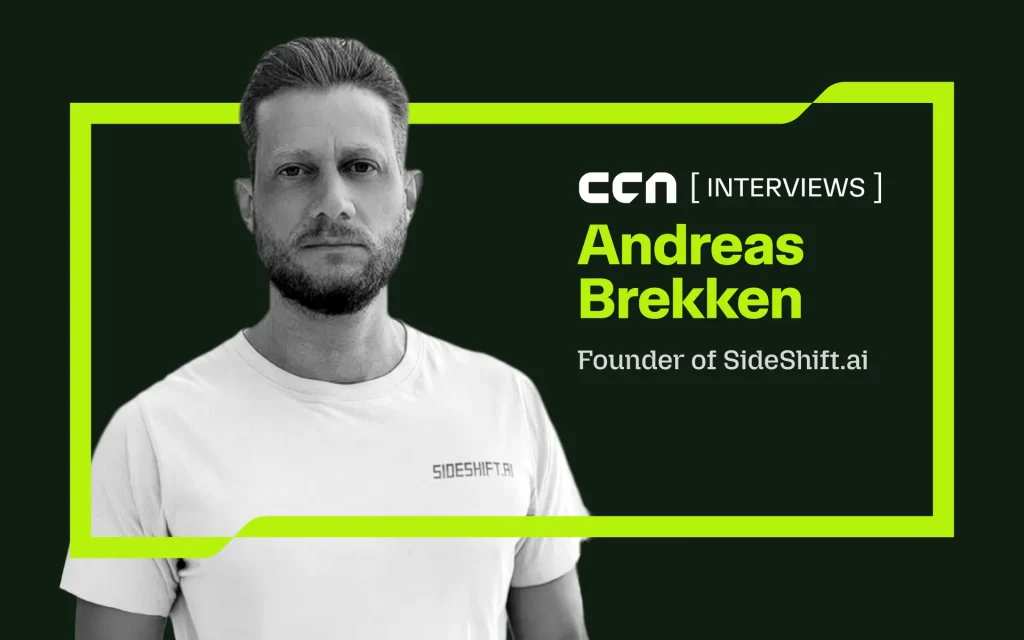
That shift has a human story behind it. And few people have watched it from a better vantage point than Andreas Brekken.
Brekken has been in Bitcoin since 2011. He founded Justcoin.com, one of Norway’s earliest crypto exchanges, later worked as a software engineer at Kraken, and has spent the years since building SideShift.ai, a non-custodial direct-to-wallet exchange that has processed over $3 billion in transaction volume without once taking custody of user funds.
When he talks about why self-custody is resurging in 2026, he is not selling a product. He is describing a market correction he had been warning about for years.
“Crypto users have been getting burned by centralized exchanges for years,” Brekken told CCN. “FTX took $8 billion. Mt. Gox lost 850,000 BTC. ZachXBT posts about exchange hacks on a monthly basis. Holding your own keys used to be for the paranoid and cypherpunks but now it’s just common sense.”
FTX Did to Crypto What 2008 Did to Banks
The FTX collapse was not just a fraud case. It was a trust event that permanently rewired how a generation of crypto participants thinks about counterparty risk. Hardware wallet use spiked immediately after the collapse as users sought to reduce exposure to platform risk, and self-custody adoption increased significantly in the months that followed.
Brekken frames it in terms that land beyond crypto circles.
“For a generation of users, FTX did to crypto what 2008 did to banks,” he told CCN. “People who never thought about where their coins actually lived suddenly learned that your balance on an exchange is just a number in someone else’s database. There are no ghost Bitcoins. There is no spreadsheet that protects you.”
The lesson is proving stickier this time. After Mt. Gox in 2014, the industry rebuilt its appetite for centralized custody within a few years. After the 2022 cascade of FTX, Celsius, and BlockFi, that recovery has been slower and more uneven.
North Korea’s Lazarus Group stole approximately $1.5 billion from Bybit in February 2025, one of the largest exchange thefts ever recorded. Every new incident resets the trust clock.
“People got complacent because nothing bad happened to them yet,” Brekken said. “But the rule never changed.”
Direct-to-Wallet Trading: Speed, Control, and No Waiting Room
Part of what makes the current self-custody wave different from earlier versions is that it is no longer purely ideological. The cypherpunk argument for holding your own keys has existed since Bitcoin’s genesis block. What has changed is that non-custodial infrastructure has gotten fast enough and simple enough to compete with centralized platforms on purely practical terms.
“You send from your wallet, you get coins back in your wallet,” Brekken told CCN. “Hundreds of coins, dozens of networks, settled in minutes, often seconds. Once people try that they do not want to go back to begging an exchange for their own money.”
Users in 2026 routinely move tokens across networks, interact with protocols, and switch tools based on the task at hand. Keeping assets locked inside a custodial platform creates dependency on withdrawal rules that are entirely outside the user’s control. Non-custodial infrastructure fits that behavioral pattern more naturally than it did when most activity happened on a single chain.
Hardware wallets are part of the same ecosystem shift. Brekken sees them not as competitors but as an onramp.
“Both push people toward self-custody, which is exactly the user we want,” he said. “The wallet has already done the hard part. We just help them reallocate, anything to anything, without ever taking custody. We are not competing with wallets. We are the natural next step for the people already using them.”
Who Survived the Bear Market
Brekken offered a read on current market composition that runs counter to standard industry optimism.
“We have been in a bear market since the MELANIA top in January 2025, and it is now the longest stretch of negative sentiment on record,” he noted. “The ones who were only here to flip memecoins and get rich by Friday are long gone. What is left is a more serious group. They hold their own keys, they think about counterparty risk before it bites them. The industry is maturing.”
That maturation has a commercial logic attached to it. Platforms that survived multiple cycles, he argues, did so by resisting a specific temptation. “The platforms that blow up are usually the ones that got bored of doing one thing well and started taking custody to chase growth,” Brekken said. “We went in the opposite direction and it has served us well since 2019. SideShift is built to be fast and simple.”
Next Billion Crypto Users: Self-Custody or Custodial Onboarding?
Whether the next wave of crypto users arrives through self-custody or centralized onboarding is a question Brekken answers practically rather than ideologically.
“Many will be onboarded by a custodial exchange because that is the easiest way in,” he told CCN. “But eventually they understand the risk. The coins on an exchange are not really yours.”
The institutional crypto custody market hit approximately $3.2 billion in 2024 and is projected to reach $27.8 billion by 2033. Institutions are building regulated custody infrastructure at scale, and ETFs have brought Bitcoin ownership to investors who will never hold a private key.
Brekken does not dispute any of that. His counterpoint is simpler. “The institutions will muscle in with ETFs and call it innovation. But nothing beats owning your own BTC. That is the whole point, and it is why people keep coming back to self-custody.”
For a market that has spent years cycling between convenience and catastrophe, that argument is carrying a different weight in 2026.
The information provided in this article is for informational purposes only. It is not intended to be, nor should it be construed as, financial advice. We do not make any warranties regarding the completeness, reliability, or accuracy of this information. All investments involve risk, and past performance does not guarantee future results. We recommend consulting a financial advisor before making any investment decisions.

Dr. Guneet Kaur is a senior editor at CCN.com and a Science Fellow at Exponential Science. She is a fintech and blockchain expert with extensive experience in digital finance education, blockchain ecosystems, and cryptocurrency markets. She has worked with global media such as Cointelegraph, as well as education and blockchain platforms, to design and lead strategic content and learning initiatives. As an educator and assessor for top-tier executive programs, she bridges real-world fintech trends with academic insight.
Dr. Kaur is also a published researcher and peer reviewer across fintech and data science journals, including Financial Innovation Journal and International Journal of Big Data Intelligence and Applications. Her work spans data-driven analysis, Web3 innovation, and technical content development. With a strong foundation in both industry and academia, she translates complex financial technologies into practical applications, empowering learners, professionals, and institutions across the rapidly evolving digital finance landscape.


 Easy
Easy