The conversation around AI and crypto has never been louder. But for most projects, the pivot to AI feels exactly like what it is: a narrative shift chasing a hotter trend.
NEAR Protocol is making a different argument. Not that it discovered AI recently, but that it was built for this moment from the start.
NEAR Protocol has quietly become one of the more serious AI-focused layer-1 networks, with its account abstraction model and chain abstraction vision positioning it as infrastructure for AI agents operating across multiple blockchains. The foundation has been methodically repositioning its roadmap around user-owned AI, a concept that sits at the intersection of decentralization and practical machine intelligence.
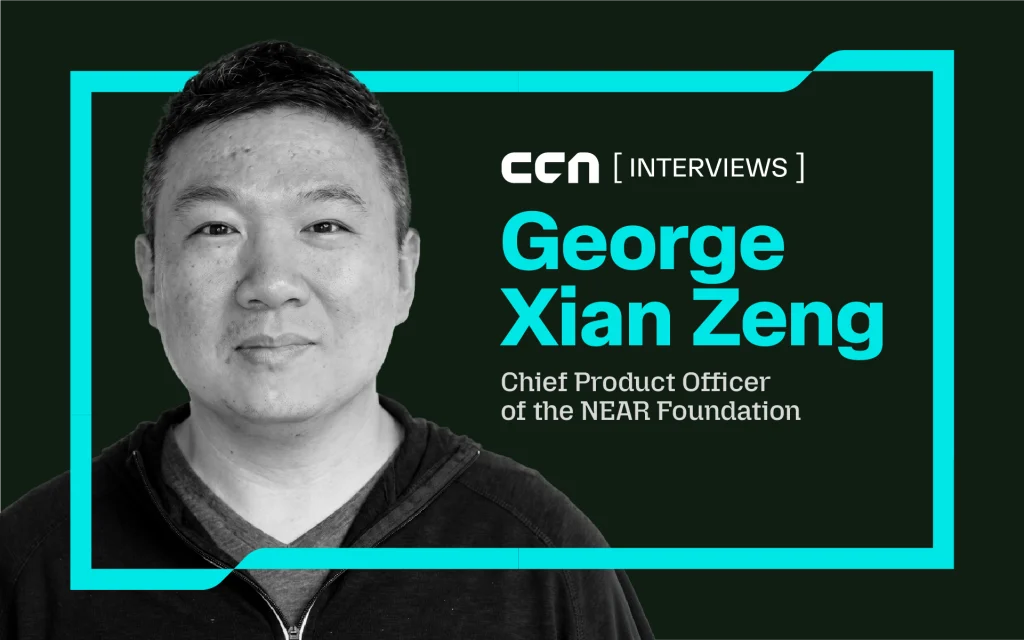
At Consensus 2026 in Miami, George Xian Zeng, Chief Product Officer of the NEAR Foundation and General Manager of NEAR AI, framed NEAR’s AI strategy not as a sudden pivot, but as a return to the project’s original roots.
“NEAR, the name came from the Ray Kurzweil book The Singularity Is Near,” Zeng told CCN’s Maxwell Moeller. “NEAR was named and built from the very beginning with AI in its roots.”
For Zeng, the renewed focus on AI reflects a broader shift in crypto: away from token-first experimentation and toward products that solve practical problems for real users. Having worked across Facebook (now Meta), dYdX, AI commerce and now NEAR, he said one lesson has remained constant: product adoption requires usefulness.
Crypto Must Evolve and Start Solving Problems
“My biggest pet peeve in crypto is when people don’t build products that solve real problems for real people,” he said. “We got one life to live. Let’s actually live that life doing impactful things.”
Zeng said his years at Facebook shaped his understanding of product culture, particularly the company’s entrepreneurial “move fast” DNA.
His time at dYdX, meanwhile, offered a “crash course” in crypto and exposed him to the challenges of building highly technical trading products. Those experiences now inform his approach at NEAR, where he believes old crypto playbooks are no longer enough.
“We have to scrap a lot of the playbooks that existed in crypto previously,” he said. “Think about things from first principles, and actually think about building real products, solving real problems for real people.”
Why NEAR Is Positioning Itself Around User-Owned AI
NEAR’s current AI thesis centers on what it calls “user-owned AI.” Zeng described the concept by comparing today’s AI environment to the early internet, when AOL nearly became the dominant gateway to the web. The internet only became open, he argued, because protocols such as TCP/IP and email allowed anyone to build freely.
“We’re in a similar place in AI today,” he said. “There’s always a place for centralized AI companies like OpenAI or Anthropic. They have real value. But there’s a real need for user-owned AI.”
In NEAR’s view, user-owned AI means users control their data, choose the models they want to use, and retain security and privacy.
Zeng pointed to NEAR’s work on secure AI agents, including Iron Claw, a secure agent harness designed to avoid the risks associated with giving agents access to sensitive credentials, passwords or private keys.
“If you end up giving your passwords or your private keys, crypto keys, to Open Claw, that would be extremely sketchy,” he said. “I would not do that.”
Privacy is the second pillar. Zeng said NEAR is building systems that allow AI models to run inside trusted execution environments on next-generation GPUs, enabling confidential inference. In that setup, he said, NEAR would not see either the user’s query or the model’s response.
“The data is encrypted going in,” he explained. “The inference is run within the secure enclaves and then comes back out.”
How NEAR Intents Could Power AI Agent Transactions
The third pillar is NEAR Intents, a framework for decentralized transactions. Zeng described it as a way for users, or AI agents acting on their behalf, to request an outcome, while a network of solvers competes to fulfill that request at the best rate.
Today, that can mean swapping Bitcoin for Zcash. In the future, he said, the same model could apply to e-commerce, real estate or any other transaction.
“I can say I’m an agent, and this agent has been requested by its user to buy Nike,” Zeng said. “It federates that request to all of these different solvers, fiercely trying to find the best rate for high-quality Jordans at the cheapest price.”
For Zeng, this is decentralization with a purpose. He warned that crypto often decentralizes systems simply for ideological reasons, despite the performance trade-offs.
“I believe deeply in decentralization, but I also believe deeply that it should serve some kind of purpose,” he said.
He pointed to the performance gap between centralized and decentralized infrastructure as an example, noting that traditional databases can process millions of transactions per second while older blockchains process only a fraction of that.
“There should be a reason for that degradation,” he said.
AI Agents, Crypto Wallets and the Future of Self-Custody
As AI agents become more capable, Zeng expects them to become a major interface for the internet. That raises new questions about wallets and custody.
Some agents may operate their own wallets with limited funds, while others may be granted access to a user’s wallet for higher-value activities such as yield optimization or crypto portfolio management.
The level of access, he said, should depend on the use case and the trustworthiness of the agent.
“If I have a third-party agent that I don’t know very well and I want it to go out and buy Nike for me, I would probably want it to use its own wallet with a constrained amount of funds,” he said.
“On the other hand, if I feel really good about a financial advisor agent, maybe I give it access to my own wallet. But now the security guarantees have to be a lot higher.”
Zeng believes both models, agents managing user wallets and agents operating independent wallets, will coexist.
NEAR AI’s Long-Term Vision for Agent Adoption
Looking ahead three to five years, Zeng said success for NEAR AI would mean seeing agents create measurable economic value. He pointed to daily active agents, transaction volume through NEAR Intents, efficient use of compute and strong user retention as key indicators.
“There’s no point in filling a leaky bucket,” he said. “When people start using these agents, they need to get enough value that they stick around.”
But Zeng’s ambitions go beyond crypto payments or agent commerce. He believes AI could dramatically accelerate scientific, mathematical and engineering progress.
“I believe AI will dramatically accelerate the speed at which we make mathematical and scientific breakthroughs,” he said. “Imagine a 10 to 100 times improvement in speed of research for science and math.”
He added that AI coding systems are already showing signs of dramatically improving engineering productivity through recursive feedback loops and verifiable outputs.
General Assistants, Vertical AI Agents and the Future of AI Infrastructure
Zeng divided AI agents into three categories: general assistants, vertical agents and horizontal agents.
General assistants, such as Iron Claw, can operate across a user’s computer with broad permissions. Vertical agents focus on specific industries such as law or crypto. Horizontal agents specialize in functions such as coding or customer support.
“The magic of Iron Claw and Open Claw is it has root access to a computer,” he said. “If I have root access to a computer, I can do anything you are able to do on your computer.”
That capability, however, reinforces why privacy and security are central to NEAR’s AI strategy.
“You don’t want to give root access to your computer unless you have security and privacy sorted out,” Zeng said.
For now, NEAR is focused heavily on general assistants and crypto-specific agents. But Zeng suggested the same frameworks could eventually expand into broader scientific and research applications.
“I think this is the most important technological revolution we’ve been through in our lifetimes,” he said. “I’m really glad people are starting to think through the implications of this and start building things that solve real problems for real people.”


 Easy
Easy