Home / Education / Crypto / Regulation / Kraken Gets Access to the US Fed’s $4T-a-Day Payment Network — 4 Ways It Could Reshape Crypto–Banking Integration
Kraken gains access to Fed's $4T-a-day payment network, marking a major step toward integration between crypto firms and traditional banking. | Credit: CCN.com
Share
Key Takeaways
Kraken has reportedly become the first digital asset company to gain direct access to the U.S. Federal Reserve’s payment system through a master account.
The Federal Reserve’s payment network, including systems like Fedwire, processes roughly $4 trillion in transactions daily.
Major U.S. banking groups, including the Independent Community Bankers of America (ICBA), have expressed concerns about allowing crypto firms access to Fed accounts.
Closer integration with traditional financial infrastructure could make cryptocurrency markets more attractive to institutional investors.
Cryptocurrency companies have long operated on the edges of the traditional financial system. For years, many struggled to secure even basic banking services, forcing them to rely on intermediary banks to move money between crypto markets and the broader economy.
That dynamic may be beginning to change.
Kraken, one of the world’s largest cryptocurrency exchanges, has reportedly secured direct access to the U.S. Federal Reserve’s payment infrastructure through a master account, marking a historic first for a digital asset company. Some policymakers and industry advocates have celebrated the development as a major milestone in the integration of crypto and traditional finance.
U.S. Senator Cynthia Lummis, a prominent supporter of digital assets, described the move as a breakthrough moment.
“After more than half a decade, Kraken just became the first digital asset company to gain direct access to the American payment system,” Lummis wrote on social media. “We are creating the 21st-century financial services industry.”
After more than half a decade, @krakenfx just became the FIRST digital asset company to gain direct access to the American payment system.
However, the decision has also triggered strong pushback from banking groups, highlighting the ongoing tension between the traditional financial sector and the rapidly evolving crypto industry.
What Is the Federal Reserve’s Payment Network?
The Federal Reserve operates the core payment infrastructure used by banks across the US.
One of the most important systems is Fedwire, a real-time payment network used by financial institutions to move large sums of money instantly. Every day, Fedwire processes transactions worth roughly $4 trillion, making it one of the most critical pieces of financial infrastructure in the global economy.
Banks connect to this system via a Federal Reserve master account. These accounts allow institutions to:
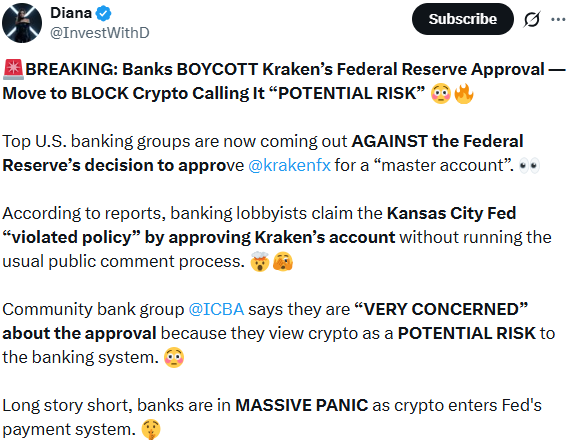
Bank lobbysts raised concerns over Kraken’s access to Fed’s payment network. | Credit: InvestWithD X profile
According to the group, allowing companies tied to volatile digital asset markets to connect directly to the Fed’s payment rails could potentially create regulatory and stability concerns.
Banking lobbyists have also argued that the approval process may have bypassed the usual public comment procedures, claiming the Kansas City Federal Reserve did not follow standard policy steps when approving the account.
Behind the regulatory debate, however, many analysts believe there is a deeper issue.
For decades, traditional banks have acted as gatekeepers between crypto markets and the broader financial system. If crypto companies gain direct access to payment infrastructure, their reliance on banks could decline dramatically.
In other words, the dispute is not only about risk; it is also about competition and control over financial infrastructure.
Four Ways Kraken’s Fed Access Could Reshape Crypto–Banking Integration
Kraken’s entry into the Federal Reserve’s payment system could have far-reaching implications for both industries. Here are four key ways it may reshape the relationship between crypto firms and traditional banks.
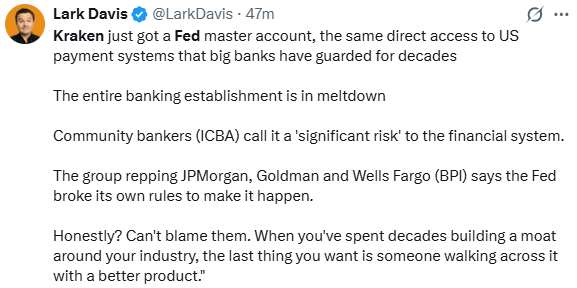
The crypto community hailed Kraken’s news. | Credit: Lark Davis X profile
1. Reducing Crypto’s Dependence on Traditional Banks
For most of the cryptocurrency industry’s history, exchanges and blockchain companies have depended heavily on traditional banks.
These banks serve as the essential bridge between fiat currencies, such as the U.S. dollar, and digital assets. Without them, crypto companies struggle to process deposits, withdrawals, and payment settlements.
However, banking relationships have often been fragile. Several crypto firms have experienced account closures or service disruptions when banks reassessed the risks of working with digital asset companies.
Direct access to Federal Reserve payment rails could reduce that dependence.
If crypto firms can settle transactions directly through the Fed’s infrastructure, they may no longer need to rely on intermediary banks for basic financial operations.
This shift could potentially increase operational stability for crypto companies while also intensifying competition between crypto platforms and traditional banks.
2. Faster and More Efficient Fiat–Crypto Transactions
Another potential impact involves the speed and efficiency of transactions between the traditional financial system and crypto markets.
Currently, moving money between banks and crypto exchanges can involve multiple steps, intermediaries, and delays. Transfers may take hours or even days, depending on the payment method.
Direct integration with the Federal Reserve’s payment infrastructure could streamline this process.
With access to Fedwire and related systems, crypto platforms may be able to:
Process deposits and withdrawals more quickly.
Reduce settlement delays.
Improve liquidity between crypto and fiat markets.
Faster settlement could make cryptocurrency trading and payments more efficient and responsive to market conditions.
3. Accelerating Institutional Crypto Adoption
The approval may also encourage more institutional participation in digital assets.
Large financial institutions typically require strong infrastructure and regulatory clarity before entering new markets. The integration of crypto firms into core financial systems could signal that digital assets are becoming more closely aligned with traditional financial frameworks.
This could help pave the way for:
Greater collaboration between banks and crypto firms.
New financial products combining traditional finance and blockchain technology.
Increased participation from asset managers and institutional investors.
In recent years, institutions have already begun exploring cryptocurrency investments, exchange-traded funds, and blockchain payment systems.
Greater integration with Federal Reserve infrastructure could further accelerate that trend.
4. Opening the Door for Other Crypto Firms
Kraken’s approval may not be the last of its kind.
Other companies in the digital asset industry are actively pursuing deeper integration with the traditional banking system.
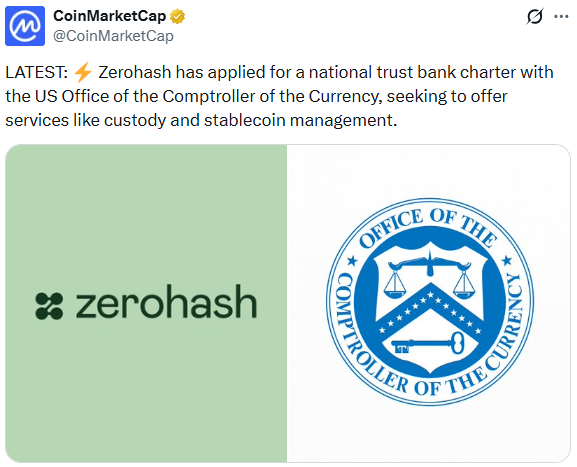
For example, Zero Hash, a crypto infrastructure provider, has applied for a national trust bank charter with the U.S. Office of the Comptroller of the Currency (OCC). The company aims to offer services such as digital asset custody and stablecoin management within a regulated banking framework.
Zerohash has also applied for a national trust bank charted in the U.S. | Credit: CoinMarketCap
If more crypto firms obtain banking licenses or regulatory approval, they may also seek direct access to Federal Reserve payment systems.
Such institutions would combine blockchain technology with regulated financial services, potentially creating new models for digital payments and asset management.
Revolut Applies for Bank Charter and Appoints New US CEO
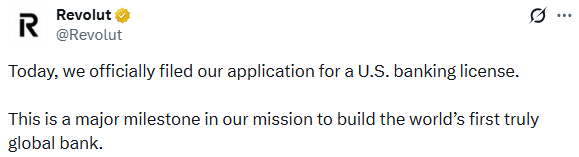
Furthermore, the fintech company Revolut has applied for a U.S. national bank charter with the Office of the Comptroller of the Currency and the Federal Deposit Insurance Corporation, marking a major step in its expansion into the U.S. If approved, the entity would operate as Revolut Bank US, N.A.
The company also appointed Cetin Duransoy as U.S. CEO, replacing Sid Jajodia, who will remain at Revolut as Global Chief Banking Officer.
Revolut announced it filed an application for a U.S. banking license. | Credit: Revolut X profile
Revolut CEO and co-founder Nik Storonsky said the U.S. is a key part of the company’s global growth strategy and that a banking license would allow it to innovate faster and expand services to more American customers.
Revolut currently serves more than 70 million customers across 40 markets and was valued at $75 billion following a secondary share offering in November 2025.
Turning Point for Crypto and Traditional Finance
Kraken’s access to a Federal Reserve master account represents more than a regulatory milestone.
In the past, the crypto industry largely operated outside mainstream financial infrastructure.
Today, however, digital asset companies are increasingly seeking to integrate with regulated banking systems rather than bypass them.
This shift is happening alongside growing interest from banks, asset managers, and regulators in blockchain technology and digital assets.
At the same time, tensions remain.
Traditional banks continue to express concerns about the risks associated with cryptocurrency markets, while crypto advocates argue that direct access to financial infrastructure will improve transparency and efficiency.
Crypto–Banking Integration’s Future
Whether Kraken’s approval becomes a turning point or remains an isolated case will depend on several factors.
Regulatory decisions, technological developments, and market adoption will all influence how deeply cryptocurrencies integrate with the traditional financial system.
If more crypto firms gain access to Federal Reserve payment systems or obtain banking licenses, the line between crypto companies and financial institutions could become increasingly blurred.
What once seemed like two separate industries, blockchain and banking, may gradually evolve into a single, interconnected financial ecosystem.
For now, Kraken’s entry into the Federal Reserve’s payment network signals that the relationship between crypto and traditional finance is entering a new phase—one that could reshape how money moves in the digital age.
A Federal Reserve master account allows a financial institution to hold funds directly at the Federal Reserve and access its payment systems, such as Fedwire. These accounts are typically granted to regulated banks and enable them to send and receive large payments through the central banking system.
Why is Kraken’s access to the Fed payment system significant?
Kraken becoming the first digital asset company with direct access to the Federal Reserve’s payment infrastructure is significant because it connects the crypto industry directly to the core U.S. financial system, reducing the need for intermediary banks.
Why are banks opposing Kraken’s approval?
Some banking groups argue that allowing crypto firms to access Federal Reserve accounts could introduce financial stability risks, regulatory gaps, and potential exposure to volatile digital asset markets. Others worry that crypto companies could begin competing directly with traditional banks.
Could other crypto companies get similar access in the future?
Possibly. Kraken’s approval may set a precedent for other digital asset companies seeking deeper integration with the banking system. Some firms are already pursuing banking licenses or regulatory approvals that could allow them to access similar financial infrastructure.
Disclaimer:
The information provided in this article is for informational purposes only. It is not intended to be, nor should it be construed as, financial advice. We do not make any warranties regarding the completeness, reliability, or accuracy of this information. All investments involve risk, and past performance does not guarantee future results. We recommend consulting a financial advisor before making any investment decisions.
Giuseppe Ciccomascolo began his career as an investigative journalist in Italy, where he contributed to both local and national newspapers, focusing on various financial sectors.
Upon relocating to London, he worked as an analyst for Fitch's CapitalStructure and later as a Senior Reporter for Alliance News. In 2017, Giuseppe transitioned to covering cryptocurrency-related news, producing documentaries and articles on Bitcoin and other emerging digital currencies. He also played a pivotal role in establishing the academy for a cryptocurrency exchange website. Crypto remained his primary area of interest throughout his tenure as a writer for ThirdFloor.


 Easy
Easy