Securitize has launched Hamilton Lane’s tokenized private credit fund on the TRON blockchain, expanding institutional access to tokenized real-world assets through one of crypto’s largest networks. | Credit: CCN.com
Share
Key Takeaways
Most attacks work by tricking users into interacting with fake or misleading tokens, not by breaking blockchain security.
High throughput and cheap transactions make it easier to distribute scam tokens at scale.
They commonly lead users to malicious websites, wallet drainers, or dangerous approval transactions.
Features like token validation, dApp screening, and transaction simulation aim to warn users before damage happens.
Scam tokens are one of the most common “low-effort, high-reach” tricks in crypto. You don’t need to hack a protocol to pull them off, you just need to get a fake or misleading token in front of enough people, then wait for curiosity, confusion, or urgency to do the rest.
That’s why scam tokens show up everywhere, especially on large, high-throughput networks: scale helps legitimate usage, but it also helps scammers distribute bait cheaply and repeatedly.
What “Scam Tokens” Are (And Why They Work)
A scam token is typically a token designed to mislead users into doing something risky, often by impersonating a real asset, promising a reward, or creating pressure to “claim,” “swap,” or “unlock” funds.
Common patterns include:
Impersonation tokens: A token name/symbol/logo that looks like a legitimate project (or a popular stablecoin), hoping users mistake it for the real thing.
Spam airdrop tokens: Random tokens sent to many wallets. They may include links in metadata or rely on social engineering to get users to interact with a malicious site or contract.
“Claim”/“unlock” traps: The token is worthless, but the claim flow pushes the user to sign approvals or transactions that enable theft (sometimes via wallet-drainer techniques).
Liquidity and swap deception: Users try to swap a token that appears valuable, but the “swap” route leads to a malicious contract or a fake interface.
A key reason these scams work is that crypto UX often rewards speed: people copy addresses, click “Connect Wallet,” and approve transactions quickly. Scammers design scam tokens to exploit that moment.
Why Crypto Scams are Growing and Deception is a Main Driver
Industry reporting suggests crypto scams remain a major and growing category of abuse. Chainalysis reports that in 2025, cryptocurrency scams received at least $14 billion on-chain (and that estimates can rise as more illicit addresses are identified).
And while scam tokens aren’t the only scam type, they frequently connect to broader deception tactics that do have measured impact:
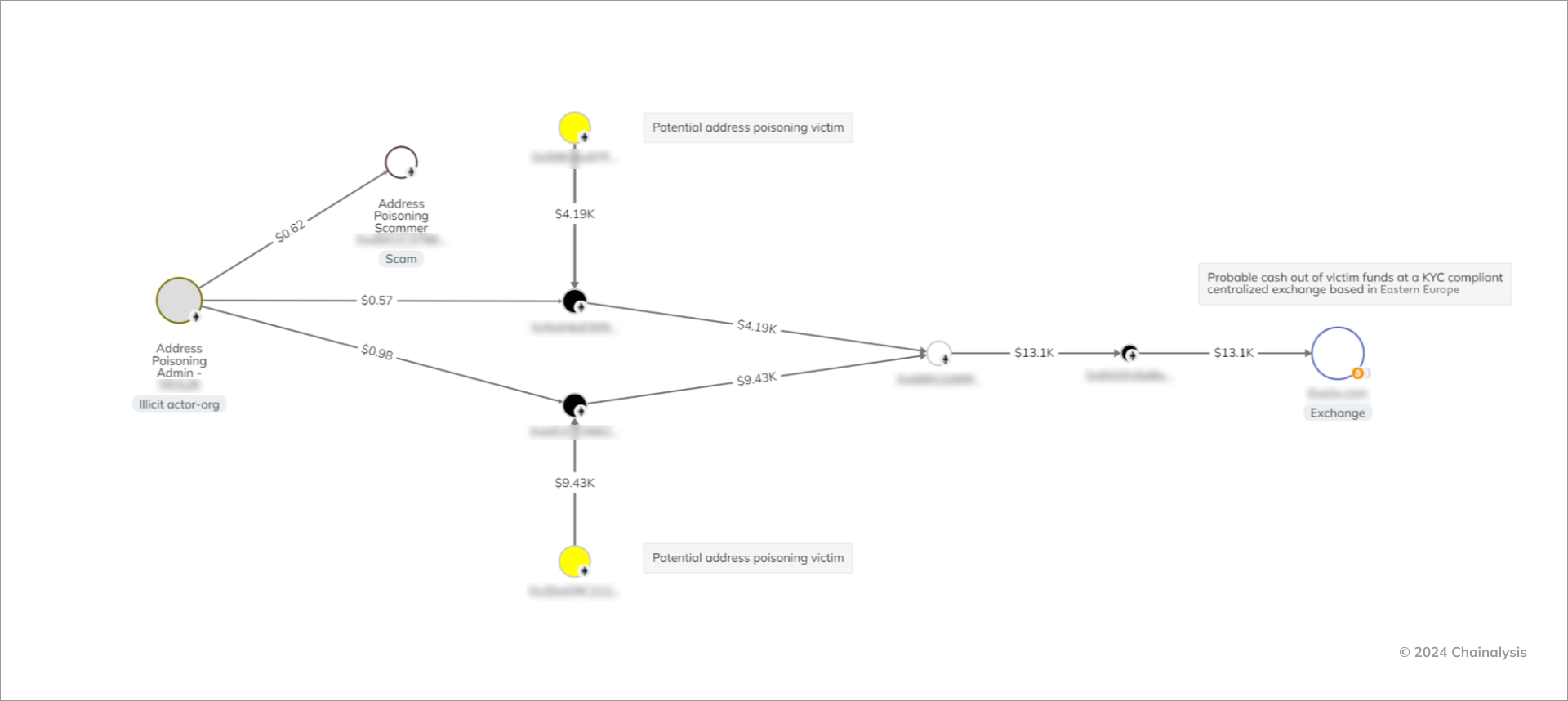
Address poisoning (sending tiny “dust” transactions from lookalike addresses to contaminate transaction history) has been observed at huge scale on major chains. A CyLab study reported 270 million attack attempts targeting 17 million victims, with confirmed losses of at least $83.8 million from July 2022 to June 2024 (on Ethereum and BSC).
Wallet drainers, often triggered after users interact with malicious links, “claims,” or approvals, have also caused substantial losses. Scam Sniffer–reported figures cited by BleepingComputer put 2024 wallet drainer theft at $494 million, affecting 300,000+ addresses.
Anatomy of an address poisoning scam. | Source: Chainalysis
Scam tokens sit right in the middle of these realities because they’re often the entry point, the bait that gets a user to click, connect, approve, or copy the wrong thing.
Why Large Networks Are a Magnet For Crypto Scam Tokens
Large networks provide three things scammers love:
Cheap distribution: When transactions are low-cost, spamming many wallets becomes economically viable.
A big target population: The more users, the more chances that someone will interact.
High stablecoin activity: Stablecoins are frequently targeted because users treat them like cash equivalents.
Networks like TRON illustrate how scale can amplify both legitimate usage and abuse. With more than 358 million users and over 12 billion transactions, the blockchain has become a major infrastructure layer for stablecoin activity, processing large volumes of everyday transfers.
This same combination of low transaction costs and high throughput, however, also makes mass-distribution scams economically viable. For example, TRM Labs has noted that such environments can be exploited for social-engineering attacks like address poisoning, where attackers send tiny “dust” transactions to large numbers of wallets to insert look-alike addresses into transaction histories or lure users into interacting with fraudulent schemes.
In high-volume networks, even low-success-rate scams can become profitable when repeated at scale, which is why preventative security measures become increasingly important as user bases grow.
This campaign began on December 10, 2025 and remains ongoing, showing how Web2 vulnerabilities can directly impact Web3 users.
Blockaid attributed the activity to a single threat actor, clustering the infrastructure, including compromised domains, injected scripts, drainer… pic.twitter.com/WMn8G25vze
On January 20, 2026 TRON DAO announced an integration of Blockaid into the TRON network with the goal of strengthening user protection and transparency at scale.
Notably, several security capabilities target the exact points scam tokens rely on:
Scam tokens often succeed because they look legitimate at a glance. Token validation is aimed at flagging:
Impersonators (name/symbol/logo mimicry)
Spam tokens (mass-airdropped bait)
Scam patterns (known malicious indicators)
This matters because a large share of scam-token harm happens before any sophisticated exploit, during the user’s initial interpretation: “Is this real?” “Why did I receive it?” “Is this a free reward?”
2) dApp Validation (Blocking Risky Connections)
A common scam-token flow is: “You received tokens, go to this site to claim/swap.” dApp validation is meant to identify risky/malicious applications before users connect their wallet.
This is especially relevant because scam tokens often push users off-chain (to a website) where the real trap is set.
3) Transaction Simulation And Validation (Catching Dangerous Approvals)
Even when a user is tricked into initiating a transaction, simulation and validation can help detect if the transaction would result in something harmful, like granting unusually broad approvals or executing a malicious call pattern.
This approach aligns with how many modern wallet-drainer schemes operate: they don’t “break” cryptography; they convince users to sign something they don’t fully understand.
Why This Approach Is Practical Against Scam Tokens
Scam tokens are less like “one big hack” and more like a continuous stream of small traps. So defenses have to be:
Real-time: warnings after funds are gone don’t help much.
Context-aware: the same token name might be legit in one case and malicious in another.
Integrated where decisions happen: at the wallet, dApp connection, or transaction-signing moment.
That’s how TRON DAO positions the integration: protection “at the exact moments where trust matters most,” and at scale across user activity like token transfers and dApp interactions.
Impersonation is a moving target: scammers can mint new variants endlessly.
Social engineering adapts: attackers test what wording, logos, and fake “support” narratives convert best.
Users still have agency: if someone ignores warnings and signs approvals, some losses can still happen.
So the realistic goal is risk reduction: fewer successful interactions, fewer approvals granted to malicious contracts, and faster identification of repeating scam infrastructure.
Practical “Rules of Thumb” For Users (Scam-Token Specific)
If you ever receive a random token:
Don’t trust the name/symbol alone. Look for verified info from a trusted explorer/project channel.
Don’t click token-metadata links or “claim reward” links.
If a site urges urgency (“claim now,” “airdrop ending”), assume it’s a trap until proven otherwise.
When signing, watch for requests that effectively say “allow this contract to move your tokens.”
More broadly, using wallets and networks that provide real-time warnings, transaction simulation, and token validation can significantly reduce risk by alerting users before harmful actions are finalized, shifting protection to the moment when mistakes are most likely to happen.
Disclaimer:
The information provided in this article is for informational purposes only. It is not intended to be, nor should it be construed as, financial advice. We do not make any warranties regarding the completeness, reliability, or accuracy of this information. All investments involve risk, and past performance does not guarantee future results. We recommend consulting a financial advisor before making any investment decisions.
Onkar Singh has three years of experience as a digital finance content creator. Throughout his career, he has collaborated with various DeFi projects and crypto media outlets. In his leisure time, he enjoys fitness activities at the gym and watching movies across different genres. Balancing his professional and personal interests, Onkar continues to contribute to the digital finance landscape while pursuing his hobbies.


 Easy
Easy